The Elderflower Blossom
The hedges have turned, almost overnight, from green to white — the elder is the reason, and every year it still seems sudden. The week has the held, slightly breathless feel of early summer deciding to commit. This week: a horse fair that runs on no charter, the year’s rushes carried into churches that stopped needing them, self-heal hiding in the verge, and the mayfly rise at dusk.
On the Horizon
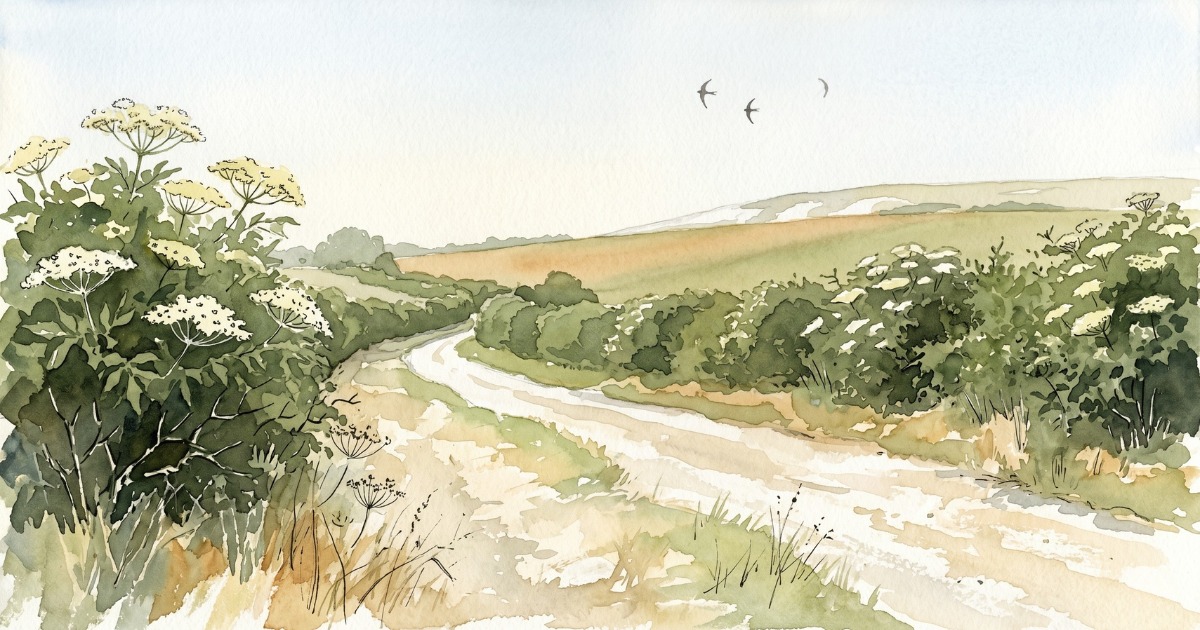
The elder is out. Every hedge along the Baldock lanes is carrying the flat creamy plates of it now, and if you walk past one in the warm middle of the afternoon the scent reaches you a few feet before the flower does, high and musky and faintly of cat, which is the honest description nobody prints on the cordial bottle. The soil has gone dry and pale, cracking a little where the morning dew used to sit, and the bats are out earlier each evening, working the insect lines along the top of the hedge in that erratic, stitching flight. Up on the farms the clipping has started, the first hoggs out of their winter wool looking suddenly thin and surprised. The gooseberries are swelling hard and sour on the bush, not ready yet, worth checking daily. And the swifts are back over the rooftops, screaming round the chimneys at head height in the last of the light, which they will do for about eight weeks and then be gone before you have got used to them.
The Sky this Week
Sunrise 4:42 am · Sunset 9:10 pm
Moon Waning Gibbous · Last Quarter Mon 8 June, 11:00 am BST
Harwich tides High 3:58 am · Low 9:33 am · High 4:00 pm · Low 10:01 pm.
The moon is going down by day now and rising late, so the dark hours belong to it. It is waning all week, thinning from the gibbous of the start of the week to its last quarter on Monday morning, and the time to catch it is the small hours before dawn, when it sits well up in the south. Look just below and to the right of it midweek and you will find Saturn, the one steady, unblinking point in that part of the sky while everything around it twinkles. The mornings are short on darkness and long on dew, so this is one for early risers, or for anyone still up.
Source: timeanddate.com (Baldock) · Royal Observatory Greenwich · UKHO EasyTide
The Curious Instance of the Appleby Horse Fair
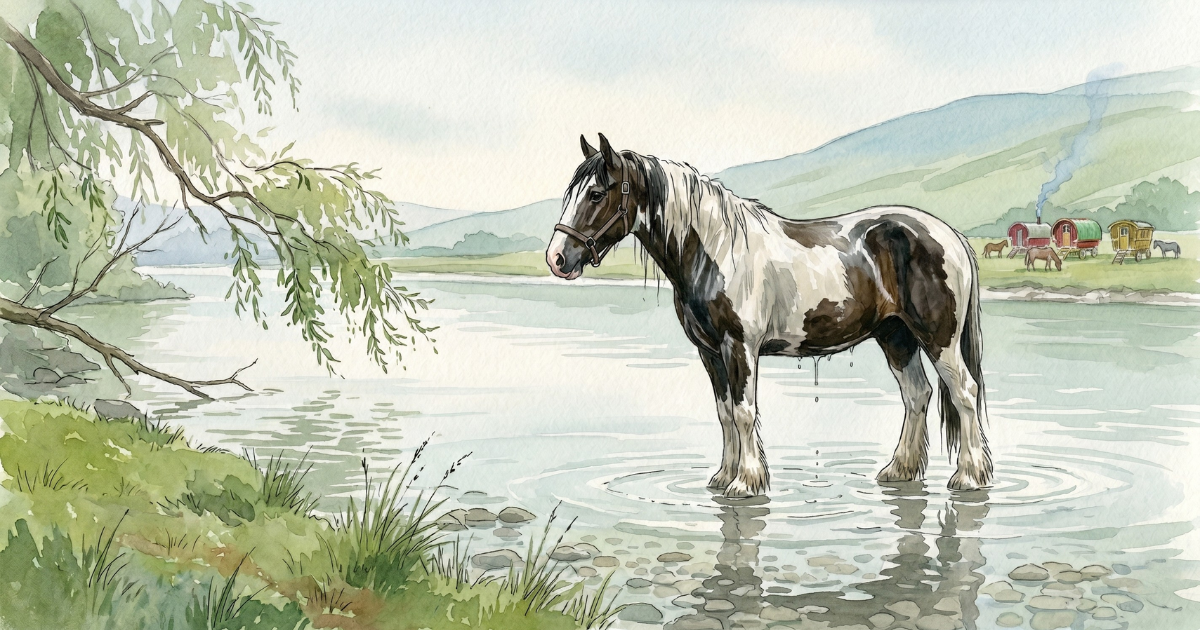
If you happen to find yourself in the Eden Valley this week, do not be surprised to see the lanes filling with driven traps and painted caravans. For one week in early June, the small town of Appleby-in-Westmorland fills entirely with horses. The Appleby Horse Fair runs from today until the following Wednesday, and it is the largest gathering of Gypsies and Travellers in Europe: something like ten thousand of them, a thousand caravans, several hundred horse-drawn vehicles, drawn to a hill outside a town of about three thousand people.
The horses are washed in the River Eden. They are led down into the water, scrubbed clean, and brought back up the bank wet and shining to be shown, and the showing is done on a stretch of road they call the flashing lane, where a man will gallop a horse hard up the tarmac and back to put its paces on display for a buyer. The fair has been held every June since 1775, though it took its present shape — the horses, the families who deal in them — only towards the end of the nineteenth century.
What it does not have is a charter. Most old English fairs trace back to a piece of parchment: a grant from some king to some borough, the right to hold a fair on a saint’s day, taxable and owned. Baldock’s own fair is one of them, granted by King John to the Templars in 1199 and still setting up in the High Street every October on the strength of it. Appleby has nothing of the kind. It rests instead on a thing the law calls prescriptive right: it has happened for so long, without a break, that the happening itself became the right. No one owns it. No one has ever been charged to come. Gallows Hill, the original ground, was unenclosed land outside the borough boundary, which is to say it belonged to nobody in particular, which is to say it was exactly the kind of place a fair like this could not be moved off.
Baldock’s fair has its parchment and its three days in October. Appleby has no parchment at all, and a hillside full of horses every June, and no document anywhere that grants it the right to be there. It is there again this morning.
Sources: Appleby Town Council - Appleby Horse Fair
The History
The Year’s Rushes
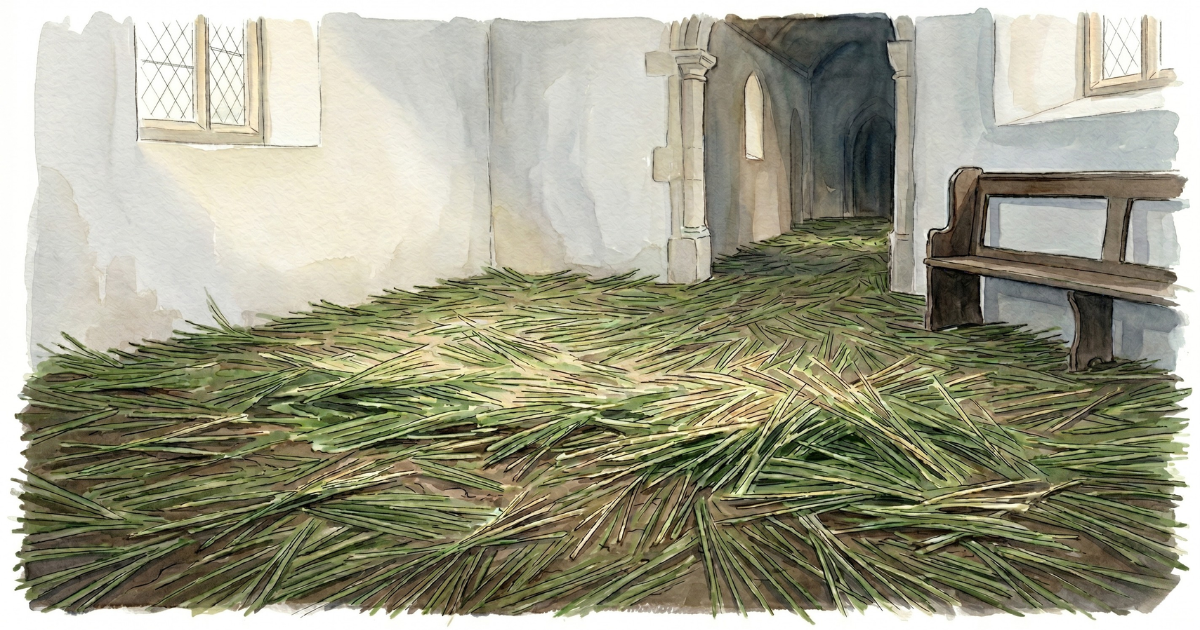
For most of their history, English parish churches had floors of beaten earth or rough stone, strewn thick with rushes. Cut green from the nearest pond margin and laid over the cold ground, the rushes were carpet, insulation, and a dry-ish surface to kneel on through a long service. In many churches they also lay over the dead, since the better-off were buried inside the building, under the same floor the living stood on.
Rushes laid one summer were filthy by the next, trodden flat and damp and full of whatever had walked in on boots and paws. So once a year the old ones came up and went out and a fresh load came in, and in a great many parishes that replacement was not a chore but the festival of the year. The new rushes were built onto a cart, packed and shaped and raised into a towering load, hung with ribbons and flowers and borrowed silver, and drawn to the church through the village behind a band and a side of Morris dancers, the whole parish walking after it.
The day was pinned to the church’s own saint or to the August wakes, and it pulled the rest of village life in with it: ale and gingerbread, wrestling and races, the rushes themselves plaited into crosses and crowns and garlands for the children to carry. It was the year’s deep clean of the church, kept as the high point of the parish summer.
What ended it was flooring. As parishes flagged their churches with stone and laid boards over the bare earth through the eighteenth and nineteenth centuries, the rushes had nothing left to do. A swept stone floor does not need a green covering renewed every summer. The practical reason fell away, and most of the rushbearings went with it, quietly, parish by parish.
A few held on as pure ceremony. At Grasmere the rushes still go up to St Oswald’s at the start of August, carried by children in plaited bearings; Sowerby Bridge still builds a full rush-cart and hauls it through the town; Warcop keeps its rushbearing on St Peter’s Day in June. The floor underneath has been dry flagstone for two hundred years. The rushes are carried in anyway.
Sources: Alfred Burton, Rush-bearing, 1891 · Grasmere Rushbearing
The Garden Plot
Weather Watch
It's a soft, unsettled week — daytime highs sitting in the high teens (about 17–18°C), nothing like the heat the elder usually opens in, with rain never quite clearing off: heaviest today before publication, easing through Thursday and Friday, then showers loitering over the weekend. The practical hinge is Friday, the one drier, brighter window before Saturday's showers come back in.
For the Longer Game
This is the week for leeks and celeriac. If you have seedlings waiting and the soil is warm, get them out now, along with any brassicas still sitting in the seed bed. Water them in properly, then keep an eye on them for the first fortnight, because June heat can check a transplant badly if it dries out at the wrong moment. Settled in now, they carry the plot through autumn and into winter.
This Week
The gooseberries are fat and tart on the bush. Pick them while they are still hard and green, before they soften, and make a fool: just the fruit cooked down with sugar and folded through softly whipped double cream, nothing else. Eat it the same day, while the gooseberry still has its bite. A riper berry makes a sweeter fool, but the green ones make a better one.
Maintenance
Go and look at the soft growing tips of your broad beans this week. If the blackfly have found them, you will see them clustered black on the tenderest new growth right at the top. Pinch those tips out, the whole soft crown of each plant, and take the colony away with them. It works better than spraying, and it is the kind of five-minute job that saves the crop if you do it today and loses it if you leave it a fortnight.
The Larder
Elderflowers
The window is now, and it is short. The elder is at its peak this week and will hold for perhaps ten days before the flowers begin to brown and the scent turns from that high sweetness to something stale. Pick on a dry, sunny afternoon when the scent is strongest and the tiny flowers are fully open, and shake each head gently before it goes in the basket, on the principle that whatever lives in the flower is welcome to stay in the hedge.
Hannah Glasse, in The Art of Cookery Made Plain and Easy of 1747, used elderflowers to counterfeit a fashionable wine. Her “Elder-flower Wine” steeps the blossom in a boiled syrup of sugar and water, with lemons and yeast worked in, and she promises it will pass for Frontiniac – a sweet muscat from the south of France that an English cook could not easily get hold of and apparently saw no reason to pay for when the hedge would do.
Elderflower Fritters
Ingredients
- 12 elderflower heads, freshly picked, a short length of stalk left on each
- 100g plain flour
- A pinch of fine sea salt
- 150ml cold sparkling water
- Sunflower or other neutral oil, for deep-frying
- 1 unwaxed lemon
- Icing sugar, for dusting
Method
- Pick the elderflower heads on a dry afternoon, leaving a few centimetres of stalk on each to hold them by. Shake each one gently to clear any insects, but do not wash it; washing flattens the flowers and rinses away the scent you are frying for.
- Make the batter just before you cook. Tip the flour and salt into a bowl and whisk in the sparkling water until smooth and thin, about the consistency of single cream. A few small lumps are fine. Do not make it ahead, or it loses its lift.
- Pour the oil into a deep, heavy pan to a depth of about 5cm and heat to 180°C. With no thermometer, drop in a little batter: it should sizzle and rise to the surface within a second or two.
- Holding a head by its stalk, dip it into the batter so the flowers are lightly coated, and let the excess drip back into the bowl.
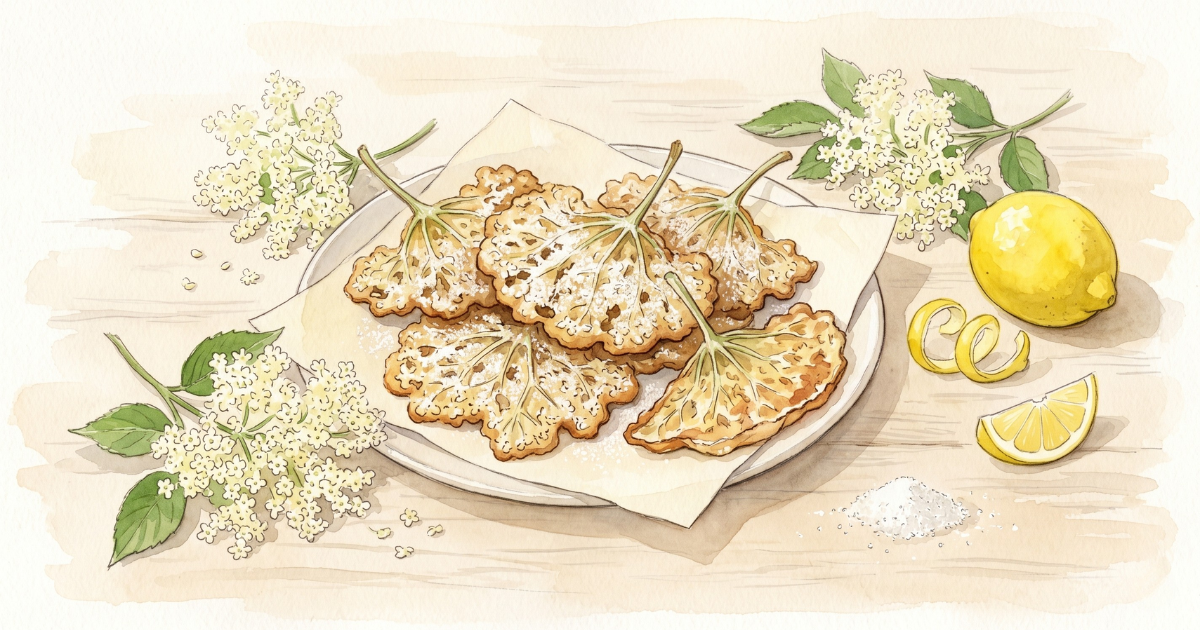
- Lower it flower-side down into the oil and fry for a few seconds, turning once, until the lace of it goes gold and crisp. Lift it out by the stalk, or with a slotted spoon, and drain on kitchen paper. Fry one or two at a time so the oil stays hot.
- Snip off the stalks. Dust the fritters with icing sugar, squeeze over a little lemon, and eat them straight away.
Keep the batter thin enough to see the flowers through it; a thick coat fries into a doughnut and buries the scent that is the whole point. The icing sugar and the lemon pull in opposite directions, sweet against sharp, and the fritters soften within a few minutes of leaving the oil, which is why this is a stove-side thing and not a plated pudding.
For the cordial that keeps the taste of this week into the winter: steep twenty-odd flower heads with sliced lemons, sugar, and a spoonful of citric acid in hot syrup for a day, then strain and bottle. Diluted in a glass in January, it tastes exactly of now.
The Still-Room
Self-Heal
There is a low plant flowering in the rough grass right now, on every verge and lawn edge that has escaped the mower this week, that you have certainly stepped on and probably never named. Self-heal: a creeping thing in the mint family, a few inches high, carrying a stubby club of violet-purple flowers on a square stem. Crouch down to it and it is a handsome little plant. Stand back up and it disappears into the green.
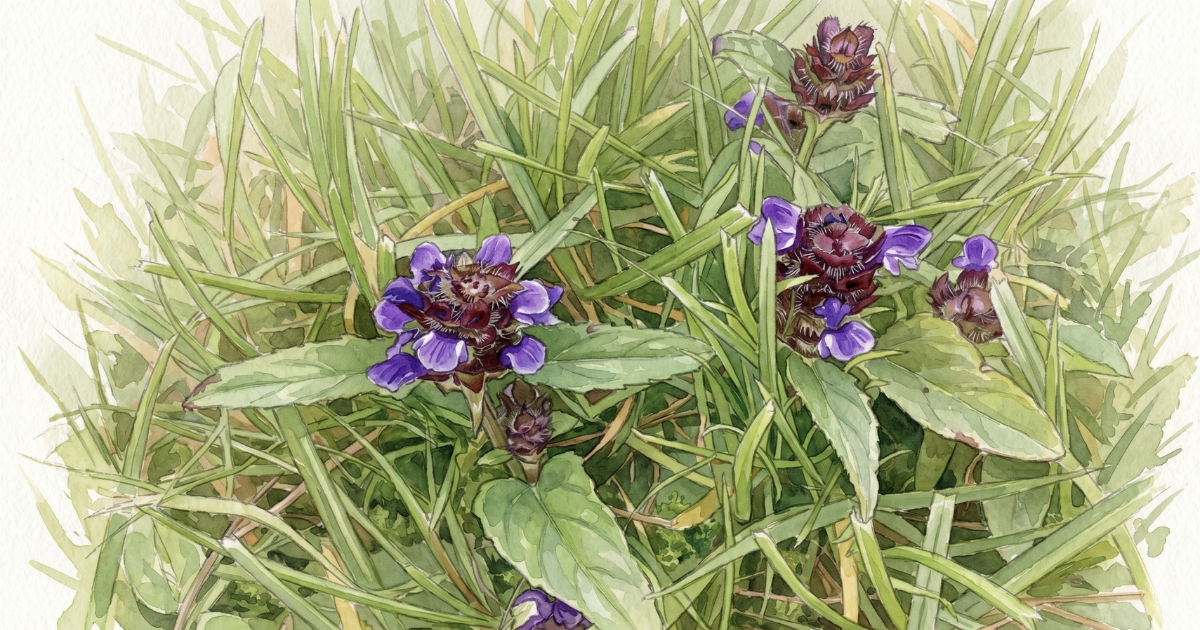
The name is the whole history. Self-heal, heal-all, woundwort, carpenter’s herb – the last because woodworkers reached for it when a chisel slipped. It was the standard country dressing for a cut, bruised and pressed straight onto the wound, and Culpeper put it plainly in 1653, calling it a herb of Venus, “whereby, when you are hurt, you may heal yourself.” Modern hedge-medicine is more careful than that, and so am I, but the plant does carry genuine astringent compounds, which is a respectable amount of truth for a folk name to be holding up.
If you want to keep some of it by, the simplest preparation is an infused oil, which you can use as it is on a graze or stir into a salve.
Self-Heal Infused Oil
Ingredients
- A good handful of self-heal in flower, leaves, stems and purple heads together
- Olive or sunflower oil, enough to cover
- 1 clean, dry jar with a lid
- Muslin, for straining
- 1 clean bottle, for storing
Method
- Gather the self-heal on a dry afternoon. Chop it roughly and leave it to wilt for an hour or two, to lose some of its water.
- Pack it loosely into the jar and cover completely with the oil, pressing the plant under so nothing sits proud of the surface.
- Lid on, and stand it on a warm windowsill for three to four weeks, giving it a shake whenever you pass.
- Strain through the muslin into the clean bottle.
It keeps about a year in a cool cupboard, and goes on minor cuts, grazes, and dry rough skin. Not for taking internally.
The Weekend Walk
The Mayfly Rise

The chalk streams in Hertfordshire are running low and clear now, the Mimram and the Beane shrinking back from their winter banks. If you can get to a chalk stream near you this week, go at dusk, and find a bridge or a bank where you can see the surface of the water clearly. You are looking for the mayfly, and for what the trout make of it.
This is the tail end of what anglers call duffers’ fortnight, the late-May to mid-June window when the big mayfly Ephemera danica comes off the chalk streams in such numbers that the trout drop all caution and even a complete beginner can catch one. By dusk the day’s hatched flies have moulted into their final adult form and gathered into swarms above the water, rising and falling on the air in a slow vertical dance. The females come down to the surface to lay, and then, their one or two days of adult life spent, they fall flat onto the water with their wings out.
That is the moment to wait for. As the light goes, the spent flies settle on the surface and the trout begin to rise to them: a soft dimple, a ring spreading on the water, then another, then the whole pool working at once. Watch the air above the stream for the dancing swarm. Then watch the water below it, and wait for the first ring.
An Old Word for It
One old word, chosen for the week.
Bourtree (n., Scots and northern English) – the elder tree. The word turns up in Scottish records by the sixteenth century and carries all the tree’s uneasy standing with it: the bourtree was the one you did not cut, did not burn, and did not bring indoors. You asked its leave before you took any of its wood. The formula recorded in Ella Mary Leather’s folklore of Herefordshire ran, “Old girl, give me some of thy wood, and when I grow into a tree, thou shalt have some of mine.” You asked, and only then cut; to take it without asking was to invite illness, an accident, or a death in the house within the year. It is the same elder whose blossom is opening white in the hedges this week, under a politer name.
In Good Report
A piece of news worth passing on, from this week.
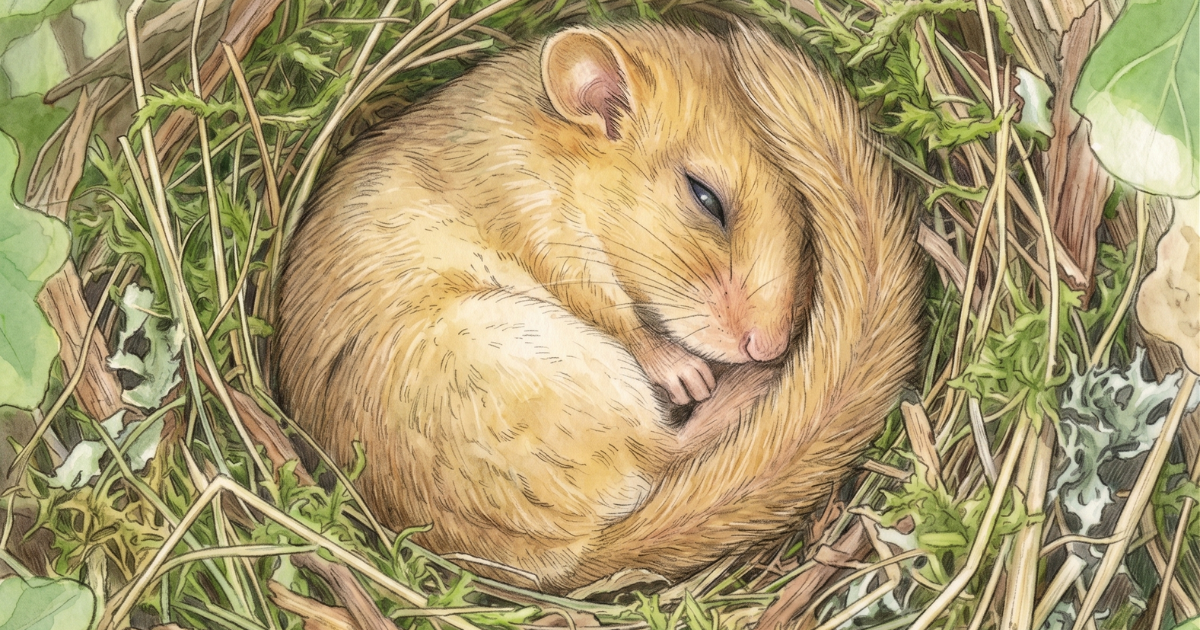
There is now a fund with the elder-and-curlew sort of countryside specifically in mind. On 25 May the Nature Minister, Mary Creagh, announced the Wildlife-Rich Habitat Fund: £30 million over three years, ten million a year from 2026 to 2029, aimed squarely at England’s National Parks, National Landscapes, and the Broads. Thirty-six of the forty-four protected landscapes have signed up for the first year, each choosing its own projects against its own recovery plan rather than working to a single national template, with the money going into peatland, wetland, new native woodland, and the kind of flower-rich grassland that curlew, turtle dove, water vole, and hazel dormouse need and have been losing.
The figure is worth holding next to another one. The body that represents those same landscapes reckons the real cost of hitting the government’s nature targets is nearer £500 million a year. The new fund is one-sixteenth of that. Its own chair, Mary-Ann Ochota, has said as much — that thirty million cannot do the whole job, but can make a tangible difference across hundreds of hectares while the funding formula is argued over for future years. The first projects go into the ground this summer.
The Turning Wheel
What’s coming, in the next fortnight.
7 June – Open Farm Sunday — working farms across the country open their gates for the day.
11 June – St Barnabas Day. The longest day under the old calendar: “Barnaby bright, the longest day and the shortest night.”
In the hedges – dog roses opening pink and white, and the first foxgloves climbing the banks and the wood edges.
By mid-June – the hay meadows at their most various, knapweed and yellow rattle and the last of the ragged robin, in the short window before the cut.
Yours, until next Thursday.
Meg.