The Standing Sun
The sun stands still on Sunday morning, or as near as it ever comes: the longest day of the year, the light not gone from the sky until nearly eleven. This week: a street in Abingdon that elects its own mayor, the heath in its three quiet weeks before the heather, an oil the colour of blood from the midsummer plant, and the latest sunset of the year, which the longest day does not own.
On the Horizon
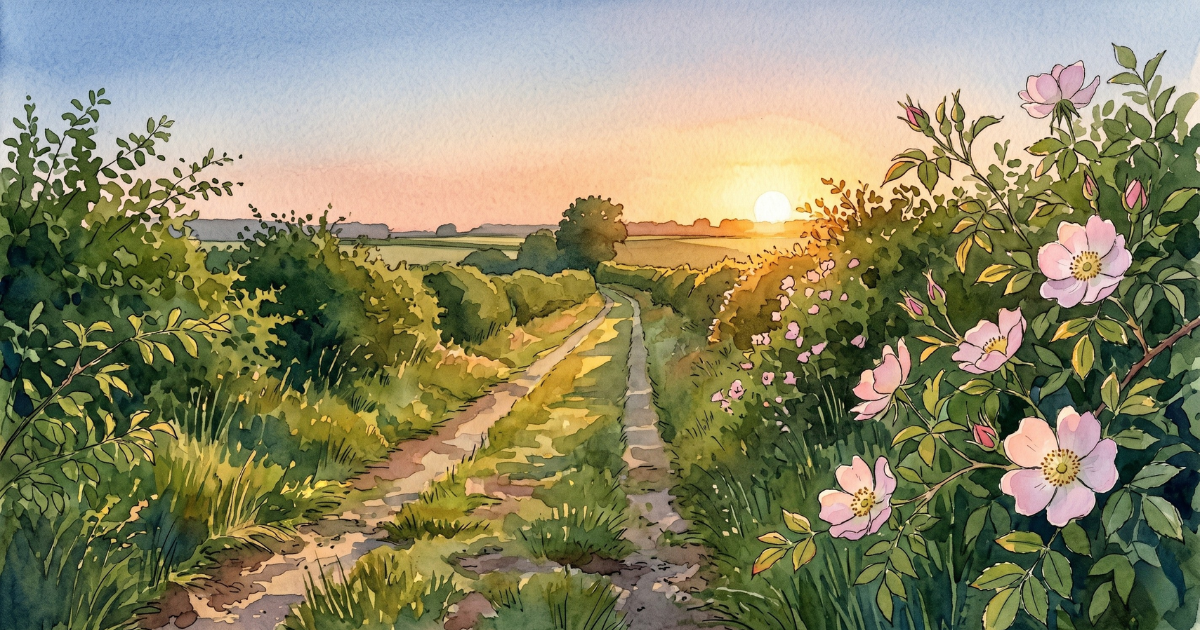
The year reaches its turning point on Sunday morning. The solstice falls at 9.24 on the 21st: not a day but a moment, the instant the sun stops climbing and begins, too slowly to see, to come back down. I keep finding reasons to be outside in the evenings this week, because this is the light we wait all winter for: still bright at nine, the last of it not gone from the sky until nearly eleven, the blackbirds still singing into the dusk. The dog roses are at their peak in the hedges along the Wallington Road, pale pink and single and open-faced, and the first field bindweed has begun its quiet annexation of the fences. Haymaking is close; you can see farmers standing at gateways looking at the sky. Midsummer Eve falls on Tuesday and St John's Day, the old quarter day, on Wednesday. The light starts back south from Sunday. Nothing about the week will show it.
The Sky This Week
Sunrise 4:40 am · Sunset 9:23 pm
Moon Waxing crescent · First Quarter Sun 21 Jun, 10:55 pm
Harwich tides Low 8:22 am · High 2:48 pm · Low 8:56 pm
The moon comes back to the evening sky this week. On Thursday it is a thin waxing crescent, low in the west-north-west after sunset and barely a fifth lit, gone well before midnight. It fattens a little each night, and reaches first quarter at 10.55 on Sunday night – the exact half, due south, on the night of the solstice itself. If you want to follow it, it sits low in the west early in the week and stands high in the south by the weekend.
Source: timeanddate.com (Baldock) · Royal Observatory Greenwich · UKHO EasyTide
The Curious Instance of the Mayor of Ock Street
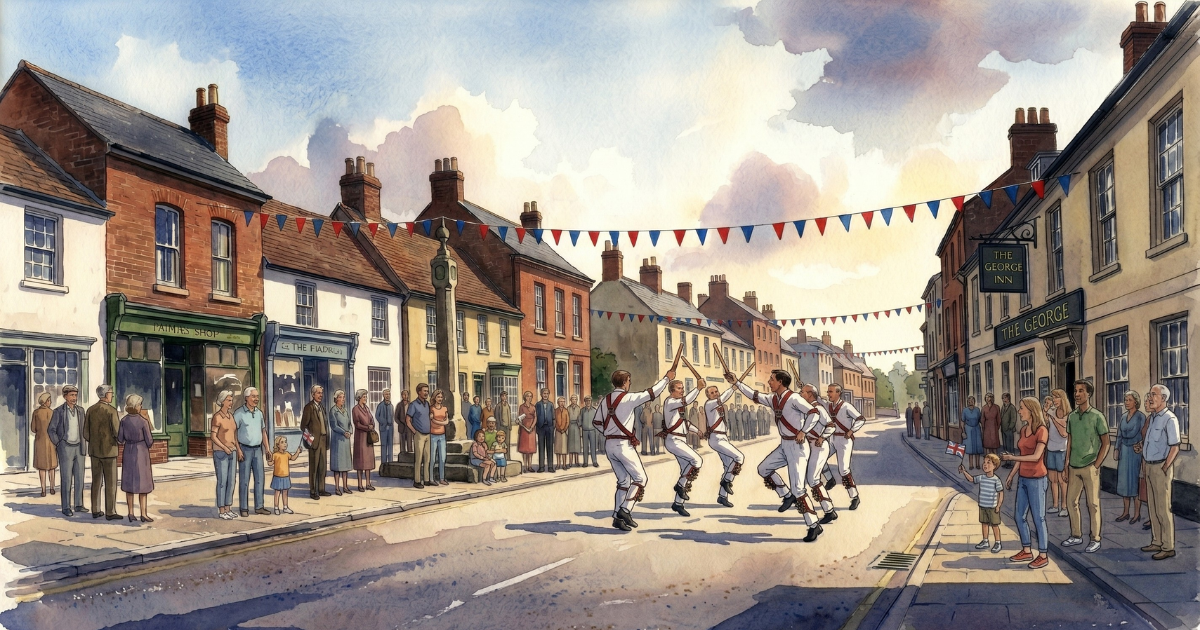
On Saturday, 20 June, the Saturday nearest the 19th, which is when this always happens, the residents of one street in Abingdon will elect a mayor. Not the mayor of Abingdon; the town has one of those already, elected by the council in the usual way since 1556. This is the Mayor of Ock Street, and the only people who can vote for him are the people who live on Ock Street. A polling station is set up at the Brewery Tap, votes are cast between ten and four, and the count is conducted with complete seriousness. In 2019 the result was 90 votes to 89.
The candidates are drawn from the Abingdon Traditional Morris Dancers, who run the election and have done for as long as anyone can establish. The winner is presented with a sword, a sash, and a cup turned from apple wood, then carried shoulder-high along Ock Street in a chair dressed with flowers, while the dancers process ahead of him carrying a pair of ox horns mounted in a carved wooden head. The head is painted with a date: 1700.
The date is the whole story, or it is supposed to be. The legend runs that in 1700 an ox was roasted at the town's midsummer fair, and that the men of Ock Street and the men of the Vineyard, the district at the other end of town, fought a pitched battle for possession of the horns. Ock Street won, paraded its trophy in triumph, and has been electing a champion to carry it ever since. The horns exist; the carved head with its date exists; the originals are now kept safely indoors and a replica made in 1979 does the parading.
What does not exist is any record of the battle. The first written reference to the custom, and to the legend itself, appears in the Berkshire Chronicle in June 1825, a century and a quarter after the fight it commemorates. Either the men of Ock Street kept a famous victory entirely out of the written record for five generations, or somebody in Georgian Abingdon carved a date onto an ox head.
Sources: Abingdon Traditional Morris Dancers · Berkshire Chronicle, June 1825
The June Heath
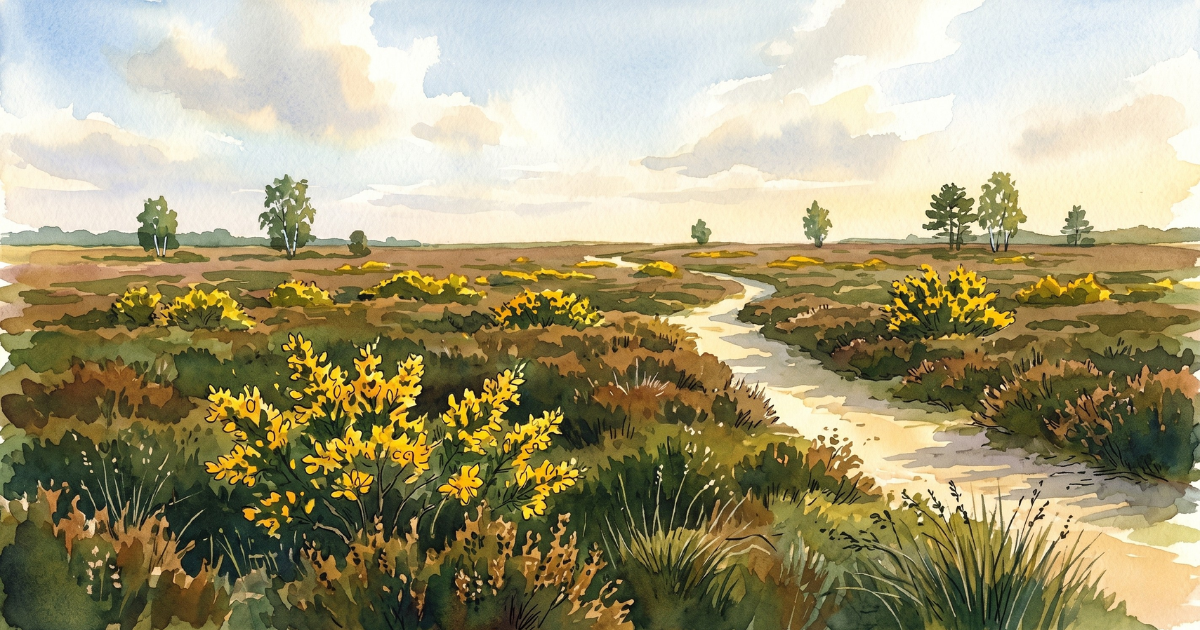
The heath in the third week of June is in its quiet interval. Everyone knows the August heath: the purple postcard, the heather in full flower, the place coachloads go to see. In June almost nobody comes, because the heather is still three or four weeks from opening and the ground reads as plain green-brown from any distance. I went up to Nomansland Common, near Wheathampstead, on Tuesday and had it to myself. The interest is all at ankle height, and you have to get down on your knees to find it.
Down there the flowers are small and exact. Heath milkwort is out now, tiny and gentian-blue, occasionally pink or white in the same patch, on stems a few centimetres tall. Tormentil is everywhere once your eye drops to it, a yellow flower the size of a shirt button, and alone among the creeping plants of this acid ground it carries four petals, not five, which is what gives it away. In the damper hollows the first sundews are open for business, their red-fringed leaves glistening with droplets that are not dew at all but glue, each leaf quietly digesting whatever the week has landed on it.
Stay still a minute and you hear the difference too. The June heath runs on insects that are gone by August: a green tiger beetle ran ahead of me along the bare sand, fast and metallic and quick to fly, and the first silver-studded blue butterflies were out, small enough to take for scraps of sky. I stayed until dusk for the nightjars. They arrived from Africa in May and are nesting now, invisible against the ground, the male churring on and on, minutes at a stretch, like a small engine that will not switch off.
Hertfordshire is a chalk and clay county, so true acid heath is scarce here; this patch survives on glacial gravels the chalk never reached, where the gorse and the acid-loving flowers hold out. The smell is the give-away. The August heath smells of honey, because the heather does. In June it smells of warm earth, crushed bracken and coconut off the gorse, the smell of the place itself rather than its most famous tenant. Three weeks from now the heather opens and takes over. This week the heath is still its own.
Sources: Nomansland Common (Woodland Trust) · Herts & Middlesex Wildlife Trust
The Garden Plot
Weather Watch
High pressure builds in over the solstice weekend, and the week turns warm, dry and settled, with daytime temperatures into the mid-twenties from Thursday and climbing toward the weekend, the only real risk a thundery breakdown in the heat. The catch for the garden is the dry ground: any late carrots, beetroot or turnips you sow this week need a damp drill to germinate, so water the bottom of the drill before sowing and keep the surface from baking until the seedlings show. The hardy geraniums and alchemilla you cut back hard will resent the heat with no leaves to shade their roots – give them a good soak and they will flush back all the faster. Water in the evening rather than the middle of the day, when most of it is gone before it reaches anything.
For the Longer Game
Sow a final row of carrots, beetroot or turnips this week. Late June sowings often escape the carrot fly that plagues the earlier ones: the first generation of the fly has finished laying by now, and quick June germination gets the roots up before the second generation arrives in August. Mark the row clearly. The seedlings are thin and easy to hoe out by mistake, and you will not remember where the row was by the time it matters.
Right Now
New potatoes are ready when the flowers open. Scrape aside the soil at the base of a stem and check – if the tubers are the size of a large egg they are perfect, and their skins so thin they rub away with a thumb. Take what you need for the pan and leave the rest of the plant growing. Boil them in well-salted water with a sprig of mint and eat them warm with butter. The first dig of the year is worth doing slowly.
Maintenance
Cut back hardy geraniums and alchemilla hard after their first flowering – right down, leaves and all. It looks brutal, and for a fortnight the gap will reproach you, but both will flush again within three weeks with fresh clean foliage and often a second round of flower before September. Done now, it works. Done in August, you just have bare patches for autumn.
The Larder
Sugar Snap Peas
The sugar snaps are coming in fast this week, and the picking rule is the opposite of the shelling pea: take them while the pods are still flat-sided and the peas inside no bigger than a match head. Wait for the pods to fill and you have missed the point, which is the pod itself – crisp, sweet, eaten whole.
Jane Grigson's Vegetable Book of 1978 notes that while the modern sugar snap is a twentieth-century hybrid, a version known as the butter pea was being grown in English gardens through the 1800s, harvested before the seeds matured and boiled whole in the pod, then served simply with a large knob of summer butter and fresh mint.
Pan-Seared Sugar Snap Peas with Crispy Pancetta and Mint
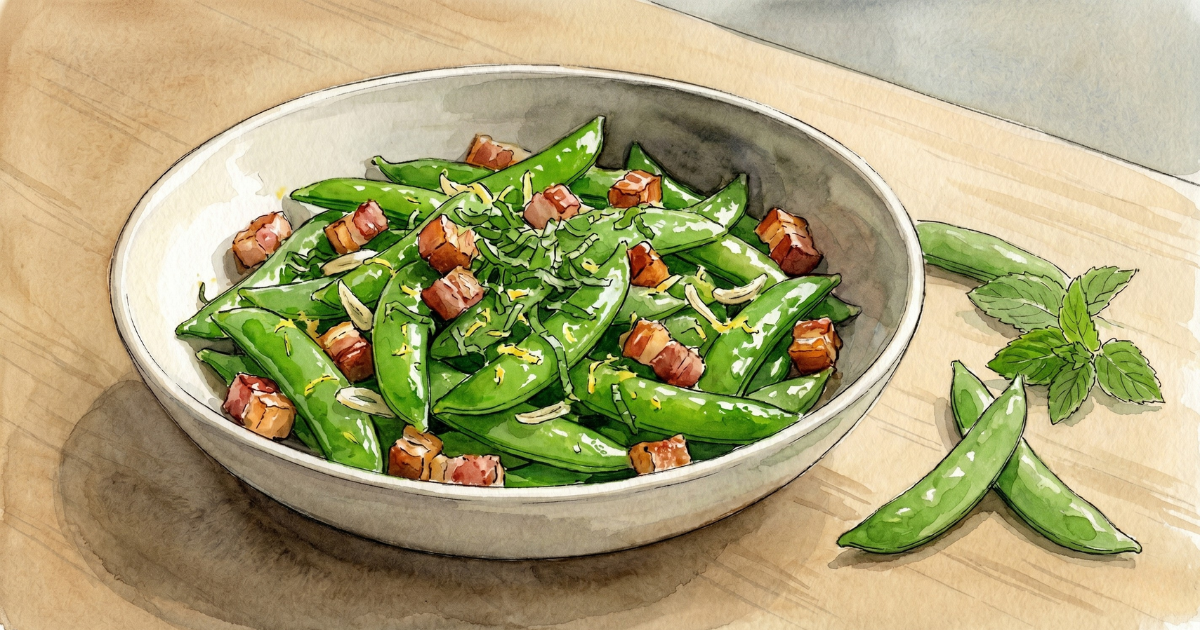
This pairs them with salty pancetta, a little garlic, and a bright hit of lemon and mint – a quick summer side, or a light lunch with goat's cheese or feta crumbled over the top.
Prep 5 minutes · Cook 5 minutes · Serves 2–4 as a side
Ingredients
- 300g fresh English sugar snap peas, topped and tailed (pull the stringy bit down the side)
- 70g pancetta, cubed (smoked bacon lardons also work perfectly)
- 1 clove of garlic, very finely sliced
- 1 tbsp extra virgin olive oil
- A small handful of fresh mint leaves, finely shredded
- Zest of half a lemon
- Sea salt and freshly ground black pepper
Method
- Set a large frying pan or skillet over medium-high heat. Add the pancetta cubes and cook for about 3–4 minutes until the fat renders down and the edges turn crispy and golden.
- Lower the heat slightly, drop in the sliced garlic, and pour in the olive oil. Stir for about 30 seconds just until the garlic smells incredible – don't let it brown or it will turn bitter.
- Toss the sugar snap peas directly into the pan with the pancetta and garlic. Turn the heat back up to high and toss everything together. Cook for no more than 2 minutes. You want them to turn a brilliant, glossy green and pick up the flavours from the pan, but they must retain their signature snap.
- Remove the pan from the heat. Toss through the shredded mint and lemon zest. Season with a small pinch of sea salt (remembering the pancetta is already salty) and a generous grind of black pepper.
Transfer to a warm dish and serve immediately while the contrast between the hot, savoury pancetta and the cool, bright mint is at its best.
Sugar snaps freeze well if you are quick: top and tail, blanch for a minute, plunge into cold water, dry, and freeze flat on a tray before bagging. They will hold their snap into the winter, which a shop-bought frozen pea has never once managed.
Sources: How to grow peas (RHS) · Jane Grigson, Vegetable Book, 1978
The Still-Room
St John's Wort
The common perforate St John's wort, Hypericum perforatum, comes into flower on the chalky verges and field edges right at the solstice, five-petalled and egg-yolk yellow, and the timing is written into the name: the feast of St John the Baptist is the 24th, Midsummer Day, and the plant was held to be at the height of its powers if gathered then. Hold a leaf up to the light and you will see it is covered in tiny translucent dots, as though pricked all over with a pin. Those are oil glands, and they are the plant's signature: the 'perforate' of the name.
The old protective use was straightforward: gathered on the morning of St John's Eve, the 23rd, before sunrise and still wet with dew, and hung above the doorway, it was held across the English Midlands to turn back witchcraft, thunder and the evil eye for the coming year. Culpeper recorded the plant's virtues in 1653, and the nineteenth-century county folklore collections repeat the doorway custom from one end of England to the other. The older name makes the logic plain – fuga daemonum, the flight of devils.
The same eve sent people out after something stranger. Fern seed was said to ripen for a single instant at midnight on St John's Eve, and because nobody had ever seen a fern's seed, it was reasoned that the seed must be invisible, and would pass that property to anyone who caught it. The catch had to be made beneath the fern on a stack of twelve pewter plates, the seed falling through eleven of them by its own power and landing in the twelfth. Shakespeare has Gadshill claim it in Henry IV: we have the receipt of fern-seed, we walk invisible. Ferns do not have seeds.
The preparation that survives is the oil, and it performs a small reliable piece of theatre. Crushed St John's wort flowers steeped in a clear oil turn it a deep ruby red over the course of a few weeks in the sun: the hypericin in those pinprick glands leaching out, the midsummer plant producing, of all things, a bottle the colour of blood. It was the standard household remedy for burns, bruises and aching joints, rubbed in externally, and it earns its keep in a first-aid drawer still. One genuine caution: the oil makes skin more sensitive to sunlight, so it is for the evening, not before a day outside.
Oil of St John's Wort in the Old Manner
After Nicholas Culpeper, The English Physitian (1652)
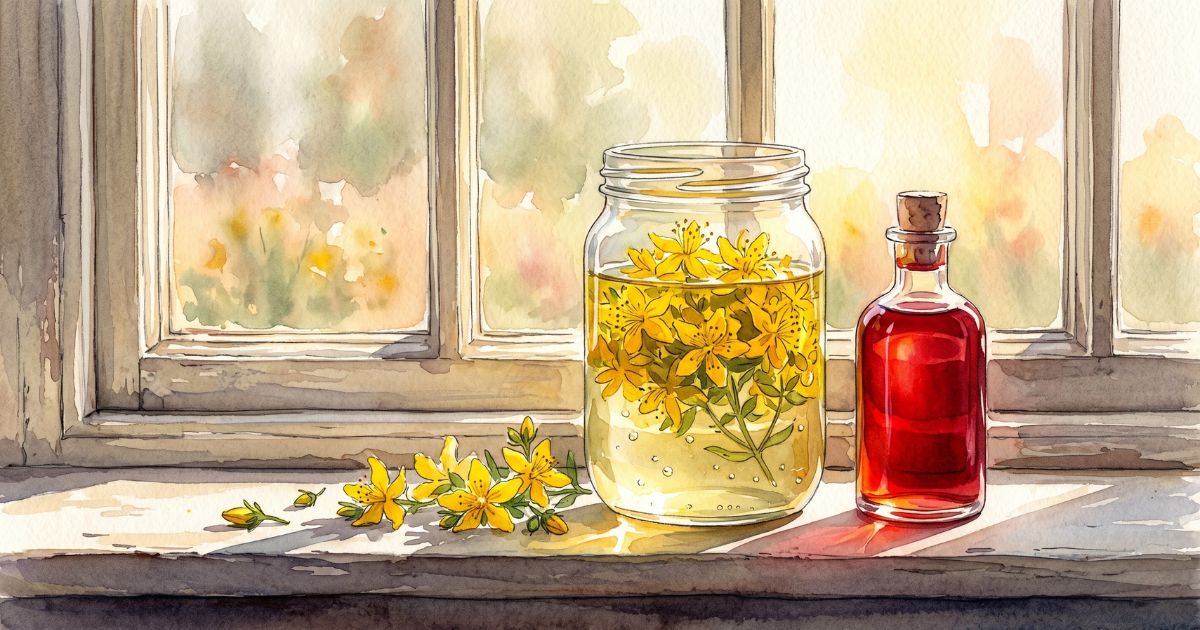
Gather the open flowers and buds on a dry morning this week, traditionally the 23rd or 24th, but the plant does not check the calendar. Bruise them lightly in a mortar. Fill a clean glass jar loosely with the flowers, cover well with a light olive or sunflower oil, and stand the sealed jar on a sunny windowsill. Shake it every day or so. In three to four weeks the oil will have turned deep red; strain it through muslin into a dark bottle, pressing the flowers well, and label it. It keeps a year. For external use only, and not before sun.
Sources: Culpeper, The Complete Herbal (Project Gutenberg) · Perforate St John's-wort (The Wildlife Trusts)
The Weekend Walk
The Latest Sunset
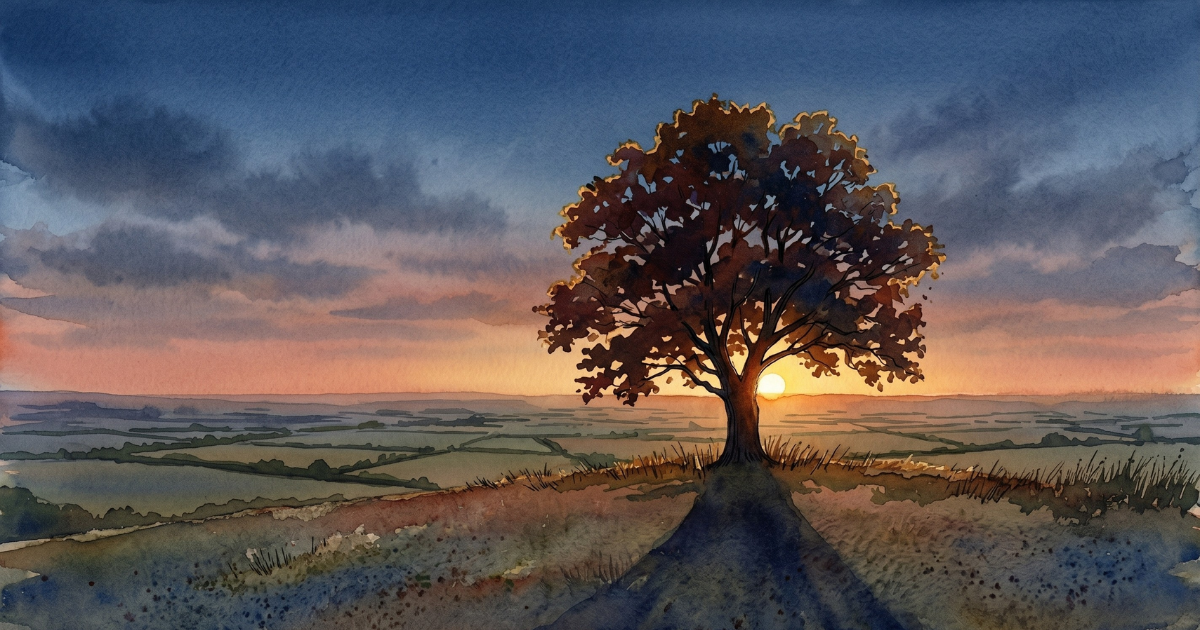
The longest day is Sunday, but the latest sunset of the year has not happened yet. Sunrise and sunset do not move symmetrically: the earliest sunrise came around the 17th, and the latest sunset will not arrive until the 23rd or 24th, because solar noon itself drifts later through these weeks. The solstice sits in the middle, longest in total, latest in neither direction.
So go and watch a sunset you can rightly call almost the latest of the year. Find a west-facing spot with a long view, a field gateway on a ridge will do, and be there for about twenty past nine. Take note of exactly where the sun goes down against the horizon: which tree, which roofline, which gap in the hedge. That is the sun's northernmost setting point, the end of its six-month travel along the horizon, and it will set within a whisker of the same spot for a week either side of now. Mark it well. If you stand in the same gateway at Christmas, the sun will be going down a full quarter of the sky away to the south, and you will have the two ends of the year fixed in your own landscape. The sun will not touch that northern mark again for another year.
Sources: Royal Observatory Greenwich (summer solstice) · timeanddate.com sun times (Baldock)
An Old Word for It
Lowance: the short break taken in the hay field for food and drink, carried out to the workers where they stood. Recorded in Hertfordshire, Bedfordshire and across the East Midlands, almost certainly worn down from 'allowance' – the food and beer were part of the haymaker's agreed terms, not a kindness. The hay is being cut across the county in the coming fortnight, and the word is exactly the right age for the work: bread, cheese and a can of beer at mid-morning, eaten in the shade of the wagon, and then back to it.
In Good Report
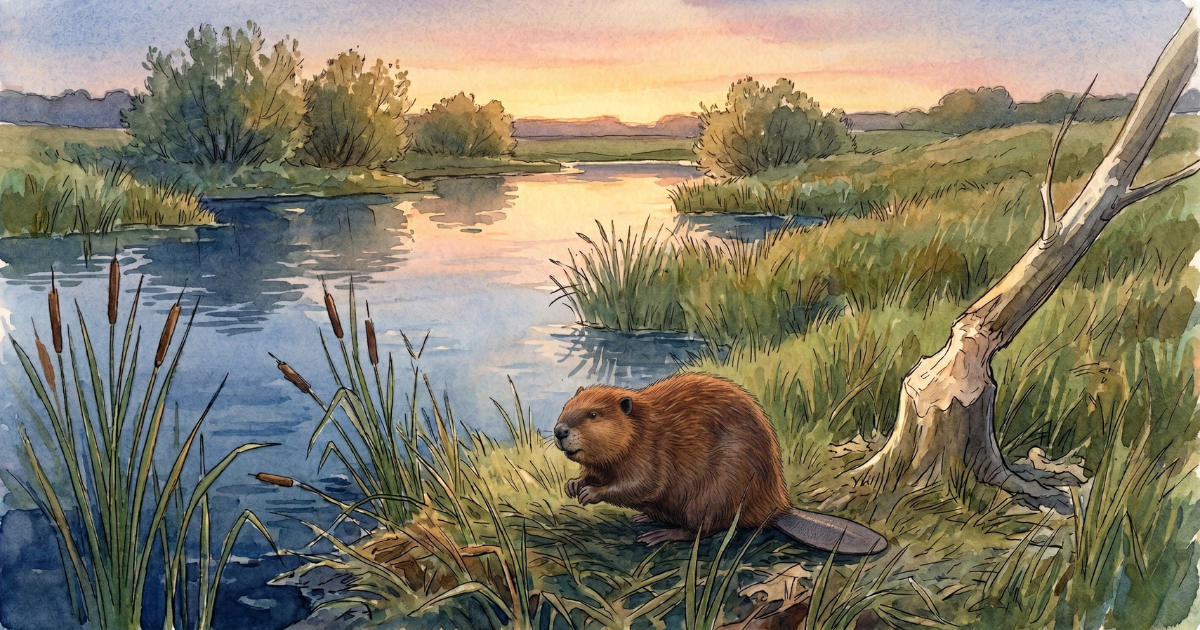
A farm near Searby in North Lincolnshire gave up its crops in 2019, and the family who run it, Hannah and Jack Dale, turned the unproductive ground over to nature instead. In December 2023, working with the Beaver Trust, they released two Eurasian beavers into a 70-acre enclosure at Wild Wrendale. This week came the first sign the pair have settled in: a single kit, caught on camera scurrying past in the dark on the 13th. Beavers have two to four young in a litter, so there are probably more in there than the one the camera found. It is the first beaver born in Lincolnshire since the species was hunted out of Britain in the sixteenth century.
Sources: BBC News – First beaver born in Lincolnshire in around 400 years (13 June 2026)
The Turning Wheel
21 June – The summer solstice, at 9.24 in the morning. The longest day of the year.
23 June – Midsummer Eve, St John's Eve. The old night of bonfires, watching, and fern seed.
24 June – Midsummer Day, the feast of St John the Baptist. One of the four quarter days of the English year, when rents fell due and accounts were settled.
29 June – St Peter's Day, the old fishermen's feast.
Turn of the month – the first cut of hay going in on the south-facing fields.
Yours, until next Thursday.
Meg.