St John's Wort: The Midsummer Plant and Its Blood-Red Oil
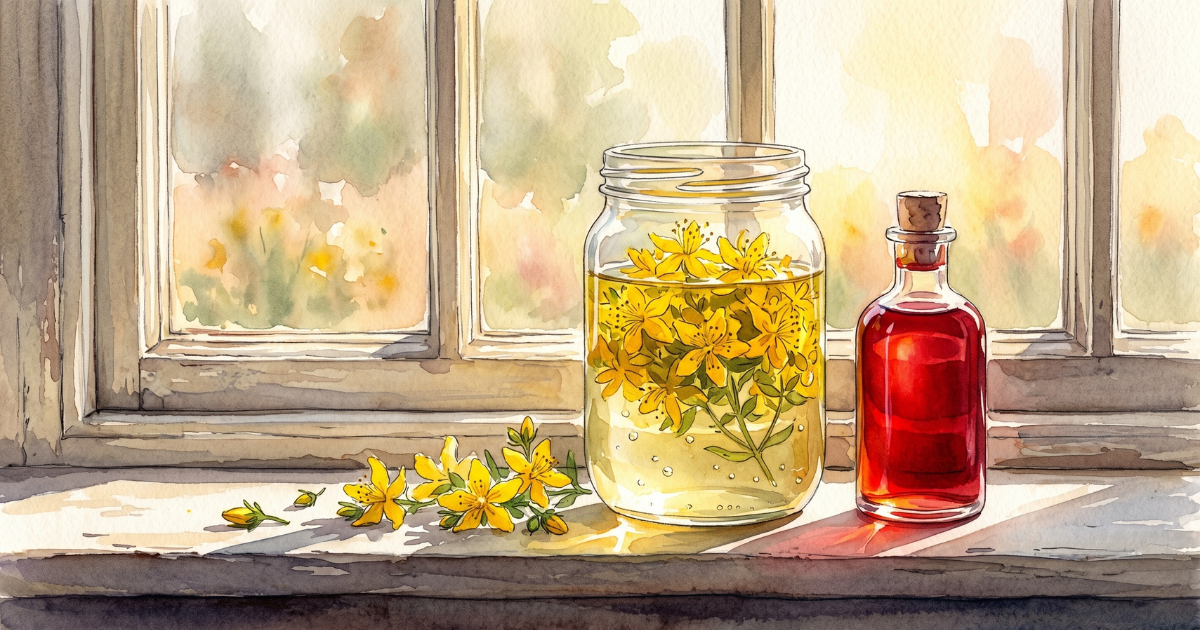
Perforate St John's wort, Hypericum perforatum, comes into flower right at the summer solstice, five-petalled and egg-yolk yellow, on chalky verges and field edges across Britain. Its timing is written into its name. The feast of St John the Baptist falls on 24 June, Midsummer Day, and the plant was held to be at the height of its power if gathered then. Hold a leaf up to the light and it appears pricked all over with tiny translucent dots, as if pierced with a pin. Those dots are oil glands, the 'perforate' of the name, and they are where the plant keeps the compound that turns an ordinary oil the colour of blood.
A plant named for a saint's day
The naming runs deeper than the flowering date. Across Europe the midsummer fires and the gathering of certain herbs were folded, as Christianity spread, into the feast of St John the Baptist on 24 June, and the wort that bloomed on cue took his name. The Wildlife Trusts note that the blood-red juice from the stems was read as a sign of his beheading, the kind of meaning a plant acquires once it is attached to a saint. The English names that survive are plainer about its job. Fuga daemonum, the flight of devils, is the oldest of them, and it tells you exactly what the plant was for.
Reading the perforate leaf
Identification turns on those glands. Pick a leaf of perforate St John's wort, hold it against the sky, and the translucent dots show up as a scatter of pinpricks across the blade; they are colourless oil glands, and they are diagnostic. Crush the flowers or buds between finger and thumb and they stain the skin a reddish purple, which no other yellow flower of the verge will do. The plant grows to about knee height, in open woods, along hedgerows and on roadside verges and waste ground, and flowers from June well into September. The five yellow petals are often edged with tiny black dots, glands again, this time on the outside.
The doorway custom
The protective use was specific and widespread. Gathered on the morning of St John's Eve, the 23rd, before sunrise and still wet with dew, and hung above the door, St John's wort was held across the English Midlands to turn back witchcraft, thunder and the evil eye for the year to come. Culpeper set down the plant's virtues in the seventeenth century, and the county folklore collections of the nineteenth repeat the doorway custom from one end of England to the other. The same midsummer eve sent people out after stranger quarry too: the fern seed that was said to grant invisibility, a separate midnight errand entirely.
The blood-red oil
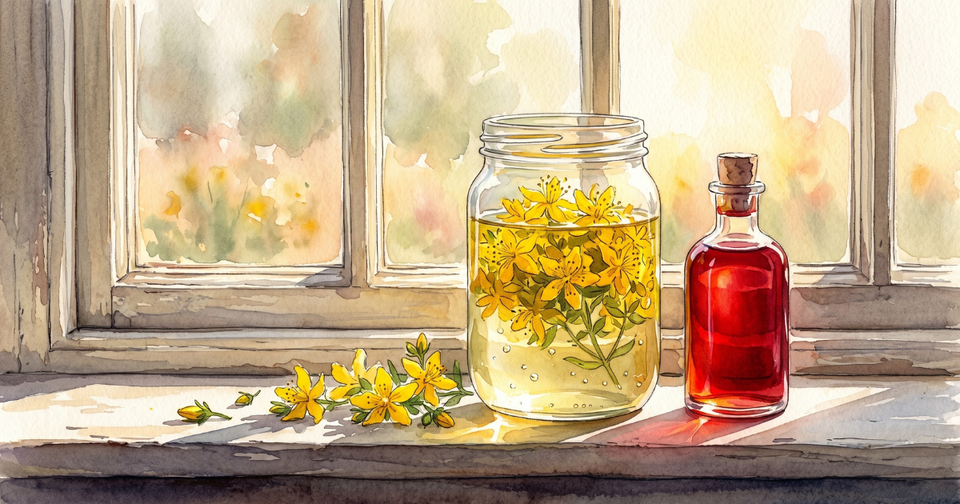
The preparation that survives is the oil. Crushed St John's wort flowers steeped in a clear oil turn it a deep ruby red over a few weeks in the sun, as the hypericin in those pinprick glands leaches out: the midsummer plant producing, of all things, a bottle the colour of blood. It was the standard household remedy for burns, bruises and aching joints, rubbed in externally, and it earns a place in a first-aid drawer still. There is one real caution. The oil makes skin more sensitive to sunlight, so it is an evening application, not something to wear before a day outdoors.
Making the oil at home
If you want to make it, gather the open flowers and buds on a dry morning around the solstice, traditionally the 23rd or 24th, though the plant keeps no calendar. Bruise them lightly in a mortar, half-fill a clean glass jar, and cover well with a light olive or sunflower oil. Stand the sealed jar on a sunny windowsill and shake it every day or so. In three to four weeks the oil will have turned deep red; strain it through muslin into a dark bottle, pressing the flowers well, and label it. The method is essentially the one Nicholas Culpeper gave in The English Physitian of 1652. It keeps about a year. For external use only, and not before sun.
Sources: Nicholas Culpeper, The English Physitian (1652); Perforate St John's-wort, The Wildlife Trusts.