The Mayor of Ock Street: Abingdon's Ox-Horn Election Custom
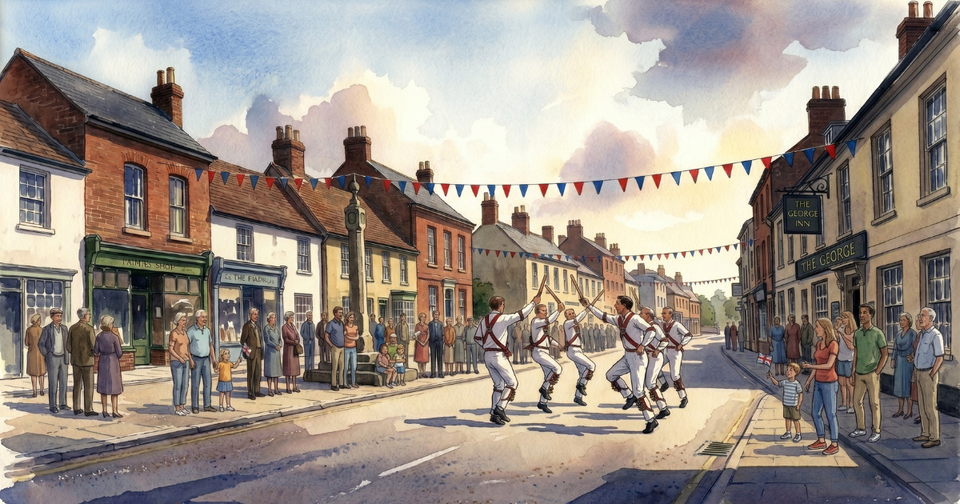
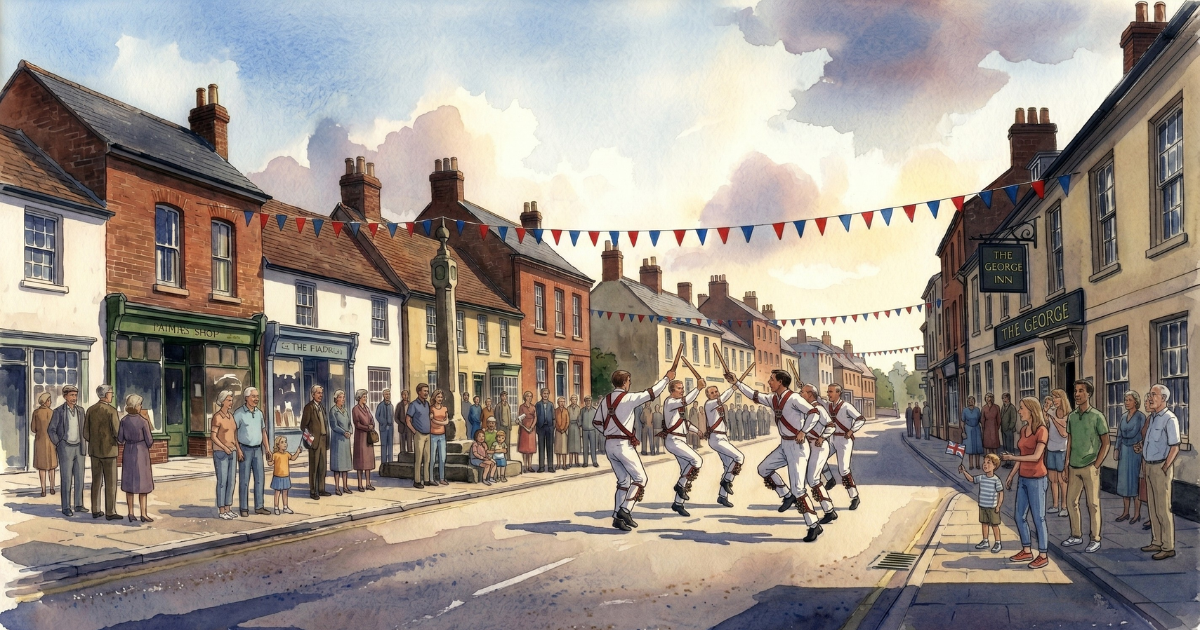
On the Saturday nearest 19 June, the people who live and work on one street in Abingdon elect a mayor. Not the mayor of Abingdon, which the town council has appointed in the usual way since 1556, but the Mayor of Ock Street, voted in by Ock Street alone. A polling station opens at the Brewery Tap, votes are cast between ten and four, and the count is done in earnest: in 2019 the result was 90 to 89. The winner takes a sword, a sash and a cup turned from apple wood, and is carried shoulder-high along the street in a chair dressed with flowers, while a set of ox horns mounted in a carved wooden head goes ahead of him. The head is painted with a date. The date is 1700.
Election day on Ock Street
The franchise is the strict part. Only those who live or work on Ock Street, and the members of the morris team that runs the whole thing, may vote. The team sets off at ten in the morning to dance its way around the town and returns to the Brewery Tap by four, when the polling closes and the votes are counted. The Mayor of Ock Street is one of the few surviving mock mayors in England, a real election for an office with no civic power and a great deal of ceremony. The new mayor is then chaired up and down the street, and the dancing carries on into the evening.
The Abingdon Traditional Morris Dancers
Running it all are the Abingdon Traditional Morris Dancers, who supply the candidates and have done for as long as anyone can establish. They dance only their own Abingdon dances, never the borrowed repertoire most teams perform, and their morris is tied up with two objects: the horns and the regalia. The mayor's symbols of office are a sword and the Mace, an apple-wood drinking cup said to have been turned from a wooden club used in the fight of 1700. The connection between a folk election and a morris side is not decoration. In Abingdon the dancing, the horns and the mayor are one custom, and have survived together where each alone might not have.
The horns and the carved head
The horns themselves are the heart of it. A pair of ox horns is mounted on a carved wooden head, and the head carries the painted date 1700. They lead the morris processions from place to place and stand before the dancers whenever the traditional dances are performed. The originals are now kept safely indoors; a replica made in 1979 does the work of parading. Photographs of the custom going back to the early twentieth century show the same head held above the crowd, flowers wound through the horns, the date plain on the front. Whatever 1700 marks, the object insisting on it has been carried through Abingdon for a very long time.
The legend of the 1700 fight
The date is supposed to tell a story. As it is handed down, an ox was roasted at the town's midsummer fair in 1700, and the men of Ock Street fought the men of the Vineyard, the district at the far end of town, for possession of the horns. Ock Street won, paraded its trophy, and has elected a champion to carry it ever since. The team's own records add that the ox roast was paid for by a farmer named Morris, and that the horns, a chalice and a sword passed down through the Hemmings family, who held the office for generations.
The gap in the written record
What is missing is any contemporary record of the fight. The earliest written reference to the custom, and to the legend itself, appears in the Berkshire Chronicle in June 1825, a century and a quarter after the battle it describes. Either a famous local victory went unwritten for five generations, or someone in Georgian Abingdon supplied a date for a custom that already existed and wanted a beginning. The horns are real, the carved head is real, and the election is still keenly fought every June. The first time anyone wrote the story down was 1825.
How to see it
If you want to see it, the election falls on the Saturday nearest 19 June, in Ock Street itself, with the polling at the Brewery Tap and the dancing through the day. The morris side leaves at ten and is back by four for the count, and the new mayor is chaired up and down the street afterwards, the horns going ahead through the crowd. Go for the chairing rather than the polling: the procession is the part worth standing in the road for, flowers in the horns, the apple-wood cup passed round, a town carrying a date it cannot quite explain up and down its own street. It first appeared in The Cottage Almanac in The Standing Sun.
Sources: Abingdon Traditional Morris Dancers (atmd.org.uk); Berkshire Chronicle, June 1825.