The Latest Sunset of the Year: Why It Is Not the Longest Day
The longest day of the year and the latest sunset of the year are not the same day. The summer solstice, around 21 June, is the day with the most daylight between sunrise and sunset. But the latest sunset comes a few days after it, and the earliest sunrise a few days before, so the solstice sits in the middle of the two: longest in total, latest in neither direction. The word solstice is from the Latin solstitium, sun-standing-still, because the sun's rising and setting points along the horizon stop and turn at midsummer. The clock, oddly, does not stand still with it.
Longest day, latest sunset
Take the solstice apart and the asymmetry shows. The total daylight is greatest on the solstice itself, which is what makes it the longest day. But sunrise and sunset do not shift by equal amounts on either side of it. Through the second half of June the time of sunset keeps creeping later for several days after the longest day, while sunrise has already begun to creep later too, having passed its earliest point a few days before. The two ends of the day are sliding in the same direction at slightly different rates. The longest day is the one with the widest gap between them, not the one that holds either extreme.
Why the sun and the clock disagree
The cause is the difference between the sun's day and the clock's day. Our clocks run on a fixed twenty-four hours, but the real solar day, noon to noon, varies slightly through the year, because the Earth's orbit is an ellipse and its axis is tilted. The running total of that difference is the equation of time, and around late June it pushes solar noon a little later each day by the clock. When solar noon drifts later, sunrise and sunset drift later with it. That drift is what carries the latest sunset past the solstice and holds the earliest sunrise back before it.
The earliest sunrise, a week earlier
The mirror of all this happens at dawn. The earliest sunrise of the year arrives several days before the solstice, not on it, for the same reason the latest sunset arrives several days after. So the run of true midsummer is not a single morning but a fortnight or so in which the sun rises and sets at its furthest north, the changes from one day to the next too small to notice. If you want the earliest start and the latest finish both, you cannot have them on one date: the earliest sunrise belongs to the week before midsummer, the latest sunset to the week after.
Marking the sun's setting point
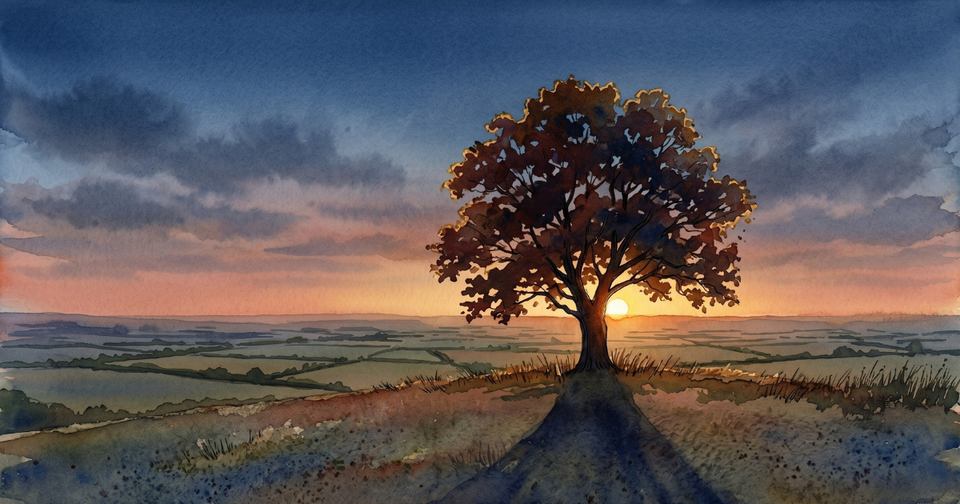
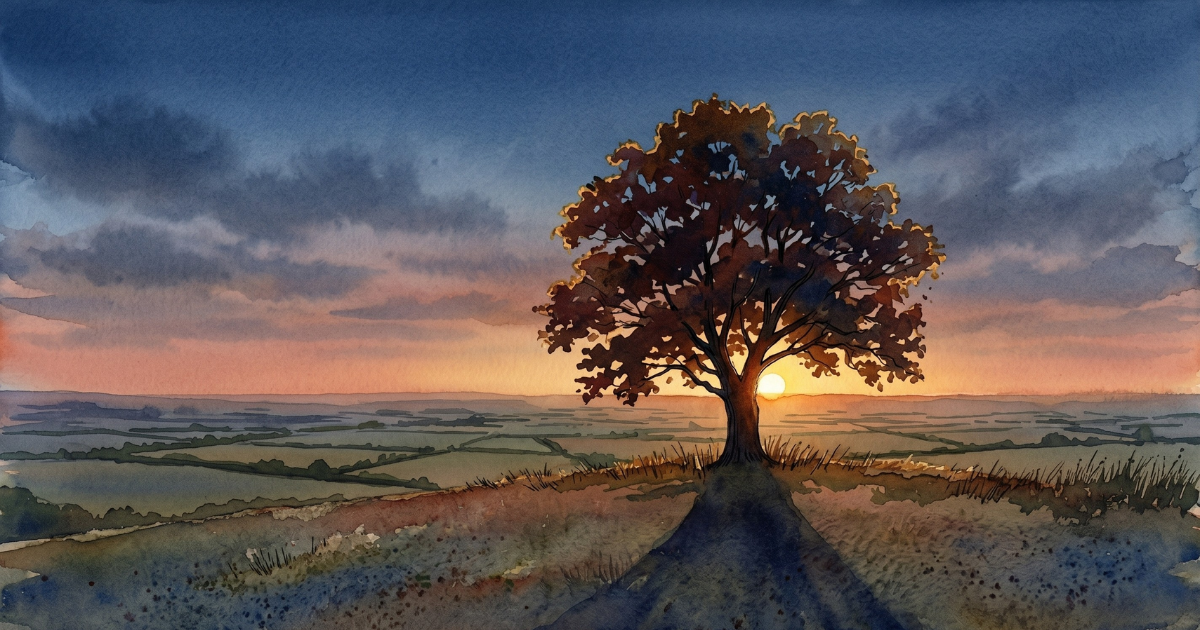
You can fix the turn in your own landscape. On a clear evening near the solstice, find a west-facing spot with a long view, a field gate on a ridge will do, and be there for around twenty past nine. Watch exactly where the sun goes down against the horizon, and note the marker it sets beside: a particular tree, a roofline, a gap in a hedge. That is the sun's most northerly setting point, the far end of its travel along the horizon, and it will set within a whisker of the same spot for a week or so either side of midsummer. Mark it well, because the sun will not return to it for a year.
The other end of the year
The same spot gives you the whole swing of the year. Stand in that gate again at the winter solstice in December and the sun will go down a full quarter of the sky to the south of its midsummer mark. The two setting points, six months and ninety degrees apart, are the visible edges of the same slow movement, and once you have both fixed against your own horizon you are reading the year the way people read it before anyone printed a calendar. The longest day will have come and gone; the northern setting point does not move, and the sun returns to it only the following midsummer.
Sources: Summer solstice, Royal Observatory Greenwich; sun times, timeanddate.com.