The Lengthening Light
The second week of June, and the light is doing most of the work. The verges are at their full height, the first meadows have gone down, and on Saturday it will be five hundred and forty-three years since the most consequential bowl of strawberries in English history was ordered, fetched, and never mentioned again. In this issue: a king's strawberries in Holborn, the flowers of the June verge, roe venison done slowly, and the smallest measure in the still-room.
On the Horizon
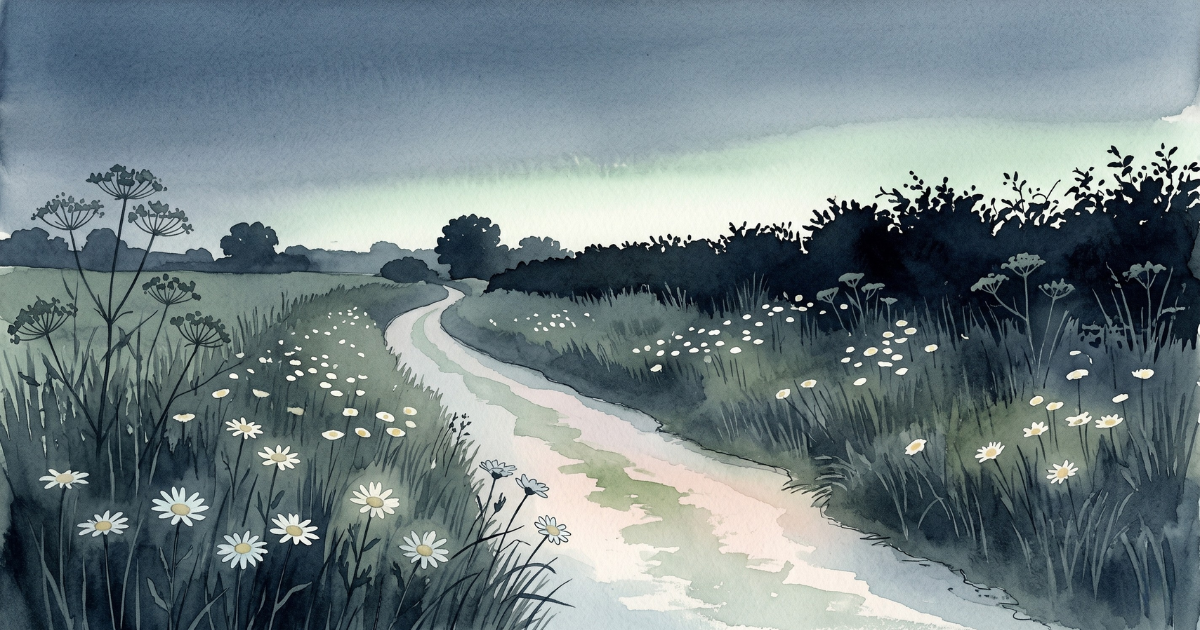
I walked back late on Monday and the sky still had not finished with the day – a pale green-white band hanging in the north well after eleven, the hedge line black against it. The light is long now, and getting longer. The path through the meadow is soft underfoot this week, because the mowing happened overnight: cut grass lying in ridges, the smell of it everywhere, the whole field changed between one evening and the next. A cuckoo is still calling from the wood edge, but there is something of the farewell in it nowadays – the adults slip away south weeks before anyone expects them to, some before June is out. The ewes have been shorn and stand about looking white, thin and faintly affronted. And the last asparagus spears are coming through woodier and less sweet than the first flush, the season ending as it always does, a little before you are quite ready.
The Sky This Week
Sunrise 4:41 am · Sunset 9:19 pm
Moon Waning crescent · New Moon Mon 15 June, 3:54 am BST
Harwich tides Low 2:22 am · High 8:43 am · Low 2:45 pm.
The moon is barely in it this week. A thin waning crescent rises in the small hours and sets before dawn, and by Monday it has dwindled to nothing – the new moon falls at 3:54 on the 15th. That leaves the back half of the week as dark as the sky gets all month. This is the season for noctilucent clouds: thin, electric-blue filaments that hang higher than any weather cloud, high enough that the sun lights them from below the horizon long after it has set on everything else. If you want to catch them, look low along the northern horizon in the hour after sunset, past ten, once the rest of the sky has gone properly dark.
Source: timeanddate.com (Baldock) · Royal Observatory Greenwich · UKHO EasyTide
The Curious Instance of the Bishop's Strawberries
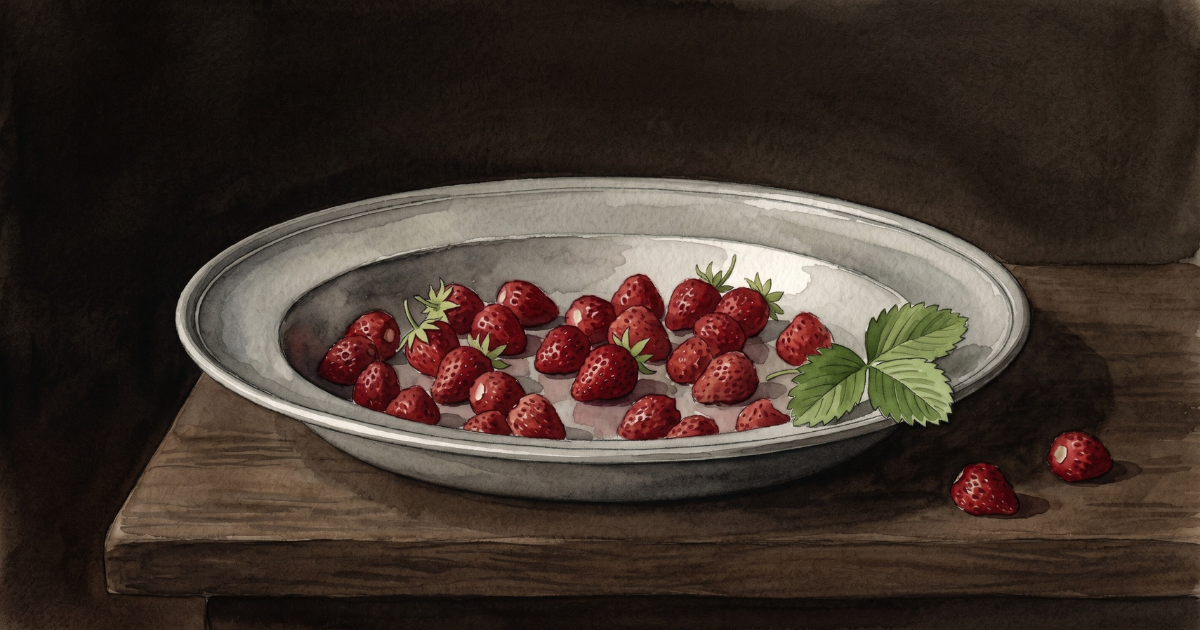
On the morning of Friday 13 June 1483, a council was sitting in the Tower of London, planning a coronation. Edward IV had died suddenly that April, and his twelve-year-old son had succeeded him; the crowning was set for the twenty-second of the month, and pageants were being built at Westminster day and night while the lords at the table worked through the order of the procession. The boy's uncle, Richard, Duke of Gloucester, was Lord Protector, the guardian of the uncrowned king. At about nine o'clock he came in, full of good humour, apologising for having slept late. He greeted the table, and then turned to John Morton, the Bishop of Ely. 'My lord, you have very good strawberries at your garden in Holborn. I require you, let us have a mess of them.' The bishop, no doubt pleased, sent a servant for the fruit at once, and the Protector excused himself from the room.
When he came back an hour or so later, the good humour was gone. He asked the lords what punishment was deserved by men who plotted his destruction, then bared his left arm and said it had been withered by sorcery: the work of the widowed queen and of Mistress Shore, the late king's lover. Lord Hastings, whose own mistress Shore now was, answered carefully that if they had done such a thing, they deserved punishment. Richard turned on the word. 'I tell thee they have done it, and that I will make good on thy body, traitor.' Armed men came in at a shout, and Hastings was taken out onto the green and beheaded over a log of timber before noon; Richard had sworn he would not dine until it was done. What followed moved at the same speed. Within days, a sermon at Paul's Cross declared the boy king and his brother illegitimate; on 26 June Richard took the throne, and on 6 July he was crowned. Edward V was never crowned at all.
The story comes from Thomas More, who heard it in Morton's own household; he had served the bishop there as a page. Some of it is certainly embroidered, because Richard's skeleton, found under a Leicester car park in 2012, has a curved spine and two perfectly ordinary arms.
Walk up Ely Place today, the gated lane off Holborn Circus, and you are standing where the bishop's garden was; a Strawberry Fayre is still held there every June. What Hastings had actually done was never tested, because there was no trial. A proclamation setting out his treasons was being read in the City within two hours of the execution – written out on parchment in a fair set hand, and at such length that, More says, every child could see it had been prepared in advance.
Sources: Dominic Mancini, De Occupatione Regni Anglie, 1483 · Thomas More, The History of King Richard III, c. 1513 · Raphael Holinshed, Chronicles, 1577 · University of Leicester, Greyfriars excavation, 2012
The Hedge
The Midsummer Verge
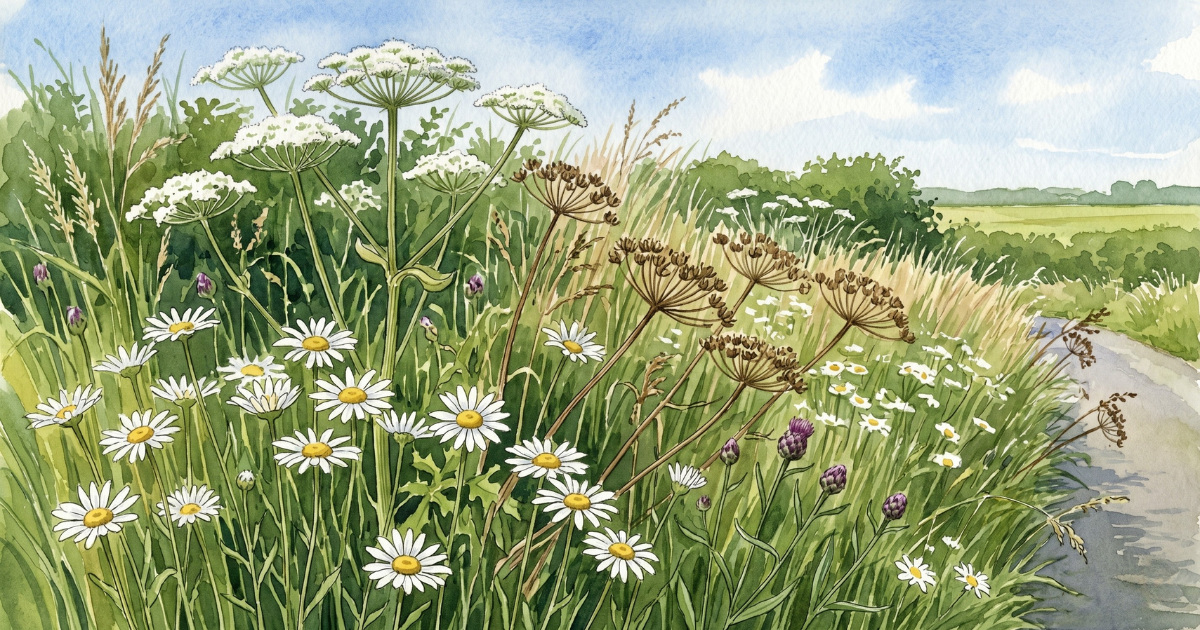
There is a lane between Baldock and the next parish that I have been watching since April, and this is the week it comes into flower properly. The cow parsley has gone over – browned, seeding, leaning into the road – and the ox-eye daisies have taken the front row, with hogweed standing behind them and the first hard purple buds showing on the knapweed. By the end of the month, on one short stretch and one stretch only, there will be meadow cranesbill, a soft violet-blue you do not get from anything else in the English flora.
That one stretch is the point. A road verge is a parish history written in flowers, and the species tell you its age. Ox-eye daisy is a coloniser: it will arrive on any bank of disturbed soil within a season or two, which is why new bypasses turn white with it. White campion and hedge mustard behave the same way: quick, mobile, and proof of nothing. But meadow cranesbill, field scabious and salad burnet are perennials of old, unbroken grassland. They move along a road at walking pace, generation by generation, and they do not cross gaps. Where you find them, the turf they stand in is older than the tarmac, and usually older than the enclosure of the fields behind it: a surviving ribbon of the broad droving verge or open common the road once ran through. Botanists use exactly this same logic to date hedgerows by their shrubs.
The same lane will not look like this next year, and that is not a sign of anything wrong. A wet May pushes the grasses up and drowns the smaller flowers; a dry one does the opposite. Where yellow rattle has seeded in, it parasitises the grass roots and opens the sward, and its populations boom and crash on a cycle of a few years, taking the balance of the verge with them. The verge has a different summer every summer. The cranesbill stretch, though, has been the cranesbill stretch for as long as anyone has thought to look.
Sources: BSBI distribution maps, Geranium pratense · Wildlife Trusts, meadow cranesbill
The Garden Plot
The Weather Watch
A cool, showery start that turns. Thursday sits at the damp end of the week, around 16°C with rain never far off, then Friday breaks it open – the temperature jumps to about 21°C, the cloud thins, and the dry, bright spell holds into Saturday. If anything wants doing in the dry, the weekend is the window: sowing, planting out, or just catching up on the watering now the warmth is back.
The Longer Game
If you want a late summer harvest, sow a final batch of French beans, beetroot and salad leaves now. June sowings often outperform May ones – the soil is warmer, and germination is faster and more even.
This Week
Pick strawberries every day once they start ripening. Leave them even a day and the slugs, birds or wasps will get there first. Eat them with nothing, or with cream if you must, but not with sugar.
Maintenance
Water newly planted things deeply every other day rather than lightly every day. Deep watering sends roots downward; shallow watering keeps them at the surface, where they are vulnerable to heat.
And keep half an eye on Monday. St Vitus's Day falls on the fifteenth, and the old rhyme is unambiguous: if it rains on St Vitus's Day, it will rain for thirty days together. The saying was already old when Richard Inwards collected it in Weather Lore in 1893.
The Larder
Roe Venison
Roe bucks came into season in April and stay in it all summer, which is why a good butcher may have it for you this month. Mrs Beeton, in the Book of Household Management of 1861, treats roe venison as a different proposition from red: a smaller deer, a finer grain, a more delicate meat, and one that punishes the roasting treatment a haunch of red expects. Her standing instruction is to hash it – the joints sliced thin and simmered gently in a gravy built on port wine and redcurrant jelly – because a small roe joint cooked fast dries out before it is done. The principle has not changed in a hundred and sixty years: roe is lean, and lean wants gentleness.
A loin, though, is the one cut that earns an exception, and if your butcher has one this is the month to take it. It wants a smoking pan rather than the stewpot: barely four minutes of cooking, then a rest twice as long as the searing, so it comes to the plate rare. The sauce is where June gets in: the first of the British raspberries, crushed into the pan with a splash of vinegar, doing the work Mrs Beeton gave to her redcurrant jelly.
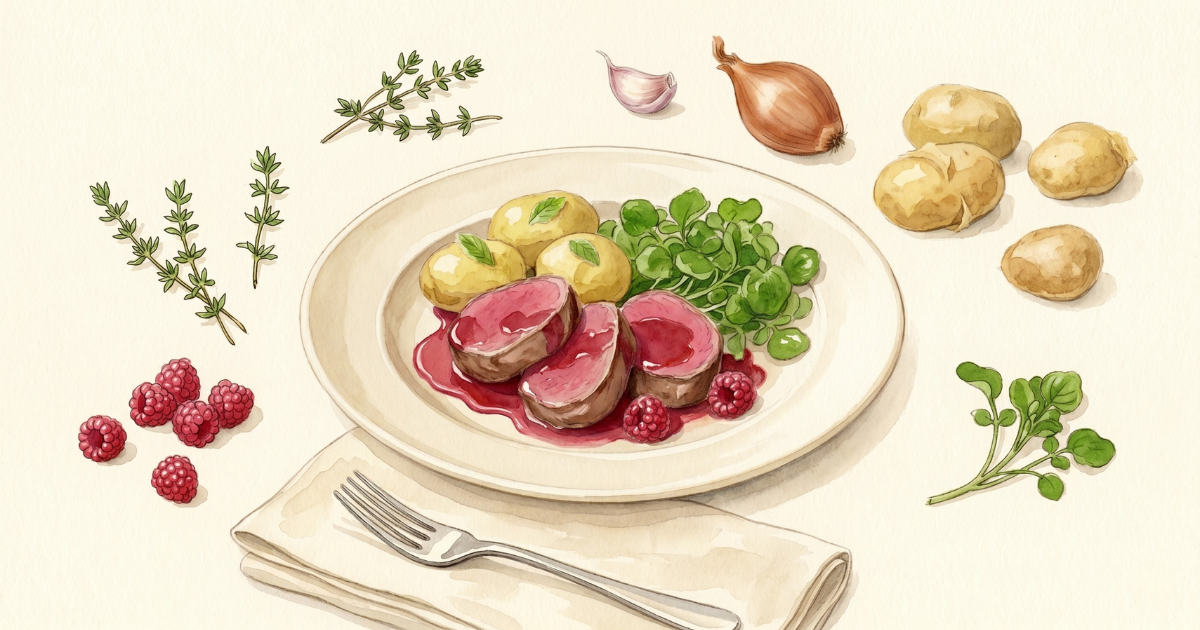
Pan-seared roe venison loin with a fresh summer berry reduction
Ingredients
- 400 g roe venison loin, whole or cut into two thick steaks
- 1 tbsp vegetable oil
- 25 g unsalted butter
- A few sprigs of thyme
- 1 garlic clove, bashed
- 1 small shallot, finely diced
- 1 tbsp red wine vinegar
- 100 ml good game or beef stock
- 100 g raspberries
- 1 tsp honey, only if the berries need it
Method
- Take the venison out of the fridge twenty minutes ahead and season it well; cold meat seizes in the pan.
- Get a heavy pan smoking hot, add the oil, and sear the venison for about two minutes a side without moving it.
- Lower the heat, add the butter, thyme and garlic, and baste with the foaming butter for a minute or two more. Take it off rare to medium-rare.
- Rest it on a warm plate, loosely covered, for eight minutes. Do not shorten this.
- Pour off the excess fat, soften the shallot in the same pan, then deglaze with the vinegar and add the stock and raspberries, crushing the berries as it simmers and thickens.
- Strain the sauce, slice the venison into thick medallions, and serve with Jersey Royals boiled with mint and tossed in butter, and a handful of watercress.
Roe is lean. It comes off the heat rare to medium-rare or not at all; past medium it tightens and the flavour goes flat. If raspberries read too sharp, ripe redcurrants or early blackberries do the same work.
And if a second loin comes your way, cure it. Rub it all over with equal parts salt and sugar, leave it covered in the fridge for twenty-four hours, rinse, pat dry, wrap in muslin and hang it somewhere cool and airy for two to three weeks, until firm right through. Sliced tissue-thin, it does what bresaola does, from a deer that is now found in nearly every English county.
Sources: Isabella Beeton, Book of Household Management, 1861 · Wildlife Trusts, roe deer
The Still-Room
The minim measure
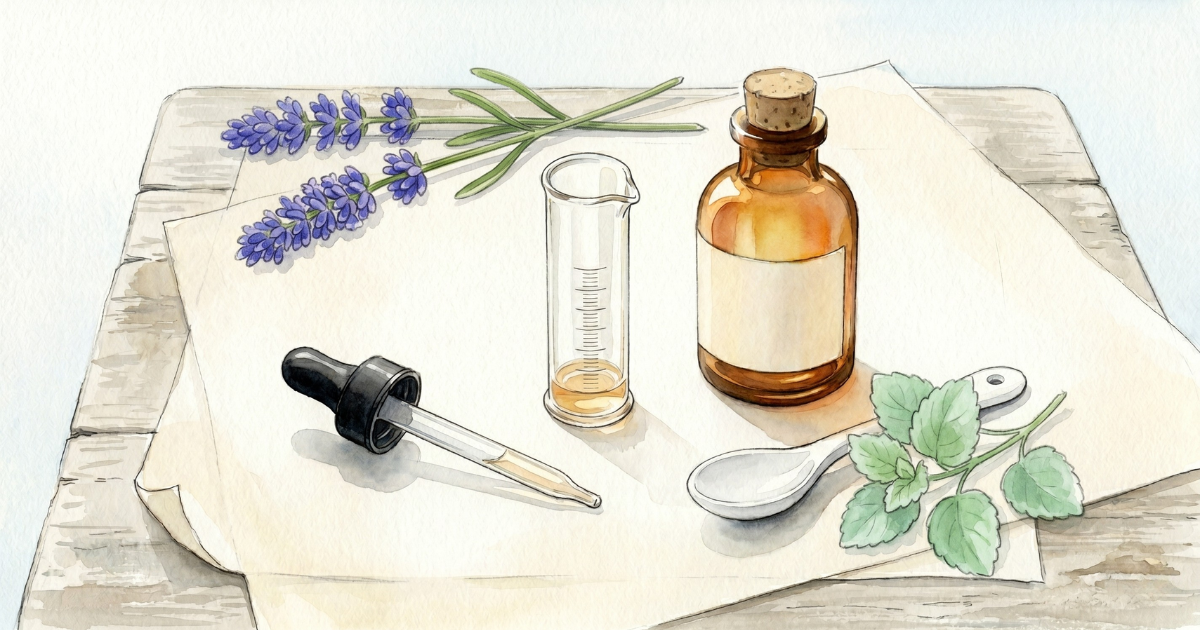
If you are following an older herbal recipe this summer, you will eventually find a dose measured in minims. It is the smallest measure in the apothecaries' system – one sixtieth of a fluid drachm, roughly a single drop – and it existed because drops are unreliable. A drop of water and a drop of tincture are different sizes; the same tincture drops differently from a wide bottle lip and a narrow one. The dispensary and the still-room needed a unit that did not change with the liquid or the glass, so the minim glass was made: a small conical measure with the gradations etched up the side, calibrated at a scale where the difference between five and fifteen actually matters. Maud Grieve gives her doses in minims throughout A Modern Herbal of 1931, because the preparations that do the most work are exactly the ones that need counting in drops.
You will need
- Any herbal tincture with a stated dose in minims
- A glass dropper, or a minim glass if you can find one
- A 5 ml medicine spoon
- A small glass of water
Method
- Calibrate the dropper: count how many drops of plain water it takes to fill the 5 ml spoon.
- A 5 ml spoon holds 84 minims, so divide 84 by your drop count to find the minims in one of your dropper's drops.
- Work out the drops needed for the stated dose, and always start at the bottom of any stated range.
- Take the dose in the glass of water, never neat.
The minim system exists for safety. Never exceed a stated dose, and treat any tincture without one as not for internal use. Antique minim glasses turn up cheaply; check the etching is legible before trusting it.
Sources: Maud Grieve, A Modern Herbal, 1931 (botanical.com)
The Weekend Walk
The long barrow
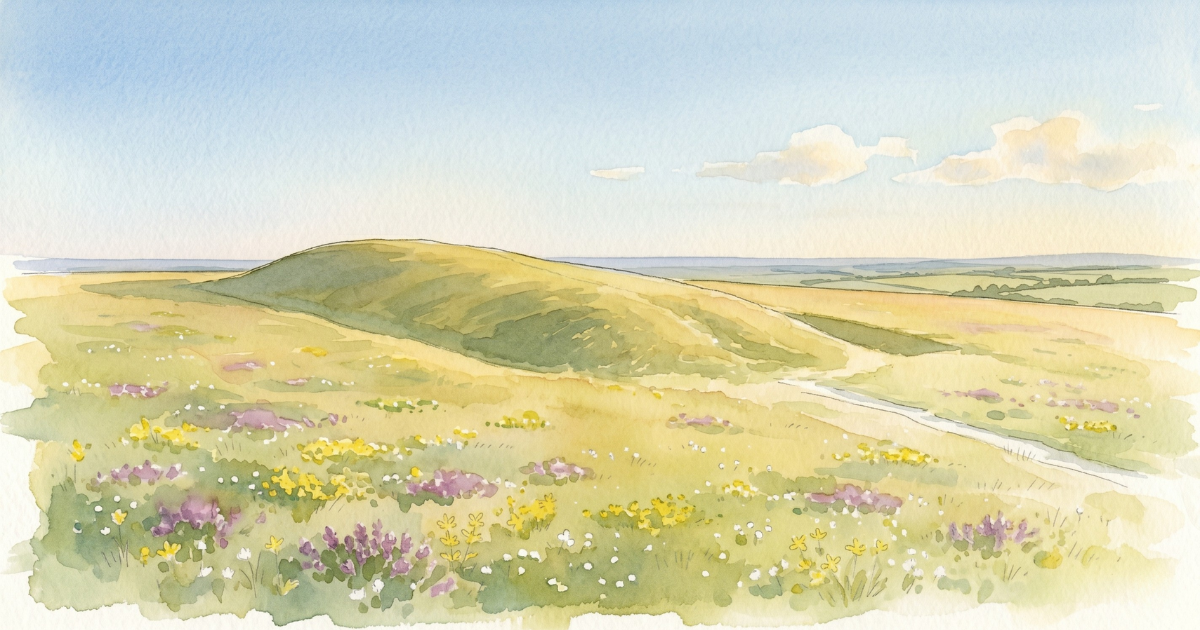
If you want a destination this weekend that out-ages everything else you will pass on the way to it, walk to a long barrow. Mine is up on Therfield Heath above Royston, a whale-backed mound on the chalk; but find your nearest, because the Neolithic put them along most of the chalk and limestone country, and a 1:25,000 map or the county Historic Environment Record will give you one within range. Go slowly on the approach, and go by nose as much as by eye. Chalk turf in warm weather has a scent nothing else replicates: crushed wild thyme and marjoram, dry grass, something faintly honeyed from the lady's bedstraw. It gets stronger where the turf is oldest, which is usually exactly where the barrow stands. What you are looking for is a low grassed mound, longer than it is wide, often with a shallow dip running along each flank where the quarry ditches were – the whole monument was dug out of the ground it stands on, with antler picks, and it has stayed put for five and a half thousand years.
Sources: Historic England, scheduled monument list entry (Therfield Heath long barrow) · OS Explorer 1:25,000
An Old Word for It
Simmer dim is what Shetland calls the light it has instead of night at this time of year: the sun barely under the horizon, a silvery half-light holding through the small hours, bright enough to read by at two in the morning. The word is Shetlandic, from Norse roots – simmer is summer, and the dim is the twilight itself. Five hundred miles south we get the diluted version: the glow that will not leave the northern sky this fortnight is the same light, at lower strength.
In Good Report
A piece of news worth passing on, from this week.
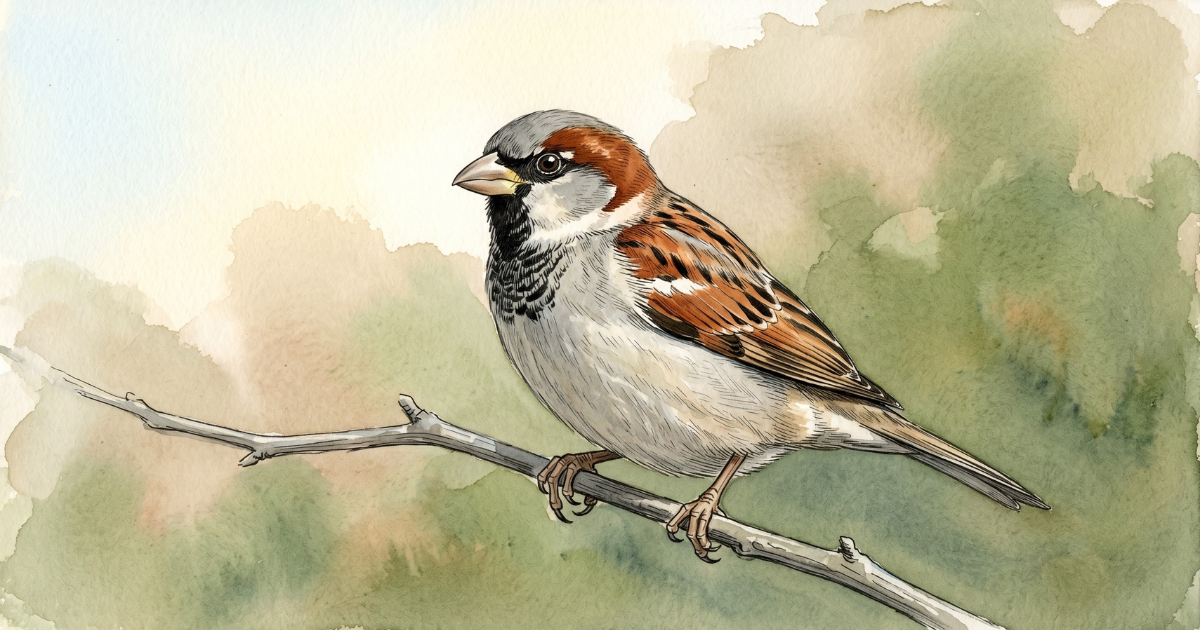
The faces on Bank of England notes belong to people – the monarch on the front of every one, and a rotating cast of famous Britons on the back: Austen on the ten, Turner on the twenty, Turing on the fifty. The next series will not. The Bank has chosen wildlife as the theme for its new notes, and on 3 June it handed the shortlist to the public: native British species, four of which will end up on the £5, £10, £20 and £50. The candidates lean toward the common and the overlooked rather than the rare, so there is a real chance of a house sparrow or a common toad being carried about in millions of wallets. The vote is open until 3 July.
The Turning Wheel
What's coming, in the next fortnight.
21 June – Litha, the summer solstice (approximate date).
24 June – Midsummer Day, the Nativity of St John the Baptist – Quarter Day, the old English rent day.
Mid-June – meadows at their most various: knapweed, yellow rattle, and the last ragged robin.
Yours, until next Thursday.
Meg.