Reading a Road Verge: The Flowers That Date Old Grassland
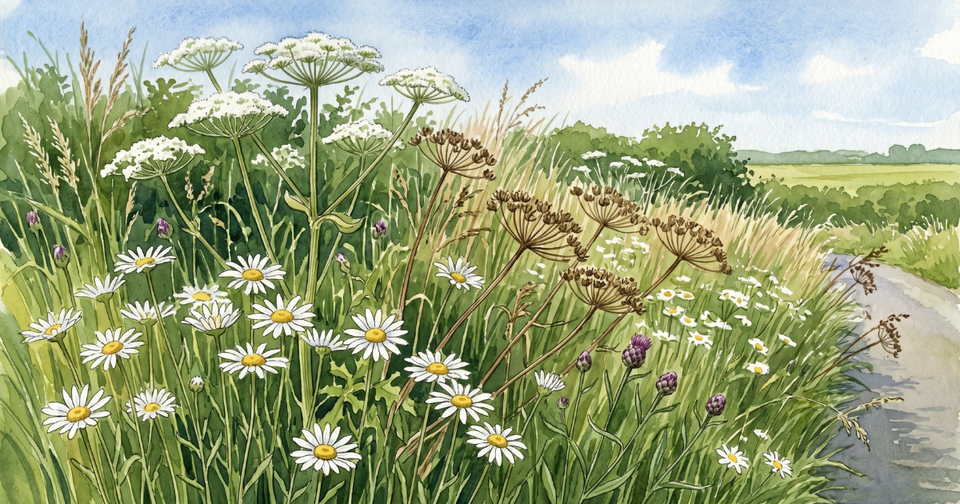
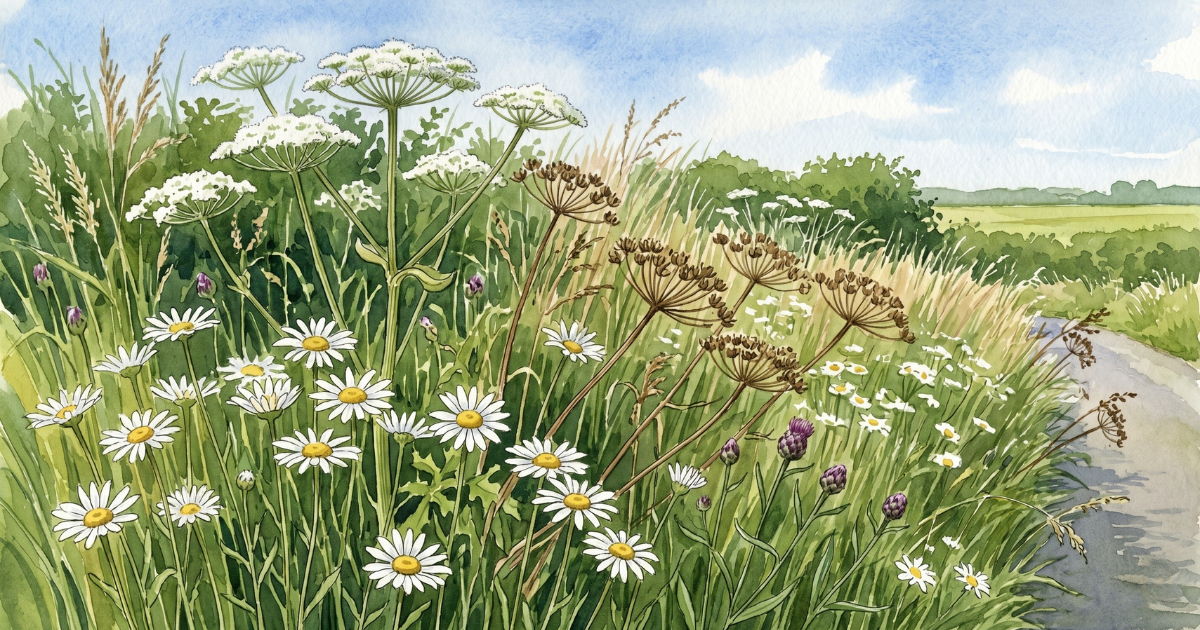
A road verge is a record of the ground it runs through, written in flowers. On one lane between Baldock and the next parish, the cow parsley has gone over and browned, the ox-eye daisies have taken the front row, and by the end of June one short stretch will turn the soft violet-blue of meadow cranesbill. That last species is the tell. Some verge flowers arrive on any disturbed bank within a season or two and prove nothing about age; others are perennials of old, unbroken grassland that spread so slowly they can date the turf they stand in. Learning which is which turns an ordinary walk past the hedge into a way of reading how long the grassland beside the road has been there.
The lane in mid-June
Watch one stretch across a season, as the lane described in The Lengthening Light has been watched since April, and the order of arrivals becomes plain. The cow parsley flowers first and is already finished by now, leaning brown into the road. The ox-eye daisies follow, big and white at knee height, with hogweed standing behind them and the first hard purple buds forming on the knapweed. Later still, on the one stretch that always carries it, comes the meadow cranesbill, a blue you will not get from anything else in the British flora. The same lane will not look identical next year, and that is normal: the balance shifts with the weather and with whatever has seeded in.
Colonisers, and what they aren't
Ox-eye daisy is a coloniser. It arrives on any bank of freshly disturbed soil within a season or two, which is why a new bypass turns white with it in its first summers. White campion and hedge mustard behave the same way, quick and mobile and happy on broken ground. None of them tells you anything about the age of the place, only that bare earth was available recently. A verge can be loud with flowers and still be young. The point of reading a verge is not how much it carries but which species it carries, and a sheet of ox-eye daisy on a raw embankment is the botanical equivalent of fresh paint.
The slow flowers
Meadow cranesbill tells a different story, and so do field scabious and salad burnet. These are perennials of old, unbroken grassland. They spread by seed and root at something close to walking pace, generation by generation, and they do not jump gaps. Where you find them holding a stretch of verge, the turf they stand in is older than the tarmac beside it, and usually older than the enclosure of the fields behind it. What you are looking at is a surviving ribbon of the broad droving verge or open common the road once ran across, left untouched while the land around it was ploughed and hedged. The flowers are the only part of that older ground still visible.
The same logic in a hedge
Botanists date hedgerows on exactly this reasoning. A hedge planted in a single operation starts with one or two woody species; over centuries more arrive and establish, at a rough rate of one new shrub species per thirty metres per hundred years, so a count of the shrubs in a measured length gives an approximate age. Verges work the same way with their herbs rather than their shrubs. In both cases the principle is that some plants colonise fast and some arrive slowly, and the slow ones, once in, are hard to shift. Read together, a hedge and the verge beneath it can place a boundary within a century or two.
A different summer every summer
None of this means a verge is fixed. A wet May pushes the grasses up and swamps the smaller flowers; a dry one lets them through. Where yellow rattle has seeded in, it parasitises the roots of the grasses, weakens them and opens the sward for everything else, and its own populations boom and crash over a cycle of a few years, swinging the whole verge with them. So the flowering shifts from year to year even where nothing is wrong. The constant is the species list of the slow perennials. The cranesbill stretch has been the cranesbill stretch for as long as anyone has bothered to look.
Sources: BSBI distribution maps (Geranium pratense); The Wildlife Trusts, meadow cranesbill; E. Pollard, M. D. Hooper and N. W. Moore, Hedges (1974), for the shrub-count dating method.