The Minim: The Smallest Measure in the Still-Room
A minim is one sixtieth of a fluid drachm, roughly a single drop, and it is the smallest unit in the old apothecaries' system of measures. It exists because a drop is not a reliable amount. A drop of water and a drop of tincture are different sizes, and the same tincture falls in different sizes from a wide bottle lip and a narrow one, so a recipe that says take ten drops cannot mean a fixed dose. The dispensary needed a measure that did not change with the liquid or the glass. If you follow an older herbal this summer you will meet the minim sooner or later, usually attached to exactly the preparations where the difference between a little and a lot matters most, as the still-room note in The Lengthening Light puts it.
Why a drop will not do
Drops vary for ordinary physical reasons. Surface tension, viscosity and the shape of the lip the liquid leaves all change the size of the bead that forms and falls, so a thick syrup drops large and a thin spirit drops small from the same bottle. For most kitchen purposes this does not matter. For a tincture of something active it matters a great deal, because the dose is small and the margin between effect and harm can be a few drops wide. The apothecaries' answer was to stop counting in drops and start measuring a fixed volume instead, fine enough to catch those differences.
The minim glass
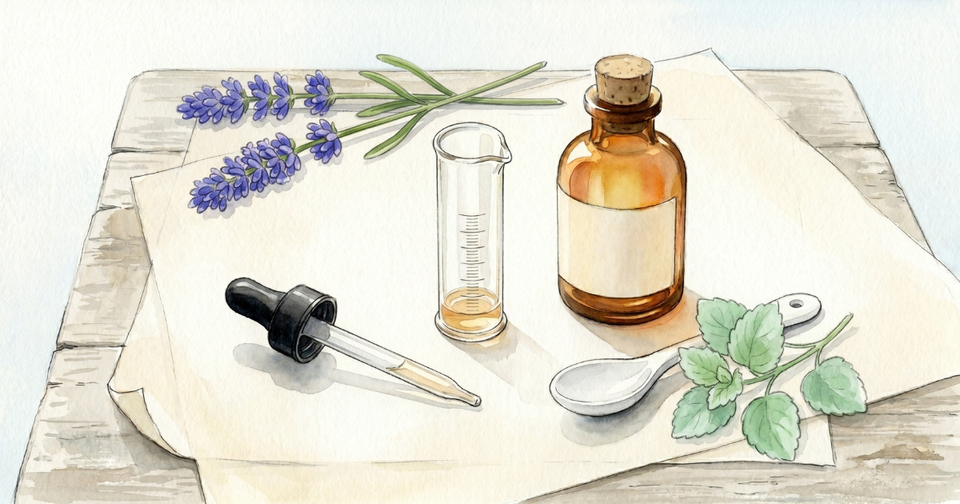
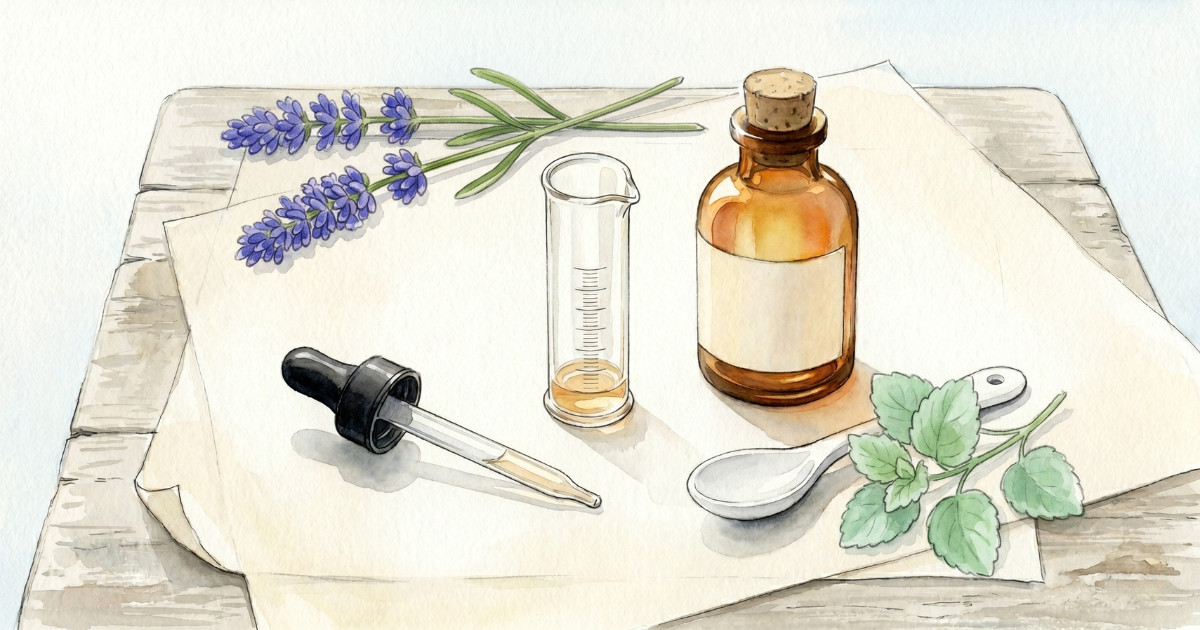
The instrument for it was the minim glass: a small conical measure, narrow at the base and widening upward, with the gradations etched up the side. The cone is the point. A given volume of liquid stands much taller in a narrow cone than in a wide cylinder, so the marks for five, ten and fifteen minims are spaced far enough apart to read by eye. Calibrated this way, the glass measures amounts a kitchen spoon could never distinguish. Antique examples turn up cheaply in junk shops, usually because nobody now knows what they are, though the etching is worth checking before you trust one.
Grieve's doses
Maud Grieve gives her doses in minims throughout A Modern Herbal, published in 1931 and online since the 1990s. She does it because the preparations that do the most work are the ones that need counting most carefully: the fluid extracts and tinctures, where a stated dose might be five to fifteen minims rather than spoonfuls. Read across her entries, the minim is less a relic than a working tool for one particular class of preparation, the strong ones. A herbal that measured everything in teaspoons would simply be unable to write those doses down with any safety.
Counting one yourself
You can work in minims with a plain glass dropper. First calibrate it: count how many drops of plain water your dropper takes to fill a five-millilitre medicine spoon. A five-millilitre spoon holds about eighty-four minims, so dividing eighty-four by your drop count gives the number of minims in one of your drops. From there you can convert any dose stated in minims into a number of drops for your particular dropper. The sensible rule is to start at the bottom of any stated range, take the dose in a glass of water rather than neat, and never go above the figure the recipe gives.
A measure built for safety
The whole system is a safety device. A unit that does not drift with the glass or the liquid is what lets a dose be written once and repeated exactly, and the warnings that travel with it are part of the same logic: never exceed a stated dose, and treat any tincture that carries no dose at all as not for internal use. The minim survived as long as it did because the things measured in it were the things it was dangerous to get wrong. British pharmacy gave up the apothecaries' measures for metric units within living memory, so the minim now survives only in old herbals and in the etched glasses made to pour it.
Sources: Maud Grieve, A Modern Herbal (1931), botanical.com.