Long Barrows: How to Find One and Read It
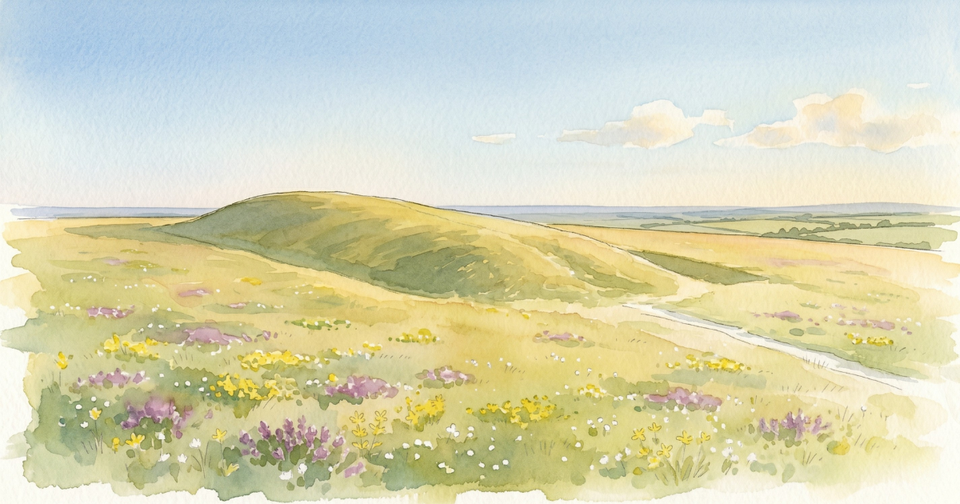
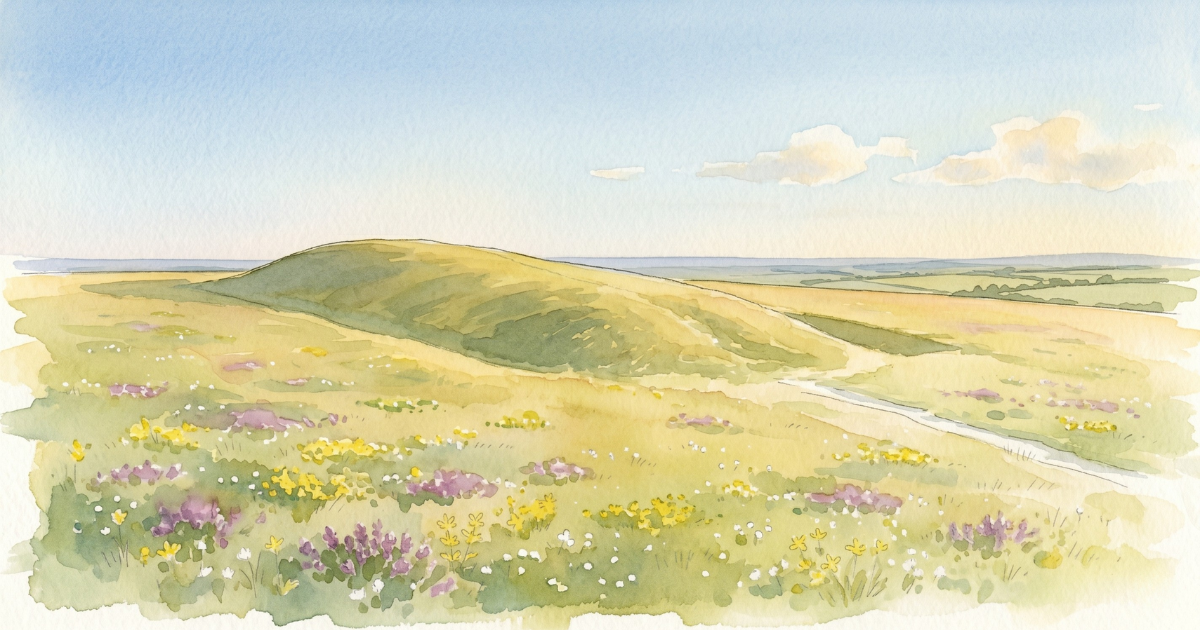
A long barrow is a Neolithic burial mound, longer than it is wide, built across the chalk and limestone country of Britain by the first farming communities about five and a half thousand years ago. There are roughly five hundred of them left in England. A barrow that has worn down for five millennia reads as a low grassy hump rather than a monument, which is why the nearest one is easy to pass without seeing it. The one above Royston, on Therfield Heath, is a whale-backed rise on the crest of the down; yours, if you go looking, may be subtler still. The trick is knowing the shape to look for and, less obviously, the smell, because the oldest turf gives a barrow away before the eye does.
The shape
What you are looking for is a low mound, clearly longer than it is wide, often aligned roughly east to west. The Therfield Heath barrow is trapezoidal, about forty-five metres long, wider and higher at the eastern end and tapering toward the west, standing two to three metres above the turf. Many are less defined than that. Running along each flank there is often a shallow trough, sometimes barely a dip: these are the quarry ditches the builders dug the mound out of, now mostly silted up and grassed over. The whole monument was raised from the ground it sits on, with antler picks and baskets, and then left.
Where they are
They cluster where the geology suited them. The Neolithic put long barrows along the chalk and limestone, from the Wessex downs up through the Chilterns and across the Yorkshire Wolds, and Therfield Heath sits on a spur of the Chilterns where the chalk breaks the surface. To find your nearest, a 1:25,000 Ordnance Survey map marks them, and the county Historic Environment Record lists them with grid references. The Therfield barrow is a scheduled monument, one of the few classes of Neolithic structure to survive as a visible earthwork, which is part of why every one of them is legally protected.
Finding one by nose
Chalk turf in warm weather has a scent nothing else quite reproduces. Crushed wild thyme and marjoram, dry grass, and a faint honeyed note from lady's bedstraw combine into something you learn to recognise once and then notice everywhere on the downs. It is strongest where the turf is oldest and least disturbed, which on a barrow site is usually the mound itself, never ploughed because the law and the slope both forbid it. Walking up slowly, into the wind, you often catch the old grassland before you have quite worked out where the ground rises. The nose finds the unimproved turf faster than the eye finds the monument.
What lies inside
Barrows are graves, and the Therfield mound has been opened twice to find out whose. E. B. Nunn dug into it in 1855 and C. W. Phillips again in 1935; between them they found a cremation and an inhumation at the broad eastern end, and at the western end two stone cists and a further burial. That is a small number of people for so large a structure, which is typical: a long barrow was not a full cemetery but a marked place for a chosen few, built and added to over generations. The bones are gone now, taken into collections, but the mound stays where it was raised.
Going this weekend
If you want a destination that out-ages everything you will pass on the way to it, a long barrow is hard to beat. Go in the late afternoon when the turf is warm and the scent is up, walk the length of the mound to feel how deliberate it is, and look for the slight parallel dips of the quarry ditches along the sides. Take a 1:25,000 map and find your own rather than borrowing the one in The Lengthening Light. The barrow on Therfield Heath has held its place on the chalk for about five and a half thousand years, which is longer than any building you have ever stood in.
Sources: Historic England, scheduled monument list entry, Long barrow on Therfield Heath (list entry 1010428); Ordnance Survey Explorer 1:25,000.