Roe Venison: A Loin Cooked Rare with Summer Berries
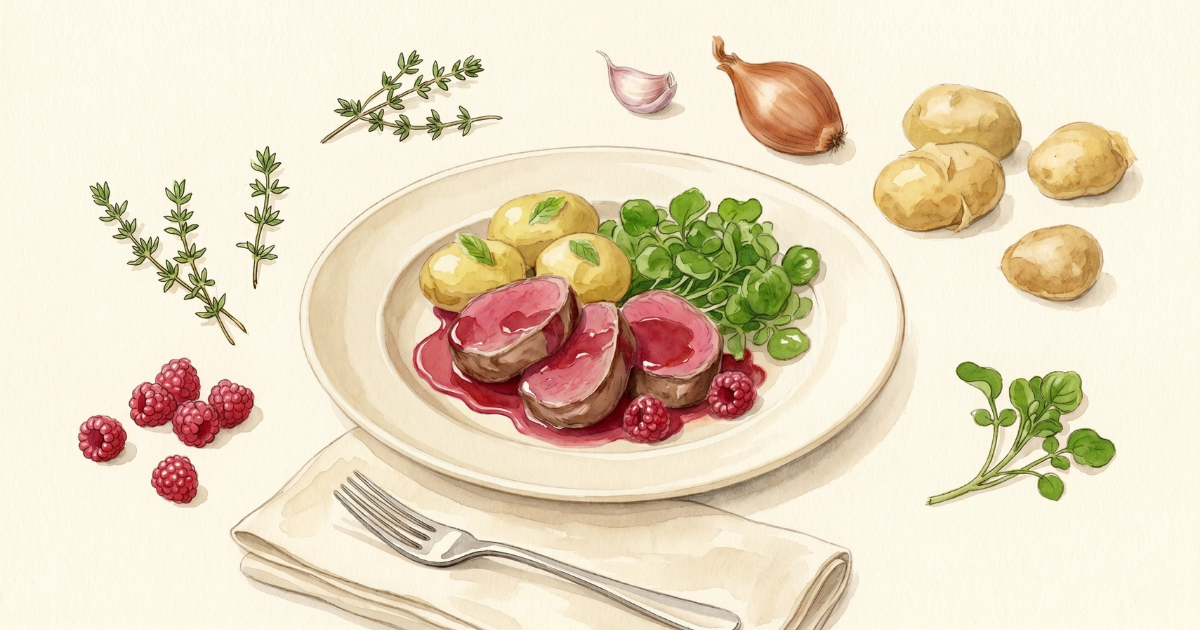
Roe is the small native deer of British woodland, and its bucks come into season in April and stay there through the summer, which is why a good butcher may have roe when other venison is out. It is a different meat from red deer: finer in the grain, leaner, more delicate, and quick to dry out if it is cooked as though it were a haunch of red. That single fact governs everything about handling it. Mrs Beeton understood it in 1861 and built her roe cookery around gentleness; the modern exception is the loin, which rewards the opposite treatment, a fierce short sear and a long rest. Either way the rule, set out in the week's Larder in The Lengthening Light, is the same: keep roe rare, or do not cook it at all.
A different deer from red
The distinction is not snobbery, it is chemistry. Roe is a small animal, its muscle fine-grained and low in fat, so there is little marbling to keep it moist and little connective tissue to break down slowly. Cook a small roe joint fast and hot, as you would a fatty roast, and it tightens and dries before the middle is done. The two ways round this pull in opposite directions: cook it long and wet so the meat stays surrounded by liquid, or cook it very briefly and serve it rare. What does not work is the middle ground, the ordinary roast, which is exactly long enough to spoil it.
Mrs Beeton's hash
Isabella Beeton, in the Book of Household Management of 1861, treats roe as its own proposition and recommends hashing it. The joint is sliced thin and simmered gently in a gravy built on port wine and redcurrant jelly, so the meat is warmed through in liquid rather than roasted dry. It is a sound instinct dressed in Victorian richness: keep the lean meat wet, bring it up to temperature slowly, and lift it with something sharp and sweet. The principle has not changed in over a hundred and sixty years. Lean meat wants gentleness, and a sharp fruit note to cut the gravy.
The loin exception
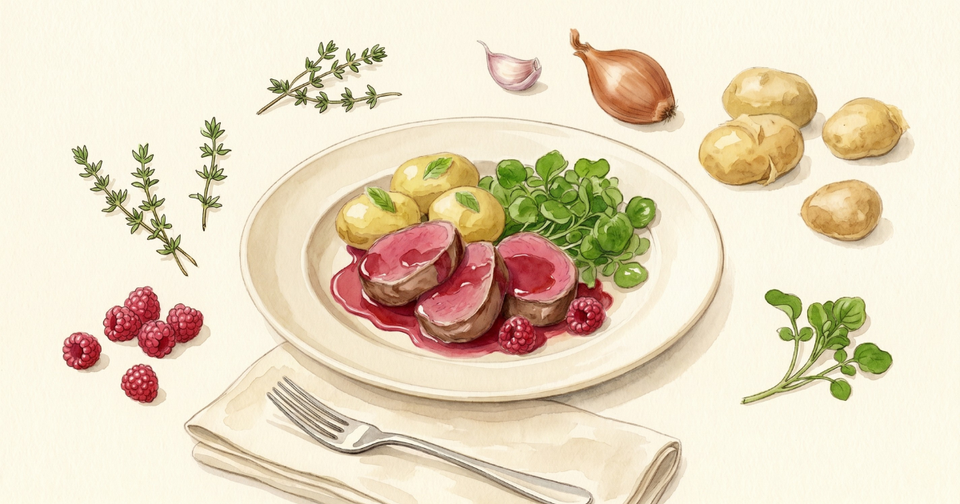
The loin is the one cut that earns the hot pan. It is the tenderest muscle on the animal, and it wants speed: a heavy pan brought to smoking, a couple of minutes on each side, then a minute basting in foaming butter with thyme and a bashed garlic clove, and off the heat at rare to medium-rare. Then it rests, and the rest is not optional. A loin wants resting for roughly twice as long as it was seared, eight minutes for a piece that took four, so the juices settle back through the meat. Past medium the loin tightens and the flavour flattens, and the whole advantage of the cut is lost.
A June sauce
The sauce is where the season comes in. With the venison resting, soften a diced shallot in the same pan, deglaze with a splash of red wine vinegar, then add stock and a handful of the first British raspberries, crushing them as the liquid simmers and thickens. Strained, it does the work Beeton gave to redcurrant jelly, sharp and fruited against the lean meat, but tuned to mid-June rather than the store cupboard. If the raspberries read too sharp, ripe redcurrants or the earliest blackberries do the same job. Serve the sliced loin with Jersey Royals boiled with mint and a handful of watercress.
Curing the second loin
If a second loin comes your way, cure it rather than cook it. Rub it all over with equal parts salt and sugar, leave it covered in the fridge for a day, then rinse, pat dry, wrap it in muslin and hang it somewhere cool and airy for two to three weeks, until it is firm right through. Sliced tissue-thin, it does what bresaola does: a dense, dark cured meat eaten raw. A roe is a small deer, a fraction of the size of a red, so a single loin is a modest piece, and curing one whole is the surest way to make it last. The deer it comes from has recovered across ground it once vanished from, and is now found in nearly every English county.
Sources: Isabella Beeton, Book of Household Management (1861); The Wildlife Trusts, roe deer.