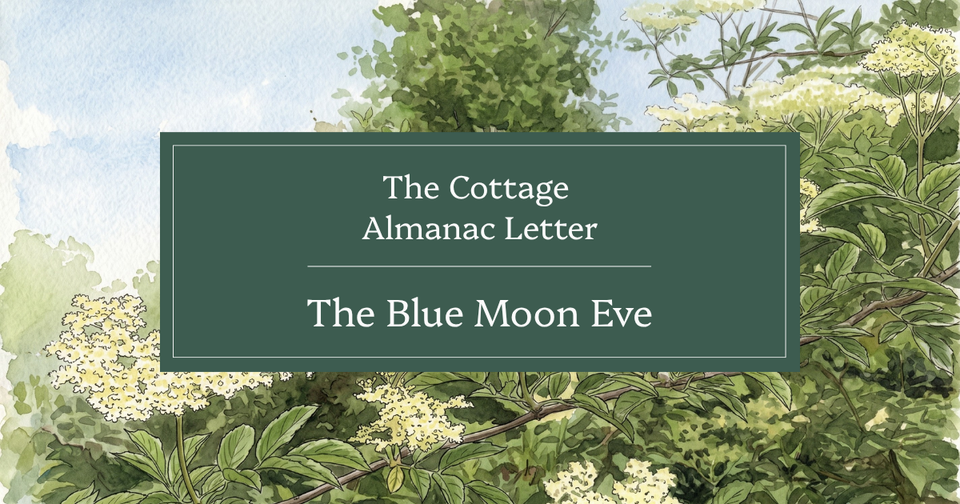
The Blue Moon Eve
The blue moon falls on Sunday morning, too late in the day to see properly, so Saturday night is the moment to look. Below it the hedges go on changing week to week: cow parsley at full height in the lanes, hawthorn going brown at the tips, the first elder coming into flower, and a Wiltshire village walking to Salisbury before dawn to keep a 12th-century woodland right alive.
On the Horizon
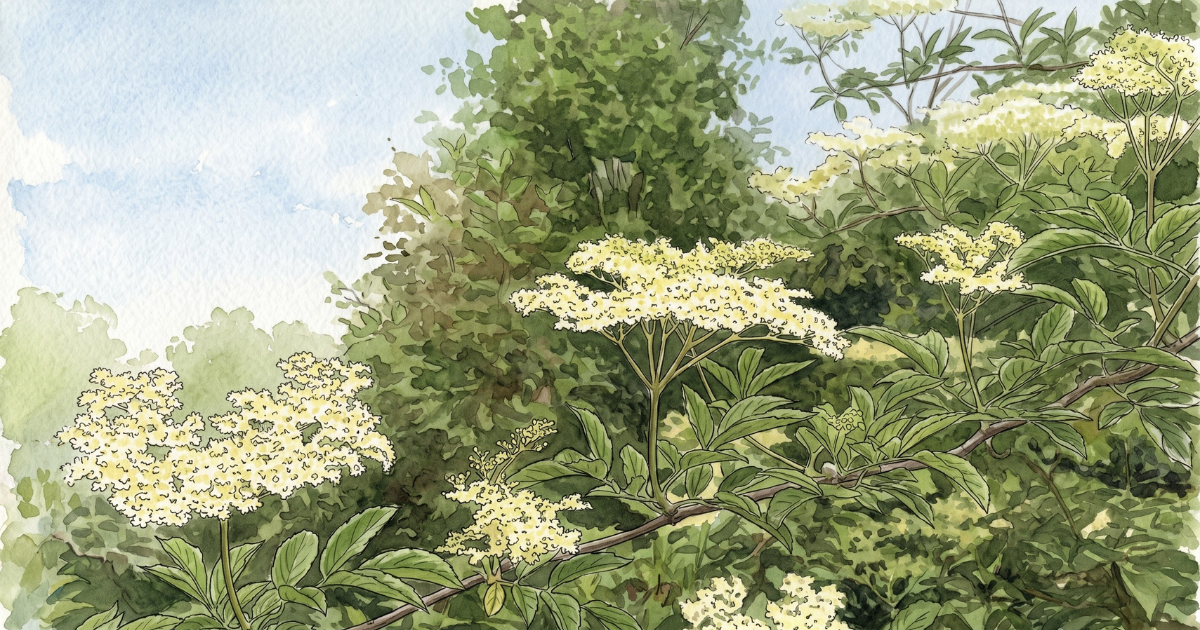
In the lanes the cow parsley is at chest height, white umbels above the verge with the hoverflies all over them. The hawthorn behind it is going brown at the petal-tips; the elder is opening only where the hedge runs south-facing. The first ox-eye daisies are up on the banks. Friday is Oak Apple Day, the restoration of Charles II in 1660, and in one Wiltshire village they will be up before dawn for it, just as they have done since at least 1603.
The Sky this Week
Sunrise 4:48 am · Sunset 9:07 pm
Moon Waxing Gibbous · Full Moon Sun 31 May, 9:45 am BST
Harwich tides Low 4:23 am · High 10:49 am · Low 4:30 pm.
Saturday night, look south. Sunday’s moon peaks at 9:45 in the morning, well past dawn in Hertfordshire, so the previous evening is the window. It is the second full moon of May, a calendar quirk that happens seven times every nineteen years, and also a micromoon – the most distant full moon of 2026, about seven per cent smaller than usual. It will sit close to Antares, the red giant at the heart of Scorpius, low in the southern sky.
Source: timeanddate.com (Baldock) · Royal Observatory Greenwich · UKHO EasyTide
The Curious Instance of the Grovely Forest Rights of Wishford Magna
Tomorrow morning, in a village five miles north of Salisbury, the residents of Great Wishford will wake their streets with pots and pans before dawn and walk up to Grovely Wood to claim what is theirs. The day is Oak Apple Day, 29 May. The right they are claiming was confirmed in a forest court held at Grovely in March 1603, but the inhabitants of Great Wishford had been defending it in court since 1292, and the charter itself records only that it confirms rights existing ‘from time out of mynde’.
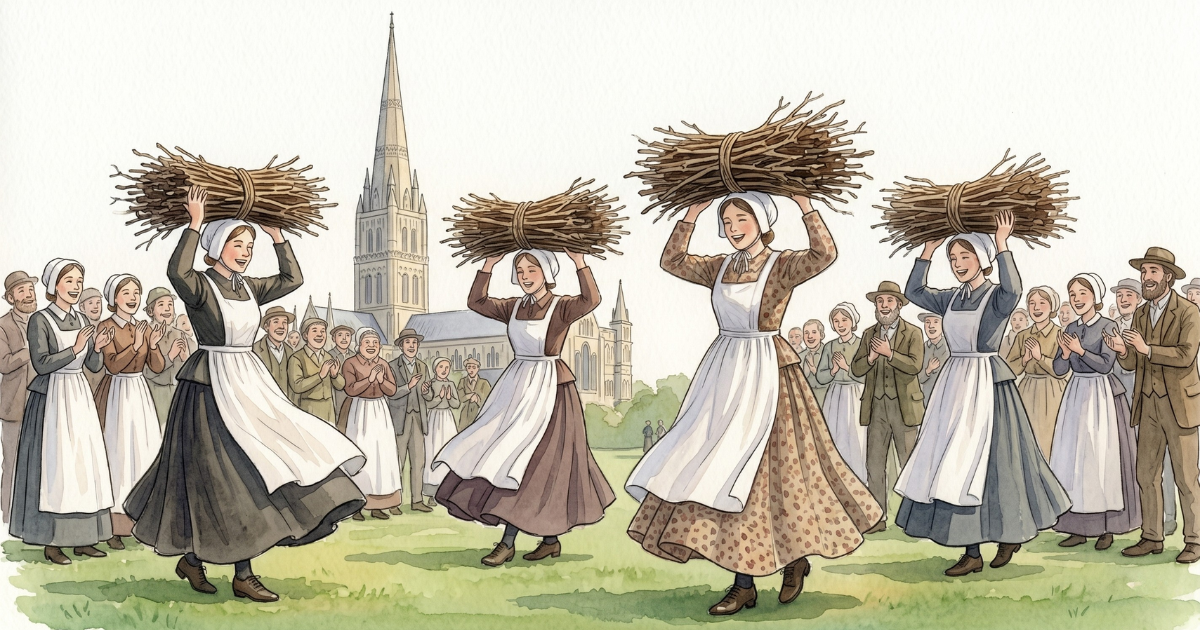
The village is woken before dawn, historically by trumpets and pots and pans clanging until every house showed a light, now at around 5.30am by anyone willing to make the noise. The villagers then walk up to the wood and cut green oak boughs, no thicker than a man’s forearm. One large bough is hoisted to the top of St Giles’s church tower as the Marriage Bough – held to bring luck to any wedding in the church in the coming year. A delegation then processes the six miles into Salisbury, where four women in nineteenth-century fieldworker costume, the Nitch Ladies, dance on the cathedral green with nitches (heavy bundles of hazel and oak twigs) balanced on their heads. The congregation enters the cathedral behind the Oak Apple Club’s banner. On the steps of the High Altar, a cathedral canon reads from the 1603 charter, and the villagers shout ‘Grovely! Grovely! Grovely! And all Grovely!’
The village has had to fight the estate to keep this access. In 1825, after the Earl of Pembroke bought the manor and prohibited wood-gathering in Grovely Wood, a nineteen-year-old named Grace Reed walked into the wood with three other women from Barford St. Martin, gathered firewood, and walked out. They were arrested, refused to pay their fines, and were committed to Fisherton Gaol in Salisbury. Local people raised the money for a lawyer; the 1603 charter was produced in court; the Earl’s prohibition was overturned. Grace Reed lived to eighty-eight at Primrose Cottage in Barford. The Oak Apple Club, which still organises the day, was founded in 1892.
If you find yourself near Salisbury on Friday, the procession leaves Great Wishford at around 10am, and the cathedral service is at midday.
The Hearth
The Elder in the Kitchen Garden
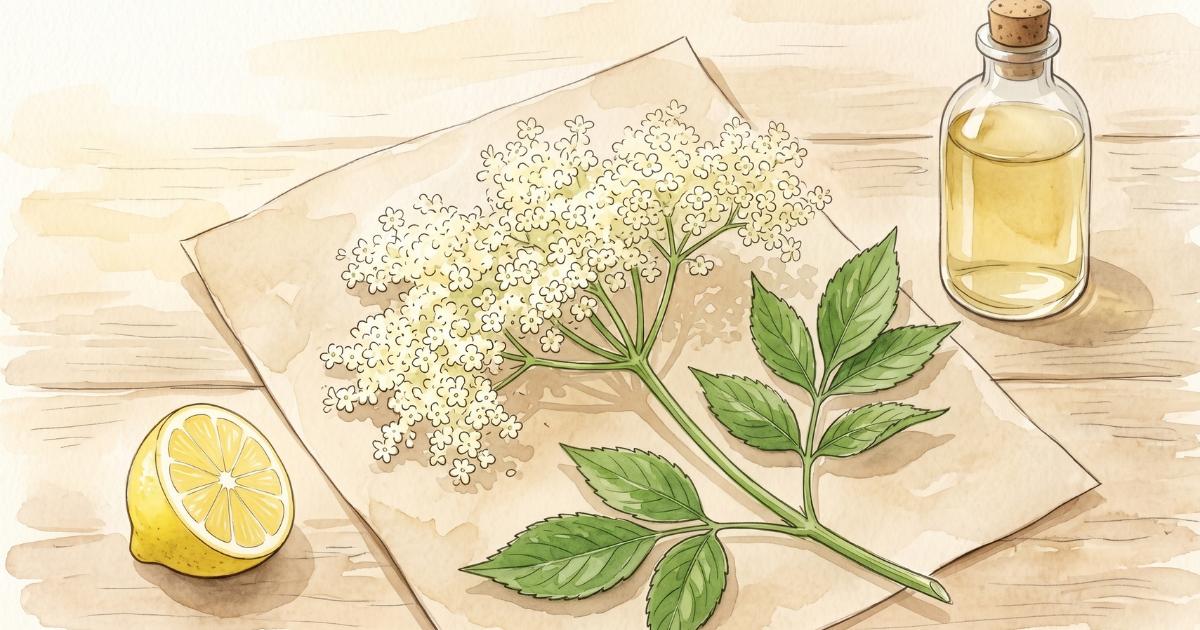
Once you have decided the elder is open, the cream lace held flat on the air and not yet drying at the edges, the kitchen calendar starts a three-week count. Then it stops. The flowers brown, the scent goes from honey-and-cat to compost, and the work is over until next year.
The domestic writers of the seventeenth and eighteenth centuries treated the elder as a major still-room subject. Hannah Woolley’s The Queen-Like Closet (1670) includes elderflower among the spring preparations: waters, vinegars, syrups, wines, the standard still-room work of any well-run kitchen. The same recipes recur in close variants in Eliza Smith’s The Compleat Housewife (1727) and in dozens of household receipt books in the Bodleian and the Wellcome that no one has bothered to print. Elder was not optional. It was the major still-room work of late May and early June.
The reason for the three-week window is in the flower’s structure. The umbel, the flat cream head, is several hundred small florets opening over about a week. For the first few days the unopened buds and the half-open florets carry most of the perfume oil; once the umbel is fully open the scent peaks for about a week; then the flowers begin to set fruit, the oils retreat into the developing berries, and the umbel browns from the centre. The work needs to happen in the middle week, on a dry morning, after the dew is off and before the heat draws the scent away.
If the elder near you has opened this week, the count has begun. Cordial freezes well in syrup. Vinegar keeps a year. Even one bottle of properly made elderflower cordial in the larder changes the back end of the year, when the cordial is what flavours apple jelly in October and turns a Christmas drink from sweet to alive.
The Garden Plot
Weather Watch
The heat eases through the week ahead. The late May Bank Holiday weekend brought temperatures past 30°C across the southeast; by Thursday the air over Hertfordshire is several degrees cooler as the high pressure moves away. Daytime highs settle back to the low 20s, with mild nights and light winds. Some showers are possible from Friday into the weekend as the heat breaks – the ground is dry, and what falls will sink in fast. Beds that came out of the heatwave parched need a soaking before any new sowing, ideally a slow watering at the base of plants rather than over the leaves.
For the Longer Game
Stake peonies, delphiniums and tall perennials before they need it rather than after they have flopped. Canes and string now take ten minutes; the same job after a June storm takes an hour and the stems are already kinked.
This Week
The chive flowers stand pink and round on their stems now – pinch off a handful, drop them whole into a jar of white wine vinegar, and cap it. By morning the vinegar has turned pale rose and tastes of onion. Use it for vinaigrettes through summer. The flowers go over within two weeks; the vinegar keeps for a year.
Maintenance
Tie in clematis, sweet peas and climbing roses before they make a tangle of themselves. A weekly five minutes with soft string in late May saves a frustrating hour of unpicking in July.
The Larder
Fresh sheep milk cheese
Dorothy Hartley, writing in Food in England (1954), describes sheep milk cheese as the standard product of the upland summer farms – the Welsh hafod and the equivalent Scottish shielings – where the sheep were milked twice a day during the peak of the spring grass. The cheeses were fresh, often crumbly, hand-turned in wooden vats, and eaten within days. They were the protein staple of shepherd families through the early summer months and kept for a fortnight at most.
Honey and Thyme Sheep's Cheese with Green Tabbouleh
Ingredients
- 2 tomatoes
- 150g bulgar wheat
- 1 tsp mixed spice
- 1 red onion
- 1 unwaxed lemon
- 1 cucumber
- 50g rocket
- A handful of mint, leaves only
- 100g soft sheep's cheese
- 40g honey
- A handful of thyme, leaves only
- 1 tbsp olive oil
- Sea salt and freshly ground black pepper
Method
- Heat the oven to 200°C / fan 180°C / gas 6. Line a baking tray with baking paper. Cut each tomato into six thin slices and lay them in a single layer on the tray. Drizzle with half a tablespoon of olive oil and a pinch of salt and pepper. Roast for 35 minutes.
- While the tomatoes are in, tip the bulgar wheat into a bowl. Sprinkle in the mixed spice and a pinch of salt. Pour over enough boiling water to cover by a centimetre, cover with a plate, and leave to soak.
- Peel and very finely chop the onion. Tip into a large bowl with the zest and juice of the lemon and a pinch of salt. Stir to mix and leave to soften.
- Peel and halve the cucumber lengthways. Scoop out the seeds with a teaspoon and discard. Finely chop the cucumber and place it on top of the onions, but do not stir it in. Finely chop the rocket and add. Shred the mint leaves and add those.
- Break or chop the sheep's cheese into a small bowl. Drizzle over the honey, scatter over the thyme leaves, and crack over plenty of black pepper.
- Drain the bulgar wheat if any water remains. Fold it through the onion, cucumber and rocket, mixing everything together. Drizzle in another half tablespoon of olive oil. Taste and season.
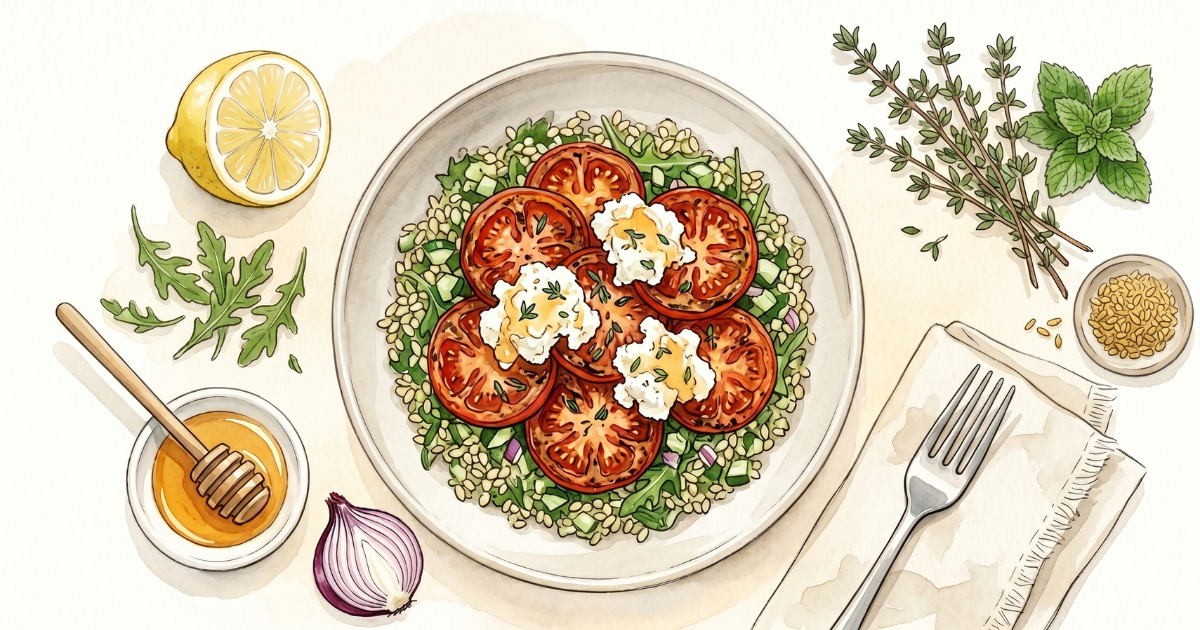
- Pile the tabbouleh onto two plates. Top with the roast tomatoes and the dollops of honeyed cheese. Drizzle over any juices from the bowls and serve.
The cheese and honey hold as a single sweet-salt element; the tabbouleh underneath carries the acid and freshness from the lemon and mint; the roasted tomatoes are the warm anchor that ties the two together.
For long keeping, the traditional method is brine. Salt the curds heavily, press them into rounds, drain overnight, then submerge in a strong brine in a jar in the larder. They will keep for months and sharpen as they age. If you want a brined version today, look to England: Sussex Slipcote, the fresh brined sheep cheese from the High Weald Dairy, and Berkswell from the West Midlands, the hard-aged version of the same tradition.
The Still-Room
Cowslip

Cowslip patches, where they still exist, are in flower this week and the working window is short. Cowslip (Primula veris) used to grow in every English meadow and now does not. Most of the lowland populations were lost in the nineteenth and twentieth centuries to ploughing, drainage, fertiliser, and over-collection; one of the things being collected, the thing that put the most pressure on the plant in the eighteenth and nineteenth centuries, was the flower-pip for wine.
Cowslip wine was a domestic standard from the seventeenth century onwards, used as a mild sedative and nerve tonic – the country alternative to laudanum for women’s nerves in the period before Victorian opiates became cheap. The plant also carried older meanings in English folk botany: the cluster of yellow florets was read as a bunch of keys held by St Peter, the keys of Heaven. A girl who placed a cowslip-ball under her pillow on a full-moon night in May, according to Aubrey’s Miscellanies (1696), would see her future husband in a dream. The flowering coincided with the marriage-banns season of early summer.
Cowslip Wine
after Florence White, Good Things in England (1932)
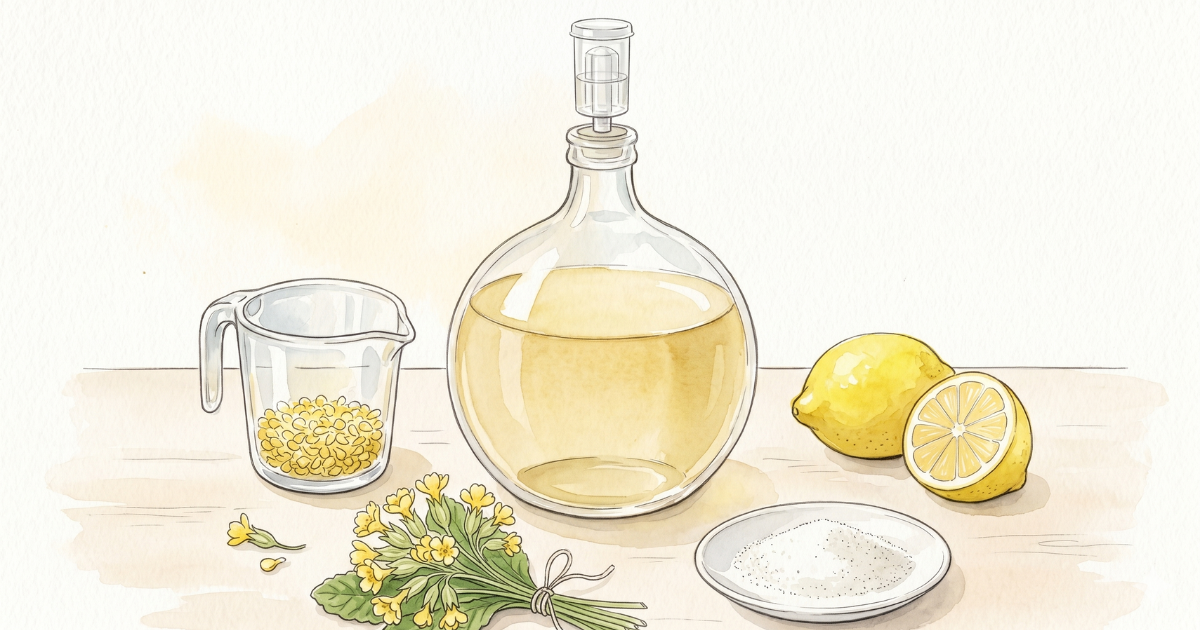
For a gallon of wine you need about a gallon of cowslip pips – the small yellow tube of each individual floret, separated from the green calyx. (This is the slow part: it takes a long afternoon.) Put the pips into a fermenting vessel with four pounds of sugar, the thin pared rind and juice of two lemons, and a gallon of boiling water. Stir until the sugar dissolves and leave to cool to blood heat. Stir in a sachet of brewer’s yeast, cover, and leave in a warm place for ten days, stirring daily. Strain into a demijohn under an airlock and leave to ferment to dryness, about three months. Rack into bottles. Drink at one year. Most cowslip patches will be in flower for another fortnight at most. After that the pips dry and the flavour is gone.
The Weekend Walk
The Cow Parsley Lane
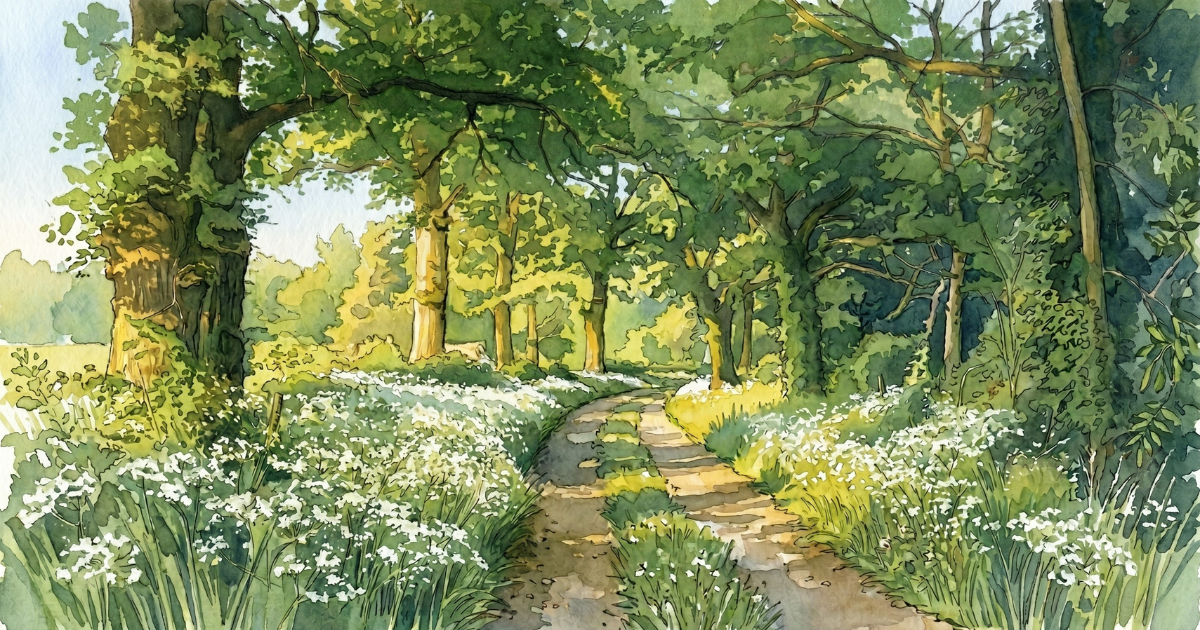
If you can get to a hedged lane in the next four days, this is the week for it. Cow parsley (Anthriscus sylvestris) is at full height now, chest height in a sheltered lane and head height in some of the deeper West Country lanes. The flat white umbels are out in their hundreds of thousands. Walk one in early evening, between six and nine, when the sun is going down behind the hedge and the side-light catches the flowers white against the dark of the leaves.
Stand still for two minutes once you are in. The hoverflies are working the umbels – most of them Episyrphus balteatus, the marmalade hoverfly, with orange and black bars on the abdomen. The bumblebees are using the same flowers more cautiously, taking nectar from the edges. The smell of the leaves where they brush your legs is faint aniseed.
Look for the first culverkeys at the base of the hedge – the small gaps cut by badgers and foxes coming and going. The cow parsley masks them in full daylight; in the evening light, they are easier to spot.
An Old Word for it
Culverkeys (n., Sussex dialect) – a gap in the base of a hedge made by the regular passage of a small animal: badger, fox, hare, dormouse. Recorded by Robert Macfarlane in Landmarks (2015) from a local Sussex naturalist. Specifically, a culverkey is the worn-through gap kept open by regular animal use; a random hole in a hedge does not qualify. Worth looking for at the base of any settled hedge on a walk this week, especially the kind where the cow parsley grows tallest.
In Good Report
A piece of news worth passing on, from this week.
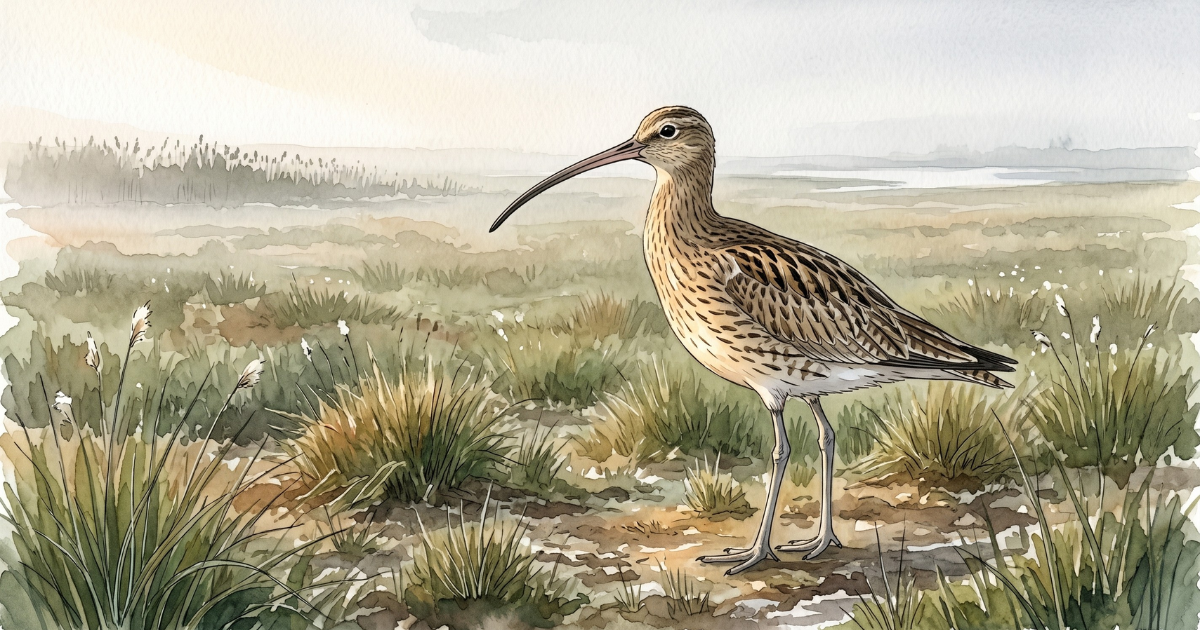
Last week, RSPB Northern Ireland announced the acquisition of Inishcreenry, a 60-hectare nature reserve in the heart of County Fermanagh. The site is lowland wet grassland, fen and reedbed – the specific kind of damp, insect-rich ground that breeding curlew, snipe and redshank need for their chicks to survive. Inishcreenry was historically one of Northern Ireland's most important sites for these species, before a century of drainage and pasture improvement took it apart. Curlew numbers across Northern Ireland have fallen by more than eighty per cent since 1987. Restoration begins now: opening up dense rush and creating wet features in the fields to restore the damp insect-rich habitats that chicks need. Inishcreenry is the first RSPB nature reserve on farmland at Upper Lough Erne. RSPB + 4
Source: RSPB Northern Ireland · PeacePlus Nature
The Turning Wheel
What's coming, in the next fortnight.
29 May – Oak Apple Day. Royal Oak Day, the restoration of Charles II in 1660, the day of the Grovely procession to Salisbury and the Castleton Garland on its tower.
1 June – the start of meteorological summer.
4 June – Appleby Horse Fair, the annual Gypsy and Traveller gathering in Cumbria, opens for a week.
7 June – Open Farm Sunday. Farms across Britain open their gates to visitors for the day; this year is the twentieth anniversary of the event.
Yours, until next Thursday.
Meg.