Culverkeys: The Sussex Word for an Animal-Made Gap in a Hedge
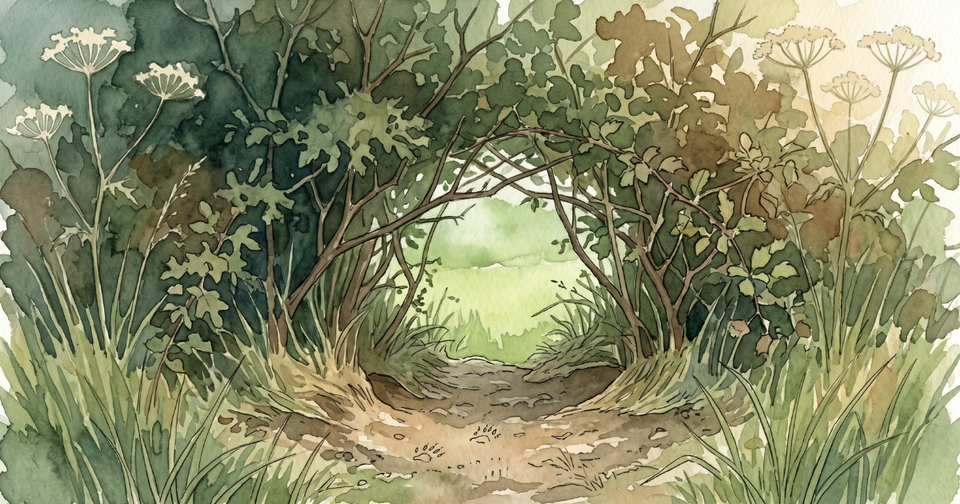
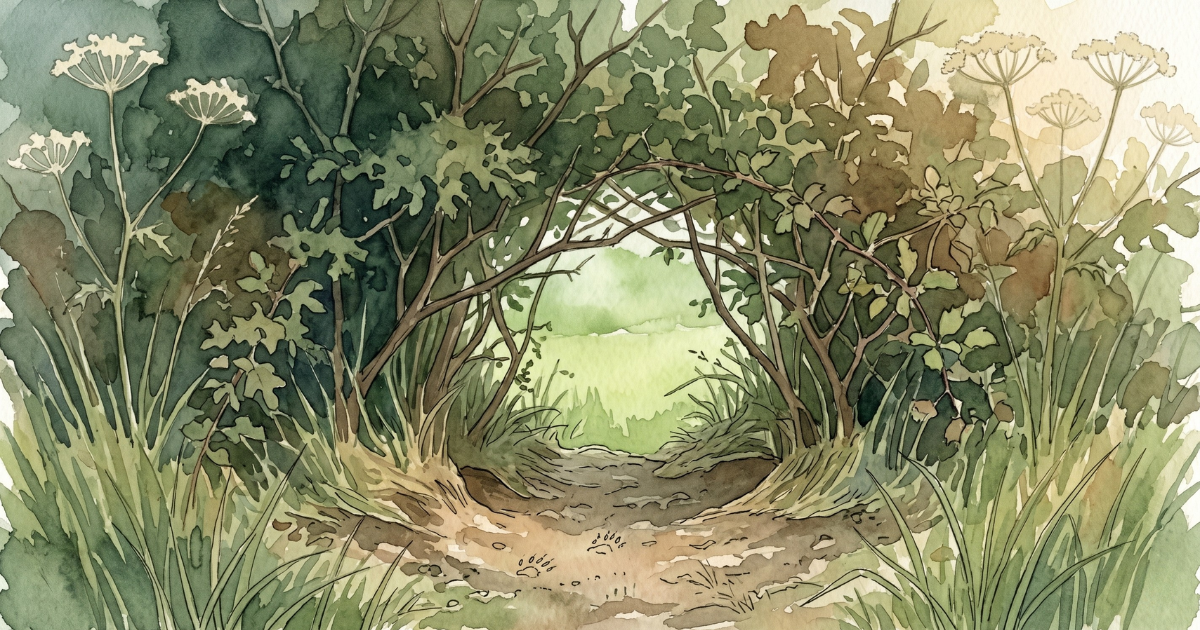
A culverkey is the gap at the base of a hedge made by the regular passage of a small animal – badger, fox, hare, dormouse – kept open by use rather than cut by hand. The word is Sussex dialect, recorded by Robert Macfarlane in Landmarks (2015) from a local naturalist. A culverkey is the worn-through gap kept open by animal use; a random hole in a hedge does not qualify. Once you have the word, you start to see them everywhere.
The definition
The defining feature of a culverkey is regular use. A hole made by a tractor catching a hedge corner, or a gap kicked open by a child, is not a culverkey. A culverkey is the gap kept clear by an animal that passes through it most days or most nights – the worn channel through the bramble, the wet earth or grass-flattened soil at the base where the body brushes through. The word carries the use.
Where culverkeys form
Culverkeys form most readily in hedges that connect two pieces of habitat the animal moves between – a wood and a field, a copse and a stream, a garden and a brook. The hedge sits across the animal's regular route, and the animal pushes through the same point each time. Over weeks the gap forms; over months it consolidates into a recognisable channel.
Identifying a true culverkey
A true culverkey shows three features. The gap goes all the way through the hedge – not a single-side hole. The ground at the base of the gap is bare or flattened, with vegetation worn away on the route through. And there is usually some sign of regular passage: fur on the bramble, footprints in soft ground, droppings nearby, confirming the animal is still using it. A gap that meets two of the three is probably a culverkey; one that meets all three certainly is.
Who makes them
Badgers are the commonest authors of culverkeys in lowland England. Badger tracks are typically forty centimetres wide and the same height, and the gap shows the round-shouldered pushing-through of a heavy-bodied animal. Foxes use smaller, narrower gaps, often under brambles where the badger would not fit. Hares prefer wider gaps on field margins. Rabbits make low burrow-mouth gaps in the base. Dormice, where they still exist, use small, high gaps in the dense interior of an old hedge – these are hard to see and harder still to confirm.
What culverkeys tell you
A hedge with several culverkeys is a hedge that is being used. The presence of regular animal trails indicates the connecting habitat on either side is also being used; the absence of culverkeys can mean the hedge is too dense for the local fauna to push through, too isolated to be on anyone's route, or too sterile to support the animals that would normally use it. Hedgerow ecology is partly visible through the gaps in the structure.
Robert Macfarlane in Landmarks
Macfarlane recorded culverkeys in Landmarks (2015), his project to gather and protect English regional words for the natural world. The word came to him from a local Sussex naturalist; the spelling and the precise definition are Macfarlane's. The project documented the loss of regional vocabulary – terms for specific kinds of frost, weather, plants, animals, that the Oxford Junior Dictionary had removed from its pages in 2007 to make room for "broadband" and "voicemail."
The wider Landmarks project
Landmarks runs to nine glossaries covering moorland, hill, wood, water, mountain, edge, undertow, the cloud, and the dark. Each gathers the regional terms in active or near-active use across Britain and Ireland. Macfarlane's argument is that specific language for a place produces specific attention to it – that "yarpha" (peat that has accumulated to a particular thickness over a particular kind of underlying rock) is not interchangeable with "peat," and the loss of the word impoverishes the looking.
Finding culverkeys on a walk
Most settled hedges have at least one. Look at the base of any hedge where it abuts open ground – a field, a track, a verge. Look for the worn-through gap that goes all the way through. Look at the base for evidence of use – flattened grass, exposed earth, prints in mud after rain. Once you find one, the rest of the hedge starts to read differently; you begin to notice the routes the animals are taking through the landscape, which is information that was always there but invisible without the word.
Sources: Robert Macfarlane, Landmarks (2015); People's Trust for Endangered Species; Sussex Wildlife Trust; Hedgerows Regulations 1997.