The Elderflower Window: The Three Weeks That Shape the Still-Room Year
Once the elder is open, the cream lace held flat on the air and not yet drying at the edges, the kitchen calendar starts a three-week count. Then it stops. The flowers brown, the scent shifts from honey-and-cat to compost, and the work is over until the following year. Hannah Woolley wrote about this in 1670; Eliza Smith in 1727; the receipt books in the Wellcome and the Bodleian record dozens of close variants. Elder was not optional. It was the major still-room work of late May and early June.
Identifying Sambucus nigra
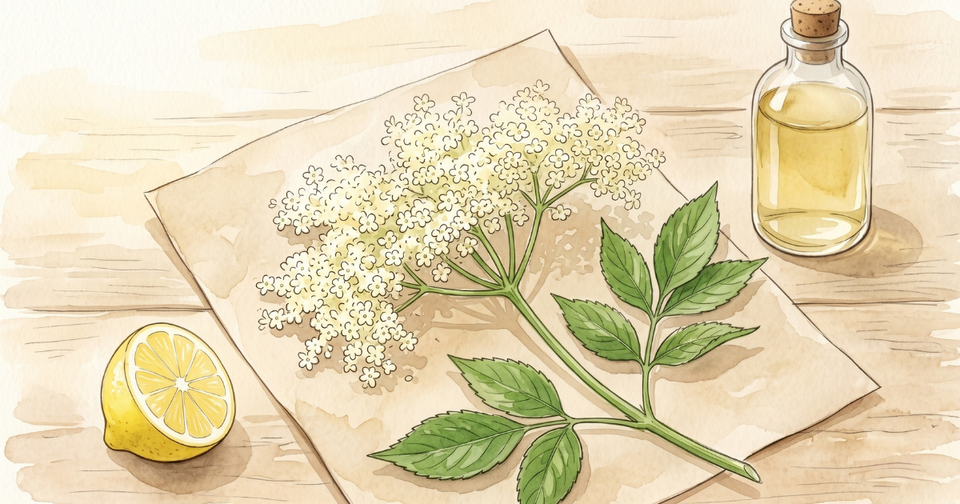
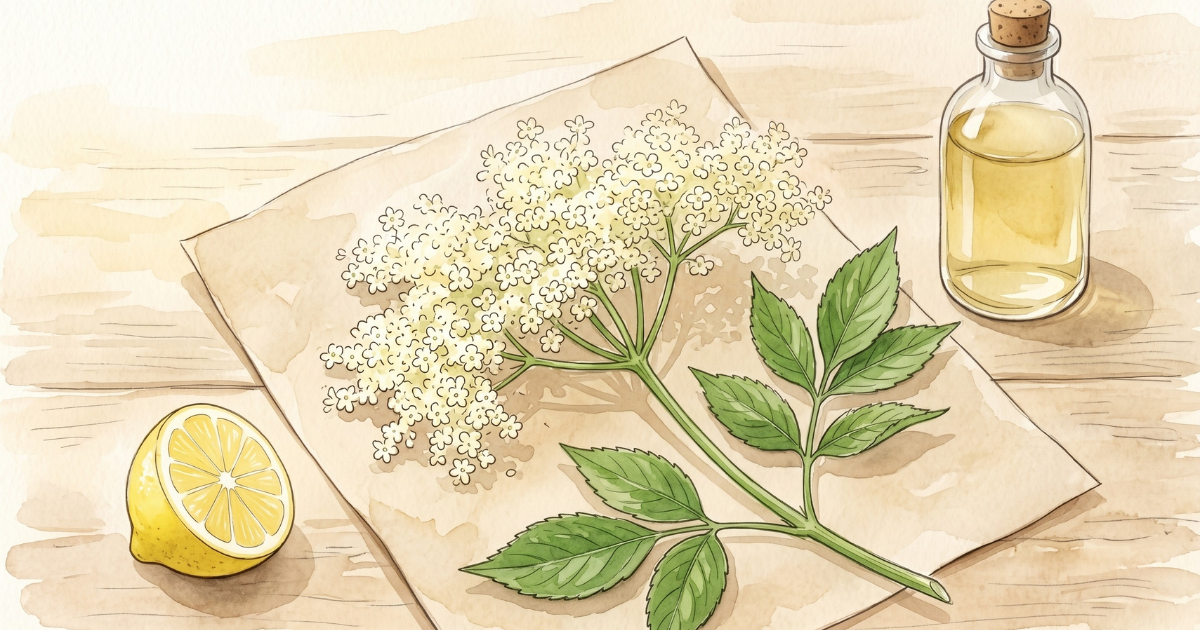
Common elder is a shrub or small tree, four to ten metres high, with pinnate leaves of five to seven oval leaflets and large flat-topped umbels of small cream-white flowers in late May and June. The umbel is the identifier: a flat plate of hundreds of tiny florets opening together. The bark is grey-brown and corky; the wood is pithy inside. Elder grows on disturbed ground, in old hedges, on the edges of woodland, and on village banks. It is one of the commonest hedgerow shrubs in lowland England.
The three-week window
The umbels open over about a week, hold their scent at peak for about a week, then begin to set fruit and the umbel browns from the centre outward. The whole window from first opening to brown is about three weeks. The fortnight from full opening to first signs of browning is the still-room week – the time to pick, the time to make cordial, the time when the flowers are worth processing.
The umbel chemistry
Each umbel is several hundred small florets opening over about a week. For the first few days the unopened buds and the half-open florets carry most of the perfume oil. Once the umbel is fully open the scent peaks for about a week. Then the flowers begin to set fruit, the oils retreat into the developing berries, and the umbel browns from the centre. The work needs to happen in the middle week, on a dry morning, after the dew is off and before the heat draws the scent away.
Picking conditions
Pick on a dry morning, between nine and eleven, after the dew has dried. Cut whole umbels with sharp scissors or secateurs. Choose umbels where the centre florets are fully open and there is no browning at the edges. Avoid umbels with insects already inside – they will multiply in the cordial. Pick from waist height up, away from busy roads, and from places you have permission to pick. A handful of umbels makes a litre of cordial; you do not need many.
Hannah Woolley, 1670
The Queen-Like Closet, published in 1670, includes elderflower among the spring still-room preparations: waters, vinegars, syrups, wines, and conserves. Woolley's recipes assume a household with a still-room, a fire, and time. They are recipes for the well-run kitchen rather than the cottage, but the practice was widespread enough that the recipes were copied and recopied in household receipt books across England. Woolley's elderflower cordial recipe is recognisable to anyone making the same drink today.
Eliza Smith, 1727
The Compleat Housewife, published in 1727 and reprinted many times through the eighteenth century, includes the same elderflower preparations as Woolley in close variants. By Smith's time the recipes were household-standard. The book ran through eighteen editions and was the most widely-owned domestic manual in England until Mrs Beeton replaced it. Smith's elderflower wine, in particular, is the recipe the receipt books copy most often.
The receipt book tradition
The Wellcome Library and the Bodleian hold hundreds of household receipt books from the seventeenth and eighteenth centuries containing close variants of the Woolley and Smith elderflower recipes. The cordial is recognisable; the wine, the vinegar, the syrup are recognisable. Households copied recipes from one another and adjusted them locally – a household in Norfolk would write down the elderflower wine recipe with its own measurements; a household in Devon would use the same recipe with different quantities and a slightly different yeast. The work was domestic, communal, and continuous.
What to make
Cordial is the standard preparation: sugar syrup, fresh umbels, lemon, citric acid, steeped for a day or two, strained, bottled. Vinegar is umbels in white wine vinegar, steeped two weeks, strained, bottled. Syrup is like cordial but more concentrated. Wine is the domestic alcohol – requires a demijohn and a year of waiting. Conserve is flowers in sugar, like the preserved violets of the same period. The cordial is the one most households still make; the others are within reach of anyone who already has the basic kit.
The year's anchor
A single bottle of properly-made elderflower cordial changes the back end of the year. The cordial is what flavours apple jelly in October, lifts a tarte tatin, sweetens a chamomile tea on a sick day, makes a Christmas drink taste alive instead of merely sweet. The elder work in late May and early June carries through to the end of the cooking year. One afternoon in the kitchen now is one bottle on the larder shelf at Christmas.
Safety note
Elderflower must be cooked, fermented, or treated with acid before being used. Raw flowers are mildly toxic; the leaves and bark more so. Cordial-making boils the syrup, which inactivates the cyanogenic glycosides responsible. Wine and vinegar both rely on fermentation, which has the same effect. Never eat fresh elderflowers raw, however appealing the umbel looks. The berries in autumn must also be cooked – raw elderberries cause stomach upset, but a few minutes of simmering renders them safe.
Sources: Hannah Woolley, The Queen-Like Closet (1670), Project Gutenberg; Eliza Smith, The Compleat Housewife (1727), Internet Archive; Plantlife species note: Sambucus nigra; RHS Sambucus nigra.