Cowslip: The Lost Meadow Flower and the Wine That Drained It
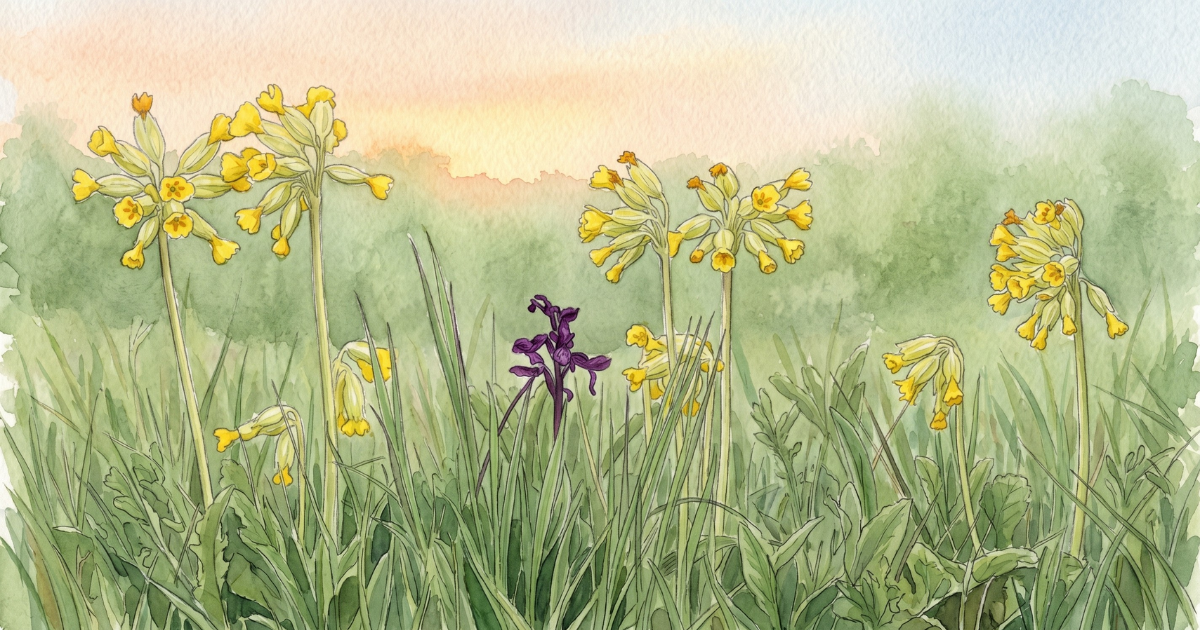
Cowslip (Primula veris) used to grow in every English meadow. Now it does not. Most of the lowland populations were lost in the nineteenth and twentieth centuries to ploughing, drainage, fertiliser, and over-collection – and one of the things being collected, the thing that put the most pressure on the plant in the eighteenth and nineteenth centuries, was the flower-pip for wine. Where cowslip patches still exist, the flowering window in May is short. The wine that drained the meadows is still made, occasionally, by people who know what they are doing.
Identifying the cowslip
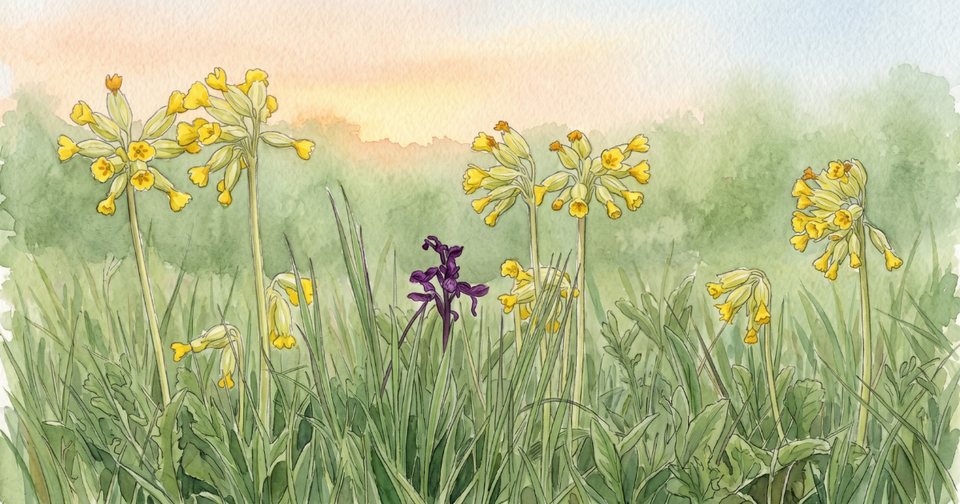
Cowslip is a small primula, ten to twenty centimetres tall, with a tight cluster of small yellow tubular flowers held nodding on a single stem above a rosette of crinkled green leaves. Each flower has five lobes and a deeper-yellow throat. The whole plant smells lightly of apricots when crushed. Cowslip is distinguishable from the closely-related primrose by its multi-flowered stem – primrose carries single flowers on individual stems – and by its apricot scent.
Where they still grow
Cowslip is now restricted to ancient meadows, churchyards, road verges, and chalk grassland that has never been ploughed. Strongholds remain in Wiltshire, Dorset, the Cotswolds, and a scatter of unimproved Hertfordshire meadows. The plant has returned in some places – verges left uncut have produced surprising populations along the M40 in particular – but the recovery is local and depends on a specific kind of land management.
The decline since 1900
Plantlife survey data show cowslip has declined by roughly ninety per cent across English lowland farmland since 1900. The cause is straightforward: improved pasture – drained, fertilised, reseeded with rye-grass – does not support cowslip, which needs short turf, low fertility, and an annual cut. The species hangs on in the corners of the landscape that nobody got round to improving. The plant has held on best where the land was too poor or too steep to be worth changing.
Cowslip wine as still-room standard
Cowslip wine was a domestic standard from the seventeenth century onwards, used as a mild sedative and nerve tonic. It was the country alternative to laudanum for women's nerves in the period before Victorian opiates became cheap. A gallon of wine required about a gallon of cowslip pips – the small yellow tube of each individual floret separated from the green calyx. This is the slow part; a gallon of pips takes a long afternoon.
John Aubrey, 1696
Aubrey's Miscellanies, published in 1696, records the folklore: a girl who placed a cowslip-ball under her pillow on a full-moon night in May would see her future husband in a dream. The flowering coincided with the marriage-banns season of early summer. The folklore reads the cluster of yellow florets as a bunch of keys held by St Peter – the keys of Heaven. Aubrey gathered these notes from informants across England in the late seventeenth century and printed them as a miscellany of country beliefs.
Florence White, 1932
Florence White recorded the standard cowslip wine recipe in Good Things in England (1932). The recipe is the same as the seventeenth-century one in close variant: a gallon of pips, a gallon of water, four pounds of sugar, the rind and juice of two lemons, brewer's yeast. Ten days of warm fermentation, three months in a demijohn under an airlock, drink at one year. White was writing as the practice was already in steep decline; her readers were saving recipes she did not expect to see made again.
The flower-pip
The pip is the small yellow tube of the floret, separated from the green calyx. It carries the colour and most of the flavour. A gallon of pips is a lot of cowslips – a single plant might produce a hundred florets in a season, so a gallon of pips might require fifty to a hundred plants. The eighteenth- and nineteenth-century practice of taking whole flowering stems for wine is what put the most direct pressure on the surviving meadow populations.
Picking ethically today
Cowslip is no longer common enough to gather for wine. If you find a flowering patch in the wild, take a single pip from each plant at most. Cowslip seed is available commercially; the right way to make cowslip wine today is to grow the plants in a meadow corner and harvest from them, not from the surviving wild patches. The seed-mix companies – Emorsgate and Naturescape are the two main suppliers – sell meadow-mix seed including cowslip.
Returning meadows
The Coronation Meadows project, launched in 2013, identified one ancient meadow per English county and is using its seed to restore meadows elsewhere. Cowslip is one of the indicator species used to measure restoration. The work is slow – meadows take decades – but in some places the cowslip has come back faster than expected once the conditions are right. The Wiltshire and Norfolk meadows are the strongest current source populations.
Sources: John Aubrey, Miscellanies (1696), Project Gutenberg; Florence White, Good Things in England (1932), Internet Archive; Plantlife species note: Primula veris; Coronation Meadows project (coronationmeadows.org.uk).