Cow parsley and hemlock – telling them apart on a May verge
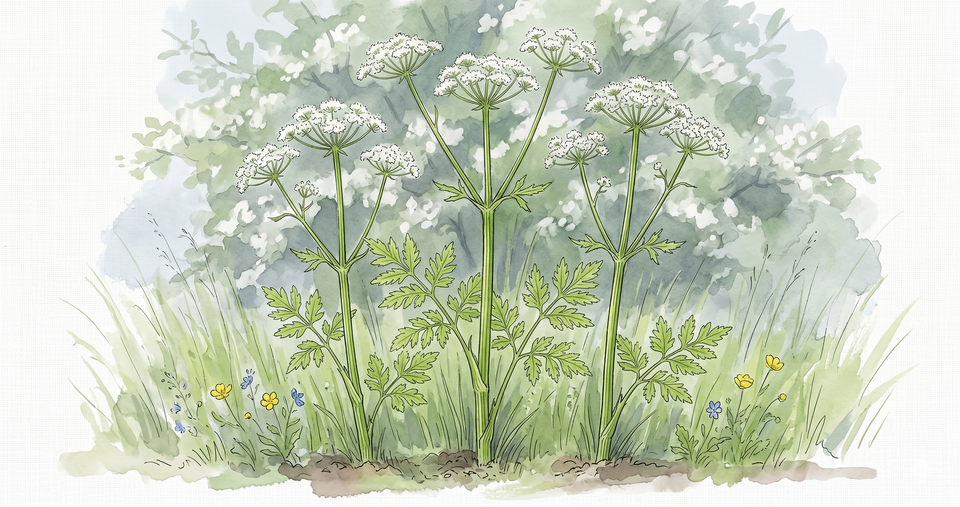
In the second and third weeks of May, the verges of an English lane carry two umbellifers in flower at the same time. Both are about waist-high. Both have a frothy head of small white flowers. Both have finely divided ferny leaves. One of them is cow parsley, which is harmless. The other is hemlock, which will kill you in a small enough dose. They are not difficult to tell apart, but the difference matters.
Cow parsley
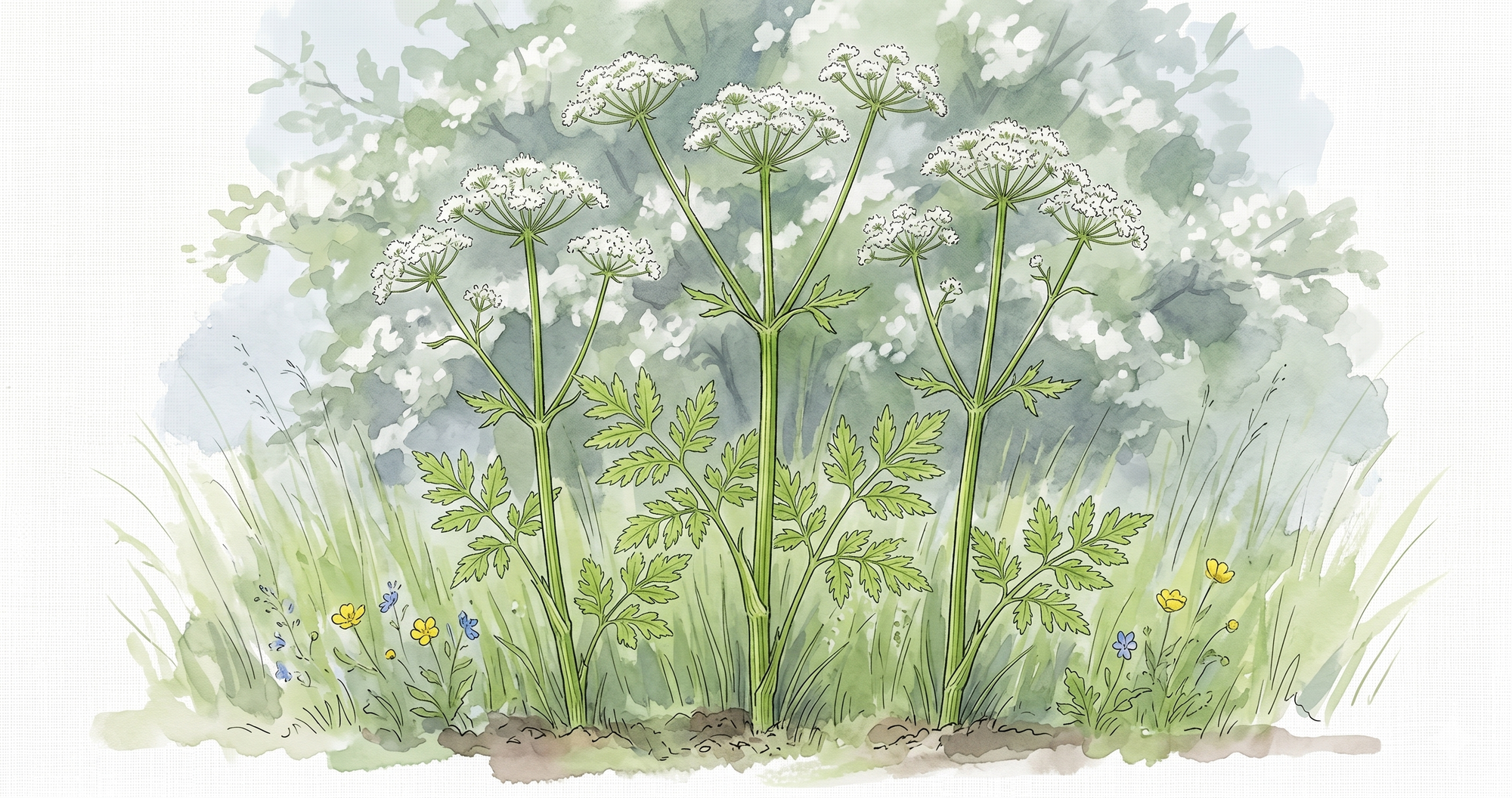
Cow parsley (Anthriscus sylvestris) is the standing white umbellifer of an English May verge. The stem is hollow, ridged, and a clean bright green; the leaves are finely divided into many small leaflets and have a faint grassy smell when bruised. The flowerheads are clean white, frothy, held on slender stalks above the leaves. The plant grows to about waist height.
Cow parsley is harmless. It is edible, technically, but not worth eating – the flavour is grassy and faint, and there are better umbellifers (alexanders, sweet cicely, wild chervil) to spend the foraging window on. Its real value on the lane is as the marker for what stage the hedgerow has reached. When cow parsley is in full flower, the hawthorn is also in flower, the swifts are back, and the year has tipped into its short overlap fortnight.
Hemlock
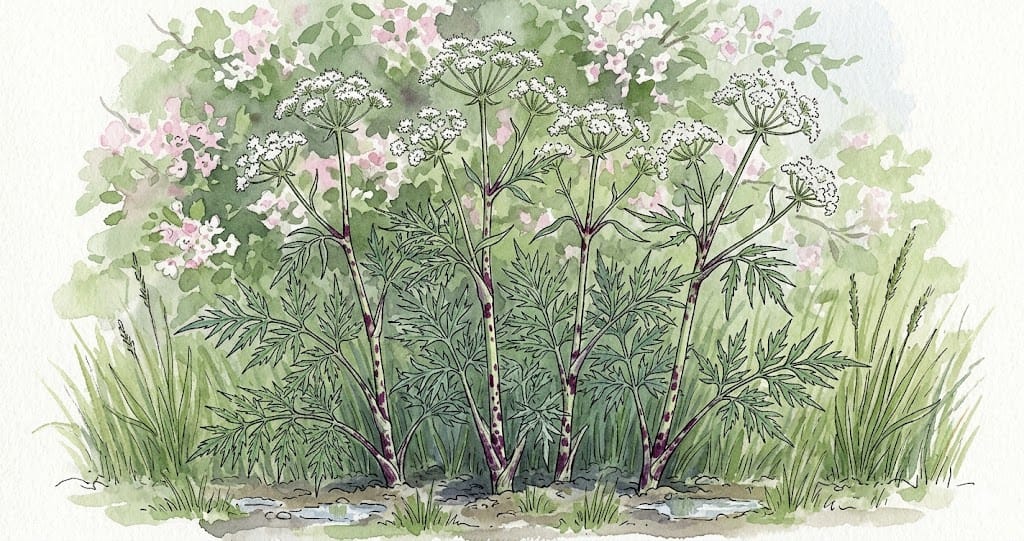
Hemlock (Conium maculatum) is the other waist-high white umbellifer of a May verge. The stem is smooth (not ridged), hollow, and pale green with distinctive purple-red blotches – often very obvious, sometimes only at the base of the stem. The leaves are finely divided, sharper-cut than cow parsley’s, and they smell unpleasant when crushed: mousy, foetid, the kind of smell you only need to learn once. The flowerheads are clean white, similar to cow parsley but slightly smaller, held on the same kind of slender stalks.
Hemlock is fatally toxic. The alkaloid coniine is concentrated in the stem and seeds, present in lower but still dangerous quantities in the leaves, and absorbed quickly through the gut. There is no safe amount to eat. Skin contact is fine; the danger is ingestion. Children pulling stems to use as pea-shooters or whistles have been poisoned, which is why country parents teach the purple stem as an absolute rule.
It grows in damp shaded ground (ditches, stream banks, woodland edges) often alongside or interleaved with cow parsley. By the second week of May the two plants are commonly in flower at the same time within a few feet of each other.
The other umbellifer relatives
Several other umbellifers are in the same family and worth knowing on a May verge.
Hogweed (Heracleum sphondylium) is taller, coarser, with broader leaves and a thick ridged stem. The leaves are not finely cut. The flowerheads are flatter and slightly off-white.
Giant hogweed (Heracleum mantegazzianum) is much taller (two to three metres), with stems streaked purple and sometimes thicker than a wrist. The sap is phototoxic on skin and the plant is best avoided in flower. Common in some river valleys; absent from most lanes.
Wild carrot (Daucus carota) flowers later in the year, June into August, and has a distinctive central dark floret in the flowerhead. Stems are bristly rather than smooth.
Ground elder (Aegopodium podagraria) is shorter, with broader less-divided leaves, and is the standard garden weed in shaded beds.
Sweet cicely (Myrrhis odorata) has the same kind of fern-like leaf as cow parsley but smells clearly of aniseed when crushed, has flat heads of small white flowers in late April rather than mid-May, and grows in shadier ground.
Alexanders (Smyrnium olusatrum) is glossy-leaved and yellow-green-flowered, easy to keep separate from anything white.
The safety summary
The rule that keeps you safe is short. Never pick a white-flowered umbellifer for the pot unless you can confidently rule hemlock out. The two reliable hemlock markers are the purple-blotched stem and the foetid smell of a crushed leaf. Either one on its own is enough to walk away from. Both together is a hemlock for certain.
The corollary: do not bring cow parsley into a kitchen where it might get confused with something edible. The risk is not the cow parsley itself but the half-bunch of unidentified umbellifer that ends up on the chopping board next to it on a busy spring afternoon.
What you can do this week
The verge changes quickly. In late April only the hawthorn buds and the alexanders are out; by the second week of May the cow parsley has filled the field edges; by the end of May the hawthorn is finishing and the hogweed is starting to come through. The overlap fortnight – cow parsley and hawthorn in flower together – is short.
On a walk this week, look at the shin and the head height. At the shin: cow parsley along the verge, hemlock in the ditch alongside it. Check stems. A purple-blotched stem at your shin means hemlock, and the answer is walk on. A clean ridged green stem means cow parsley, which is fine. At head height: hawthorn in blossom, with bees on it through any sunny half-hour. By the time you have walked the length of one field, the bats will be out and the hedgerow has tipped fully into May.
Sources: Plantlife species pages · Richard Mabey, Flora Britannica (1996) · BSBI handbook on umbellifers · NHS Poisons Information Service