The English still-room
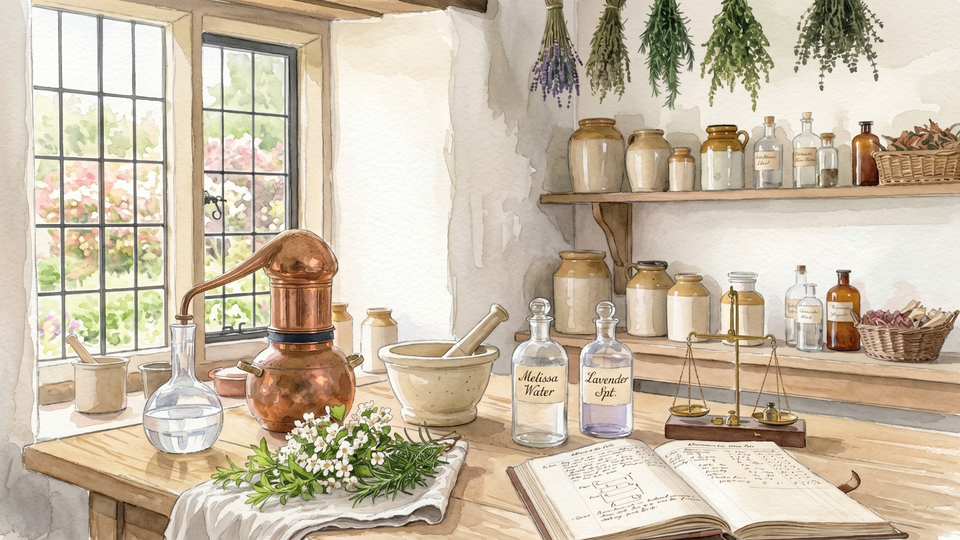
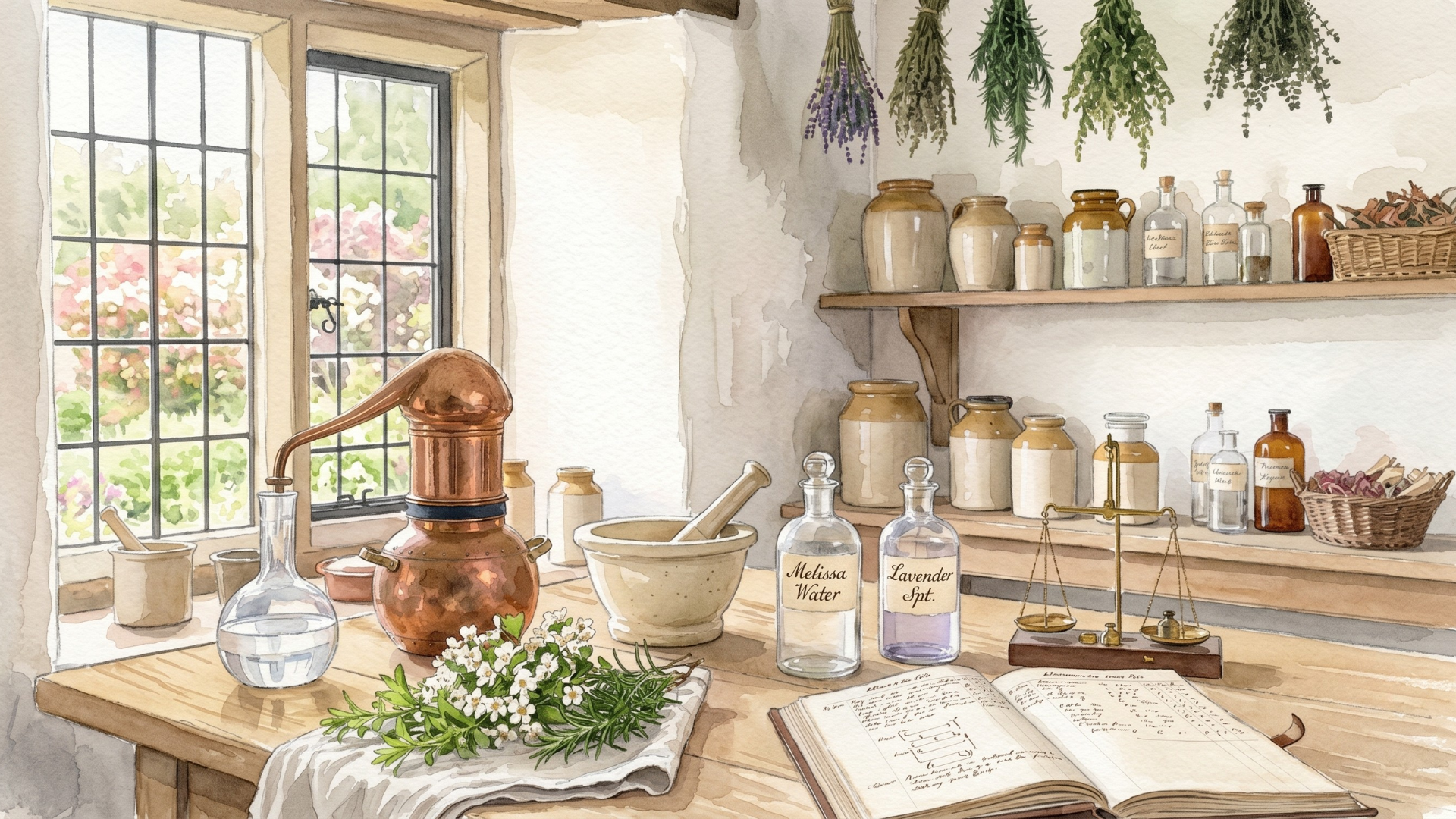
The still-room was a real room with a specific function. From the medieval period through to the early twentieth century, every country house of any size had one – a workroom set apart from the kitchen, run by the lady of the house or a senior female servant, in which the household’s medicines, cosmetics, tonics, perfumes, preserves, and household preparations were made.
The name comes from the still – the small copper distillation apparatus at the centre of the work. Floral waters, scented oils, spirits of lavender, rose water for the table and for the linen press were all distilled in the still-room. The work expanded outwards from there. By the time Hannah Woolley published The Queen-like Closet in 1670, the still-room was producing several hundred separate preparations a year in a household of any standing.
Who ran it
The still-room was women’s territory and remained so until its decline. In a great house, the still-room maid reported directly to the housekeeper rather than the cook, and the work was considered senior to kitchen labour. In a smaller house, the lady of the family ran it herself, often with a daughter learning the craft alongside her. The recipes were copied, traded, and inherited. The still-room book – a manuscript collection of receipts kept for generations – is one of the most consistent personal documents to survive from English domestic history. The British Library, the Wellcome Collection, and most county record offices hold them in numbers.
What it produced
The standing output of an English still-room covered four broad categories.
Medicines and tonics. Cordials, electuaries (medicinal pastes), syrups, and infusions for everything from a sore throat to a fever to a weak stomach. Many were genuinely effective; many were not. The line between still-room medicine and apothecary’s medicine was blurred for centuries, and the household practitioner was often the first call before a doctor was sent for.
Cosmetics and washes. Floral waters, hand creams, hair rinses, complexion lotions, tooth powders. A cleavers rinse for the scalp, a comfrey salve for bruised hands, a rose water for the face, a lavender wash for the linen drawer. The cosmetic and the medicinal often overlapped – a wash for the complexion was as likely to be valued for what it cleared as for what it added.
Preserves and confections. Fruit preserves, candied flowers, cordials for the table, syrups for cooking, sweet vinegars. The line between still-room and pantry was administrative rather than functional – the preserves came from the still-room because the still-room had the equipment.
Household preparations. Beeswax polish, soap, scenting agents for clothes presses and bedlinen, rush lights, tallow candles. The polish on the staircase, the scent of the pillowcase, the soap by the basin – all of it came from the still-room.
What survived, and what didn’t
By the late nineteenth century, the still-room was contracting. Mass-produced soap, branded medicines, and proprietary cosmetics replaced the household preparations, and the still-room maid was the first member of the female staff to disappear. By 1914 the role was extinct in most country houses; by 1939 it was extinct in all of them. What survived was the still-room book itself, often kept on the kitchen shelf as a sentimental object after the work it described had stopped.
The recipes in those books are now the basis of most serious revivals of historical English country preparation. Dorothy Hartley, working in the 1930s and writing Food in England (1954) and The Land of England (1979), recorded the last surviving practitioners she could find. Her records, alongside Maud Grieve’s A Modern Herbal (1931), are the standing reference for anyone making these preparations today.
Which preparations are still worth knowing
Several of the standard still-room preparations are entirely viable in a modern kitchen, given a clean jar, a low heat, and a willingness to wait. The Cottage Almanac runs a Still-Room section in every weekly issue, drawing on this tradition. Recent pieces include:
Cleavers rinse for the hair and scalp, after Maud Grieve. A simple infusion of fresh April cleavers, used as a final rinse after washing. The full recipe is in Issue 3, The First Swallow.
Comfrey salve for bruises and sprains, after country still-room practice. An olive oil infusion of wilted comfrey leaves, set with beeswax. Issue 4, The Cuckoo’s Arrival.
Sweet cicely cordial, after Culpeper. A May preparation, gathered from your own garden where possible. Issue 5, The May Eve.
A new preparation appears every Thursday in the newsletter. The historical sources are named; the methods are workable; the windows of seasonal availability are flagged.
Sources and further reading
Hannah Woolley, The Queen-like Closet (1670). Nicholas Culpeper, The Complete Herbal (1653). Mrs Beeton, The Book of Household Management (1861). Maud Grieve, A Modern Herbal (1931). Dorothy Hartley, Food in England (1954) and The Land of England (1979). Wellcome Collection still-room manuscripts.