Spring arrivals: a calendar of returning birds
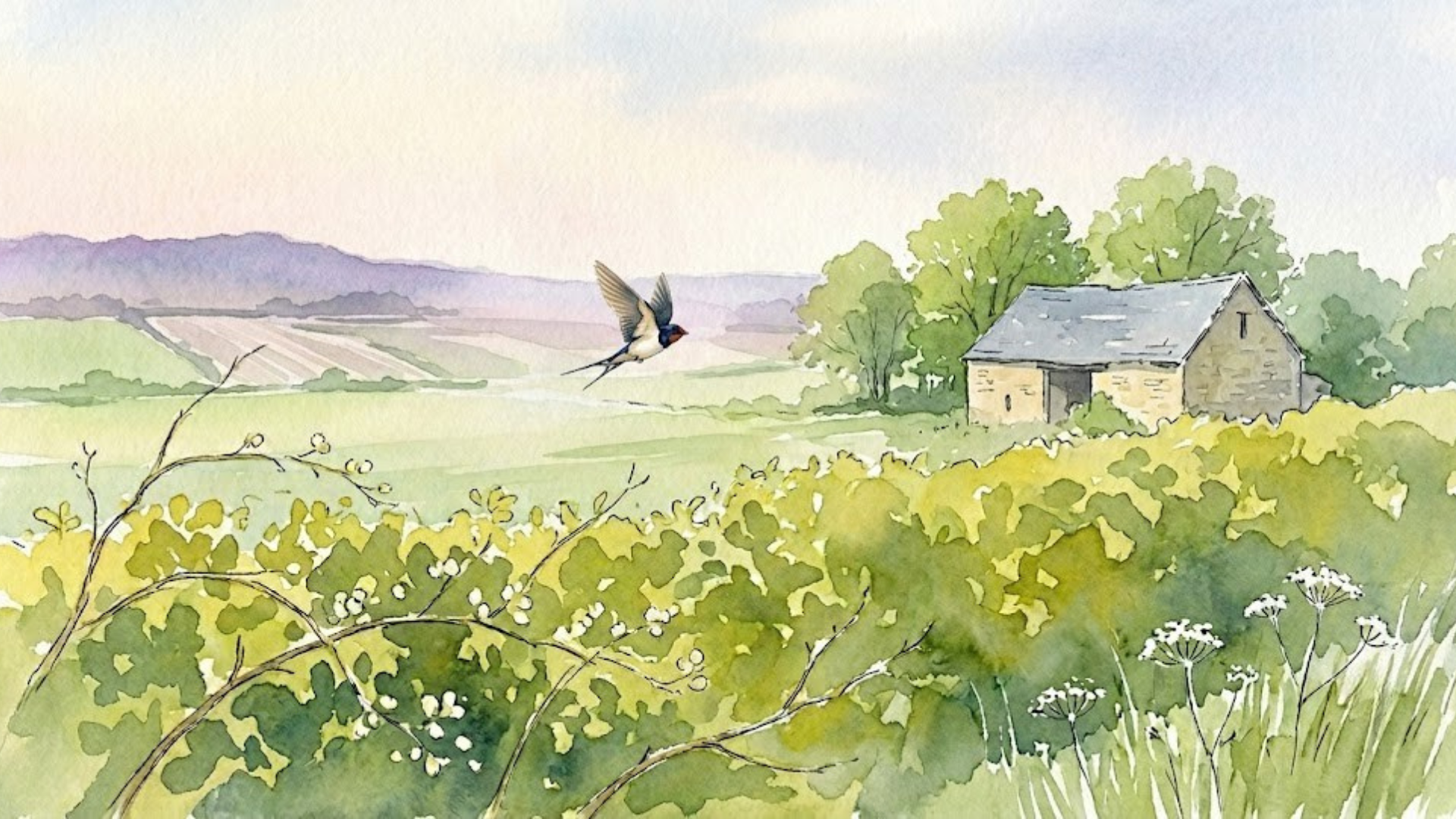
The migrant birds returning to Britain each spring are one of the few seasonal events that can still be marked precisely. The first chiffchaff of the year, the first swallow, the first cuckoo – these are all dates that have been recorded by parish naturalists, schoolteachers, and country diarists for several centuries, and the arrival pattern has held with remarkable consistency. What has shifted is the volume. The dates have not.
This is a working calendar of the main arrivals, in roughly the order they appear, with a note on what each bird tells you about the spring around it.
Mid to late March: the chiffchaff
The chiffchaff is the first migrant warbler to return, usually arriving in southern England in the third week of March. The song is its own description – two notes, repeated, “chiff-chaff-chiff-chaff” with the second note slightly lower than the first. A chiffchaff calling on a sunny morning in late March is the standard signal that the migration has begun in earnest. The bird itself is small, olive-grey, and difficult to see in still-bare branches. Listen rather than look.
Late March into April: the wheatear
The wheatear is the first long-distance migrant to reach the open uplands and the coast. The males arrive a week or two ahead of the females, conspicuous on bare turf and stone walls in the hills. Wheatears that breed in Britain have wintered in sub-Saharan Africa; some of those passing through to Greenland will fly a further two thousand miles before they stop. The white rump in flight is the reliable identification feature.
Early to mid-April: the willow warbler
Two or three weeks behind the chiffchaff, the willow warbler arrives, and the two species are visually almost identical. The song is the difference – a long, descending phrase that runs for several seconds and falls away at the end, quite distinct from the chiffchaff’s two-note call. Where chiffchaffs prefer mature woodland, willow warblers favour scrub and woodland edge. By mid-April both birds are in song across most of Britain.
Mid-April: the first swallow
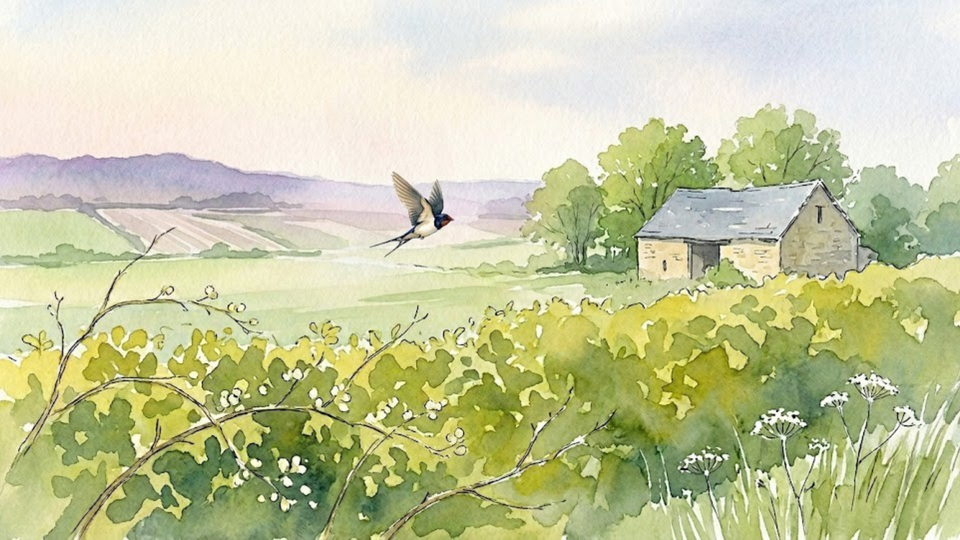
The first swallow of the year is the signal most country naturalists watch for, and the date varies more than most. A swallow in early April is unusual but not rare; mid-April is the standard window in southern England; the swallows in Scotland may not arrive until the first week of May. Swallows have flown roughly six thousand miles from southern Africa, at an average of twenty miles an hour, navigating by sun, stars, and the magnetic field. They return to the same barn, the same field, the same stretch of hedge year after year.
The arrival of the first swallow was the framing for Issue 3 of The Cottage Almanac, The First Swallow, which set out the relationship between the swallow and the south-facing hedge it hunts above.
Late April: the cuckoo
The cuckoo arrives in the last week of April with a precision that has held across centuries. A cuckoo heard before the middle of April is an early bird; the absence of the call into May indicates a cold spring and a delayed insect hatch. The two-note phrase is a territorial call, and the territory is open ground – heathland, scrub, water meadow. A cuckoo on a Surrey heath can be heard at half a mile across open country. Reports of cuckoos in February or March are almost always collared doves or wood pigeons.
The cuckoo’s preference for heathland over woodland was the subject of Issue 4 of The Cottage Almanac, The Cuckoo’s Arrival.
Late April into May: the swift
The swift is the latest of the conspicuous migrants and also the most missable. Swifts arrive between the last days of April and the second week of May, and their absence from the air above the village before that point is one of the markers of the not-quite-summer. They are the only one of these birds that does not land on British ground. Swifts feed, sleep, and mate on the wing; the only time they touch a surface is at the nest. Their stay in Britain is short – three months – and by the first week of August most have gone.
Early May: the nightingale
The nightingale is now confined largely to the south-east of England – Sussex, Kent, Essex, Suffolk – with smaller populations in the south Midlands. The bird arrives in the last days of April and sings most reliably from the first week of May. The song is unmistakable: a wide range of fluty whistles and clear runs, often delivered after dark from low scrub. Numbers have declined sharply in the last fifty years, and a singing nightingale is a more specialised find than it once was. The RSPB reserves at Pulborough Brooks and Minsmere are among the most reliable sites.
Mid-May: the turtle dove
The turtle dove is the latest arrival in this calendar and the rarest. The soft, purring call from a hedgerow is now a sound heard in only a handful of English counties – East Anglia, the south-east, and pockets of the south Midlands. The turtle dove has declined by more than ninety per cent since the 1970s, and its reappearance each May is no longer guaranteed even on its remaining breeding grounds.
What the arrivals tell you about the year
The order of the arrivals does not change. What changes is the timing relative to the calendar, and the variation tells you what the spring is doing. A late chiffchaff usually means a cold March. An early swallow means the weather over France in the previous week has been kind. A delayed cuckoo means the insect population is still sluggish. The birds are not reading the date. They are reading the conditions.
Sources and further reading
British Trust for Ornithology arrival-date archive. RSPB species pages. The Migration Atlas (BTO, 2002). Richard Mabey, Whistling in the Dark: In Pursuit of the Nightingale (Sinclair-Stevenson, 1993).