The Enclosure Hedge: Reading the Hawthorn Lines Across England
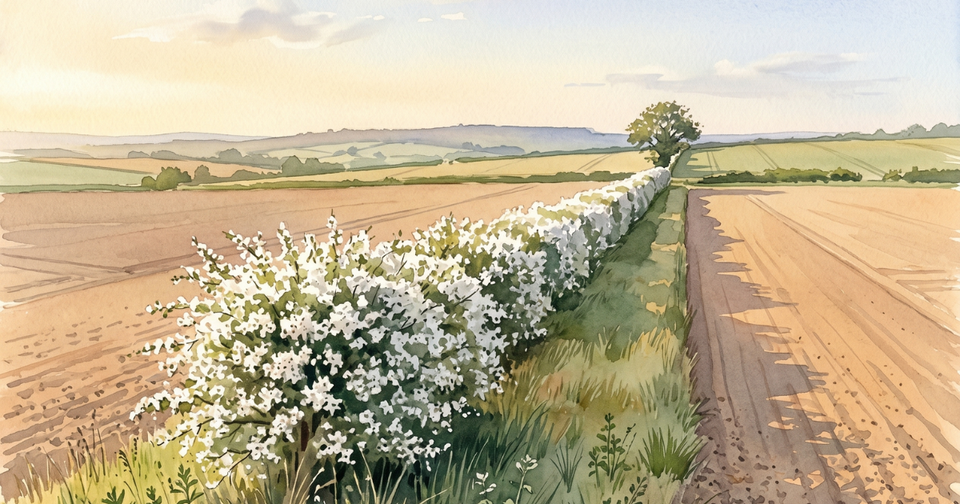
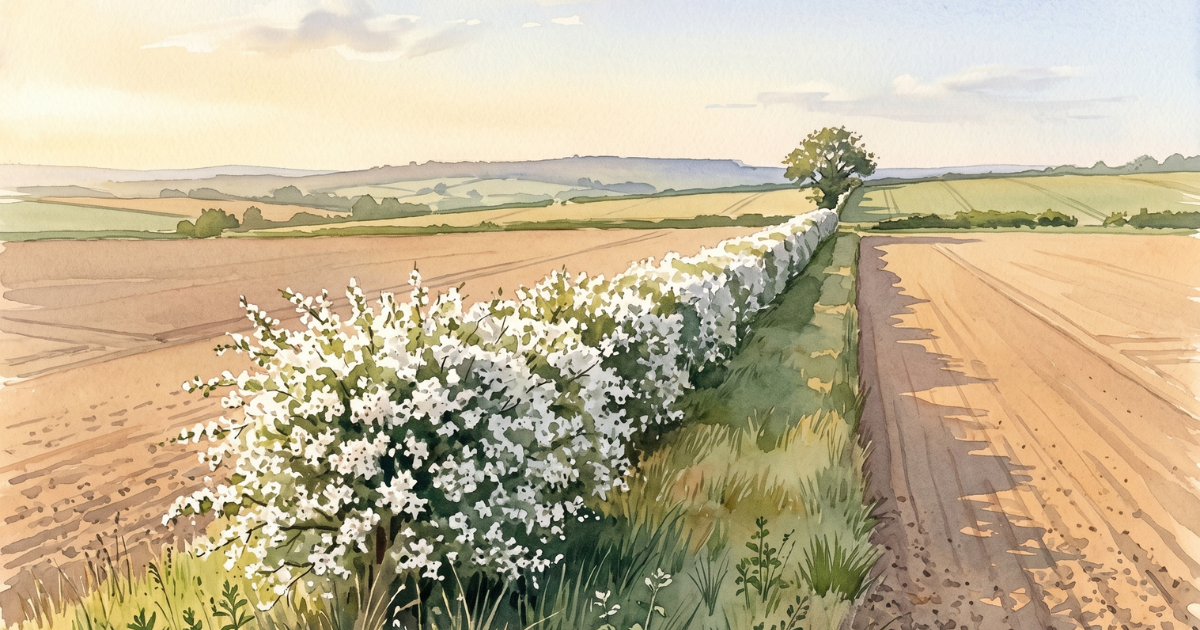
The hedges along the fields on the way out of every English village are not a natural feature of the landscape. They are a decision, hammered out in parliamentary acts between 1773 and 1882 and executed by surveyors who marched across the fields with chains and ranging poles. The lines they drew are still visible from the air. On the ground in May they go white together, eight weeks of blossom across half the country, then settle back into hedge.
A landscape decision
The first general Inclosure Act passed in 1773, the last in 1882, with the great wave of activity falling between about 1790 and 1840. Across that period roughly six million acres of common land and open field were enclosed by parliamentary act, divided into rectangular fields, and hedged. The Enclosure Commissioners specified the species, the planting density, and the height of the bank. The hawthorn whip was the standard choice, set in a single line, ten or twelve to the yard. A near-monoculture hedge running straight across a parish is, with very few exceptions, the work of those commissioners.
Why hawthorn
The commissioners chose hawthorn because it works. It grows fast, becomes stockproof in a few years, tolerates being cut and laid, and regenerates from a stump if you cut it back to nothing. It throws thorns dense enough to hold a cow. It seeds itself if the gaps need filling. Once established it needs trimming once every couple of years and replacement once a generation. As fence material went, in 1800, it was unbeatable. Beauty in May was not the point and not the reason it was planted, but it came in any case.
Reading the line
The straight line is the giveaway. An enclosure hedge follows a surveyor's ruler across the parish, sometimes for half a mile without a kink. An ancient boundary follows the terrain instead, curving along the line of an old stream or skirting the foot of a slope. Compare the same Ordnance Survey map to an enclosure award and the difference is obvious: ancient hedges curve, enclosure hedges run straight. From the air, the curving lines are usually older than 1700; the straight ones are from the Acts.
The Hooper method
In the field, the Hooper method is the rough test. Count the woody species in a thirty-metre stretch and multiply by a hundred to get an approximate age in years. A near-monoculture of hawthorn suggests a hundred years, classic enclosure. Five species (hawthorn, blackthorn, field maple, hazel, dogwood) suggests five hundred, a boundary that was there before parliament got involved. Seven species – add holly, elder, dog rose – suggests seven hundred. It is a rule of thumb rather than a hard law: hedges accumulate additional species over time as a function of age, but local conditions can speed or slow the process. As a quick reading at walking pace it works well enough.
The death-omen taboo
An older, stranger taboo runs alongside the practical reasons. Cut hawthorn brought into the house was held to be an omen of death, recorded across England and Wales well into the twentieth century. The chemistry has caught up with the superstition: hawthorn flowers contain trimethylamine, the same compound the human nose registers in early-stage decomposition. Folks who refused to bring the blossom indoors were not being irrational. They were responding to a smell their noses had every reason to mistrust.
The May moment
In mid-May, when the hawthorn hits full blossom, these distinctions stop mattering. Ancient or enclosure, curved or straight, every hedge is in full white flower, thick with the scent of honey and trimethylamine for two or three weeks together. For that fortnight the map and the memory align, and every hedge looks the same. Then the petals brown and drop, the wind takes them off the lanes, and the lines settle back into their separate histories.
Sources: M. D. Hooper, E. Pollard, & N. W. Moore, Hedges (Collins New Naturalist, 1974); The Inclosure Acts 1773–1882; Plantlife species note: hawthorn (Crataegus monogyna).