Bluebells: how to tell a native wood
The English bluebell is one of the easier wildflowers to identify and one of the harder ones to read. The flower is unmistakable. The wood it stands in is the longer story, and reading it correctly is a useful skill in late April and the first week of May, when the plant is at its peak.
The flower itself
The native English bluebell, Hyacinthoides non-scripta, has three diagnostic features that separate it cleanly from the Spanish bluebell, Hyacinthoides hispanica, and from the hybrid that has now spread across most of the country.
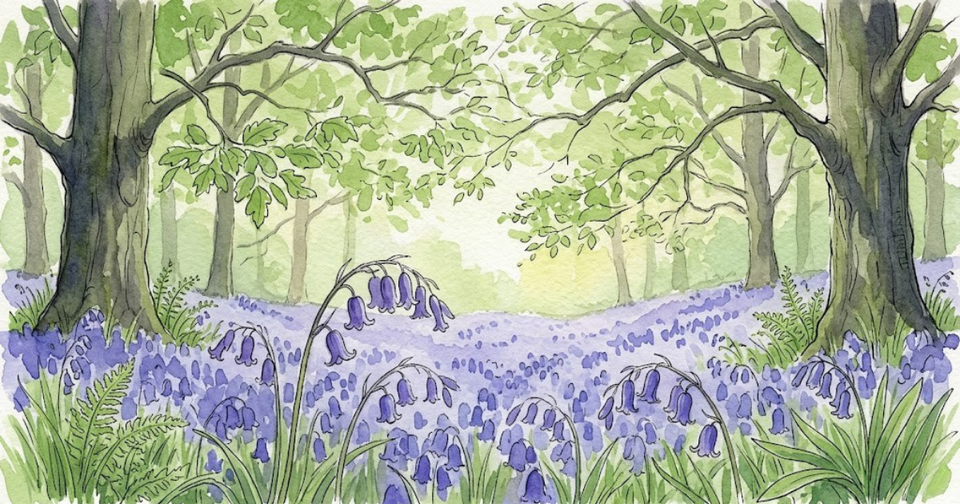
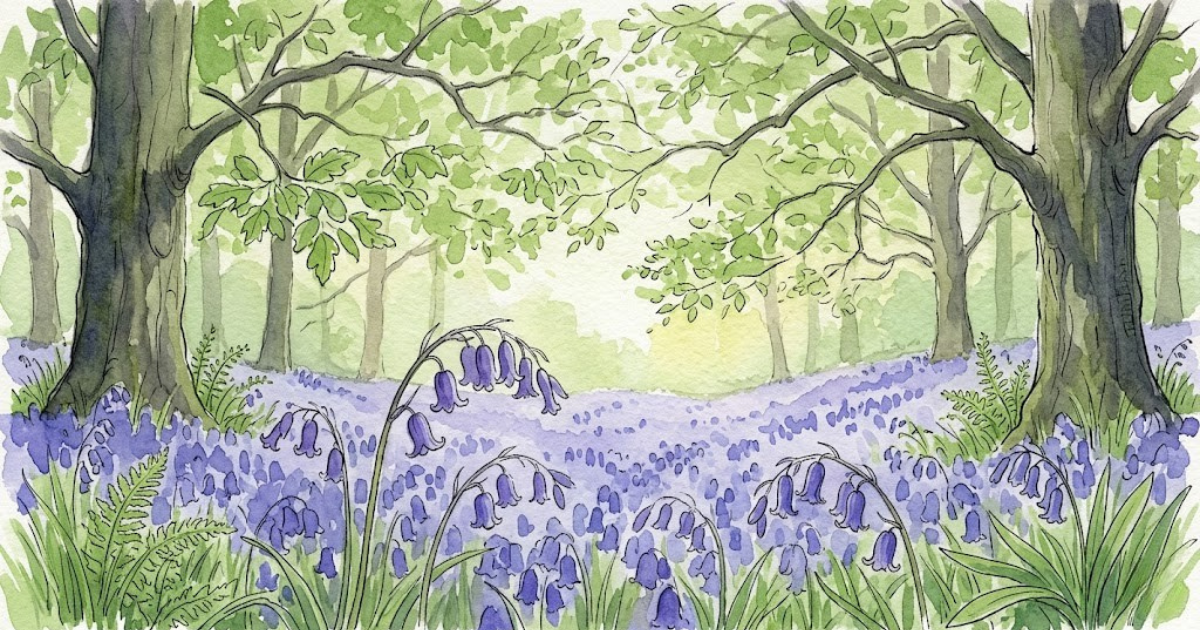
The first is the way the flowers hang. On a native plant, every flower hangs from one side of the stem. The stem curves under the weight of them, a clear arc that bends the head of the plant towards the ground. On a Spanish bluebell, the flowers are arranged around the whole stem, and the stem stands erect.
The second is the shape of the bell. The native flower is narrow and tubular, with the petals curling sharply back at the tip into a small lip. The Spanish flower is broader and more open, the petals less tightly curled.
The third is the pollen. Native bluebell pollen is creamy white. Spanish bluebell pollen is blue. Lift one flower and look inside – the answer is unambiguous.
The hybrid sits between the two on every measure and is the most common form in churchyards, garden borders, and disturbed ground. In a wood, the native form is almost always what you are looking at. In a verge or a lane near houses, the hybrid is a real possibility.
Reading the wood
The native bluebell reproduces slowly and spreads slowly. A new colony takes decades to become visible. A dense carpet, the kind that floods the woodland floor for as far as you can see, almost certainly means woodland that has been continuously wooded since before 1600. Bluebell density is one of the indicator features that ecologists use to identify ancient woodland on the Ancient Woodland Inventory, alongside dog’s mercury, wood anemone, and yellow archangel. The same indicator logic applies to the deepest holloways in the chalk-edge counties, where ancient-woodland species sometimes survive in lanes long after the woodland around them has gone.
A wood with a thin scattering of bluebells is younger, or has been heavily disturbed. A wood with bluebells confined to one corner has often been re-planted, with the original colony surviving only where the soil was undisturbed.
The light inside a bluebell wood at the peak of the flower has a particular quality, green-filtered and faintly underwater, shifting with the density of the canopy overhead. Where the tree cover is thicker the bluebells thin out – they need the spring window before the leaves close. The pattern of flowers across the floor is a map of the canopy above.
Folklore
Roy Vickery, in his archive of British plant lore, records that bluebells were called Fairy Thimbles in parts of the West Country, and a wood in full flower was not considered a place to linger in alone. To wander in was to risk being pixy-led, disoriented by the carpet of flowers and unable to find the way back. The taboo is not universal across England, but it is widely recorded across the south-west, from Devon into Somerset, and survives in oral tradition into the twentieth century.
When to go
Late April through the first week of May is the peak across most of England. Earlier in the south-west and Welsh borders, later in the north. The flowers are over by the end of May and gone entirely by the time the canopy closes in June. The window is roughly three weeks in any given wood.
Where to go
Among the most reliable bluebell woods in England: Ashridge Estate in Hertfordshire and Buckinghamshire (National Trust), Micheldever Wood in Hampshire (Forestry England), Foxley Wood in Norfolk (Norfolk Wildlife Trust), Coed Cefn in the Welsh borders, and the Lake District oakwoods around Buttermere. Find one near you on the Woodland Trust’s ancient woodland map.
Native bluebell woods featured as the Weekend Compass in Issue 4 of The Cottage Almanac, The Cuckoo’s Arrival.
Sources
Woodland Trust, Bluebell species pages and Ancient Woodland Inventory. Plantlife species accounts. Roy Vickery, A Dictionary of Plant-Lore (Oxford University Press, 1995). Roy Vickery’s online archive at plant-lore.com.