The Padstow ‘Obby ‘Oss
If you happen to find yourself in north Cornwall as April turns to May, don’t be alarmed by the rhythmic thrum of drums echoing off the harbour walls. You haven’t stumbled into a fever dream; you’ve just arrived in Padstow for the ‘Obby ‘Oss.
It is, quite frankly, one of the most intoxicating spectacles in the British calendar. Forget the polite Morris dancing you might see on a village green. This is a wild, visceral, slightly sweat-soaked rite of spring that feels as though it belongs to another century entirely.
What actually happens
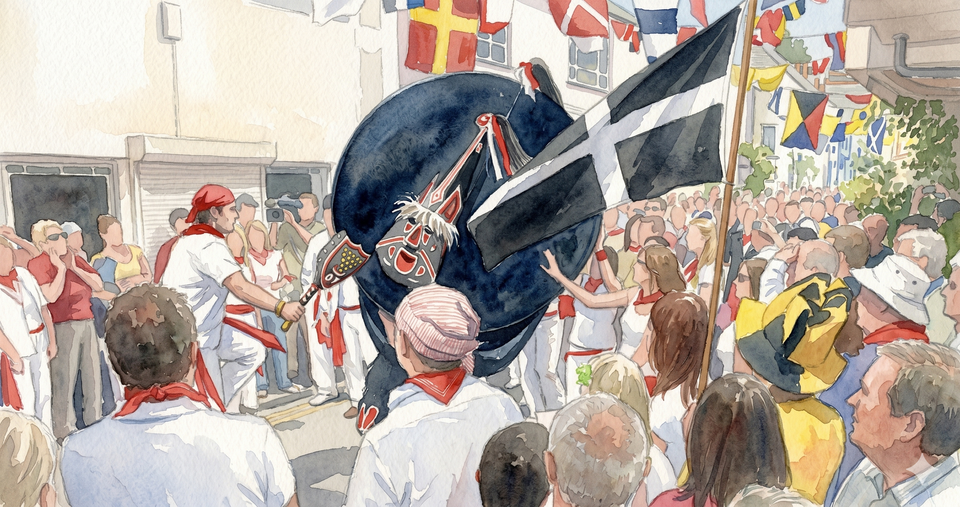
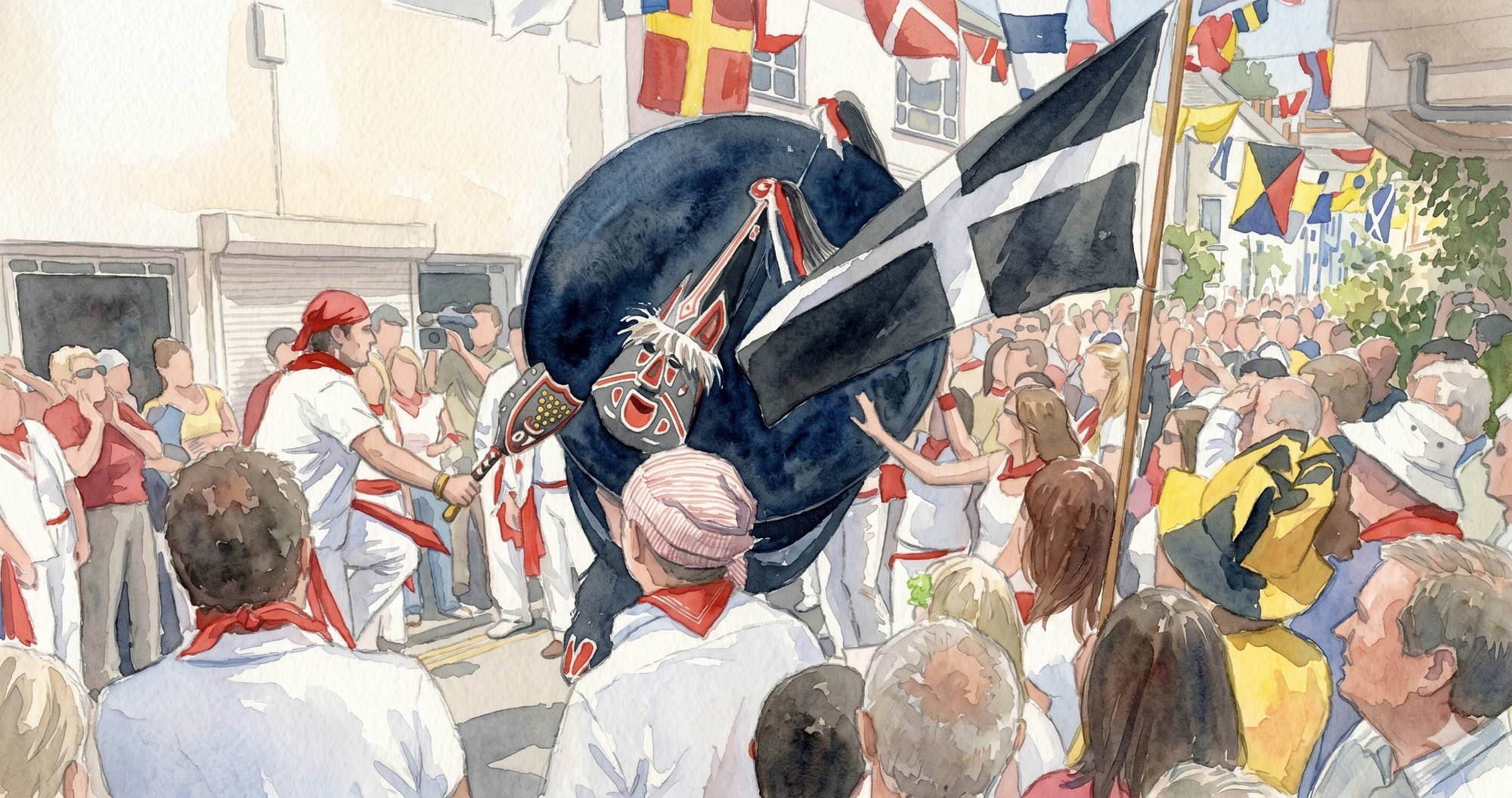
The festival revolves around two rival “Horses” – the Old ‘Oss and the Blue Ribbon ‘Oss. These aren’t your standard costume shop finds. Each ‘Oss is a massive black-sailed hoop nearly two metres across, worn by a dancer who must navigate the town’s narrow medieval streets while swirling and snapping a wooden jaw at the crowd. Accompanying each ‘Oss is a Teazer, who dances ahead with a decorated club, coaxing the beast forward.
The two camps run in parallel through the day. The Old ‘Oss is the senior of the two and emerges first, from its stable at the Golden Lion Inn at ten in the morning after a dawn carol service. The Blue Ribbon ‘Oss, established in the late nineteenth century as a temperance offshoot, comes out from the Padstow Institute. The two follow separate routes through the town, coming together at the maypole on Broad Street at intervals through the day, and finally at midnight when both Horses are “put to bed” until the next year.
The air through all of this is thick with the scent of beer and crushed cowslips, and the entire town is draped in “May” – branches of birch and sycamore cut at first light and tied to doorways, gateposts, and the masts of the boats in the harbour.
The May Song
You’ll hear the May Song roughly five hundred times before lunch. It’s played on a loop by a legion of accordionists and drummers, acting as a hypnotic metronome for the day. There’s a specific, haunting moment in the tune where the music slows, the ‘Oss bows low to the ground in a symbolic death, and only “resurrects” and surges forward as the tempo explodes again. It’s a classic cycle of rebirth – out with the winter, in with the summer.
The song itself is in Cornish English and runs to half a dozen verses, the most familiar of which begins “Unite and unite and let us all unite, for summer is acome unto day.” The words are recognisably late medieval in shape and have been collected in Padstow since at least the seventeenth century. There is no other custom in England in which a single piece of music is performed continuously by a town for seventeen hours.
How old it is
The honest answer is that no one knows. The ‘Obby ‘Oss appears in Padstow records from the 1830s onwards, but the records are administrative – objections about disorder, mostly – and the custom is older than its first written mention. Ronald Hutton, in Stations of the Sun (1996), places it within the wider tradition of English May games and “hooden” hobby horse customs documented from the medieval period. Padstow’s version is the most elaborate and the only one with continuous community ownership. The day is run by Padstonians, on Padstonian terms, and has never been a folk-revival reconstruction.
How to attend
The day runs from dawn on 1 May until midnight, regardless of weekday. If 1 May falls on a Sunday, the main day is held over to the Monday – the only concession the town makes to the modern calendar.
The traditional dress is white, accented with red ribbons for the Old ‘Oss or blue for the Blue Ribbon ‘Oss. Match the locals to feel part of the fold. The ‘Osses move with surprising speed through dense crowds and you’ll often find yourself ducking into a shop doorway to make room. Pace yourself. Padstow is busy by mid-morning and there is almost no parking; the park-and-ride from Wadebridge is the practical option.
If you can be in town the night before, the Eve of May singing at the Golden Lion Inn from around eight in the evening is the quieter half of the festival and the moment most regulars treat as the real beginning. The first carol of the morning, sung outside the landlord’s window before five, opens the day.
Padstow was the Curious Instance in Issue 5 of The Cottage Almanac, The May Eve, published 30 April 2026.
Sources
Padstow ‘Obby ‘Oss official site. Ronald Hutton, Stations of the Sun: A History of the Ritual Year in Britain (Oxford University Press, 1996). Cornish Studies Library, Redruth, holds early manuscript collections of the May Song.