Rushbearing: The Year's Rushes Carried Into Church
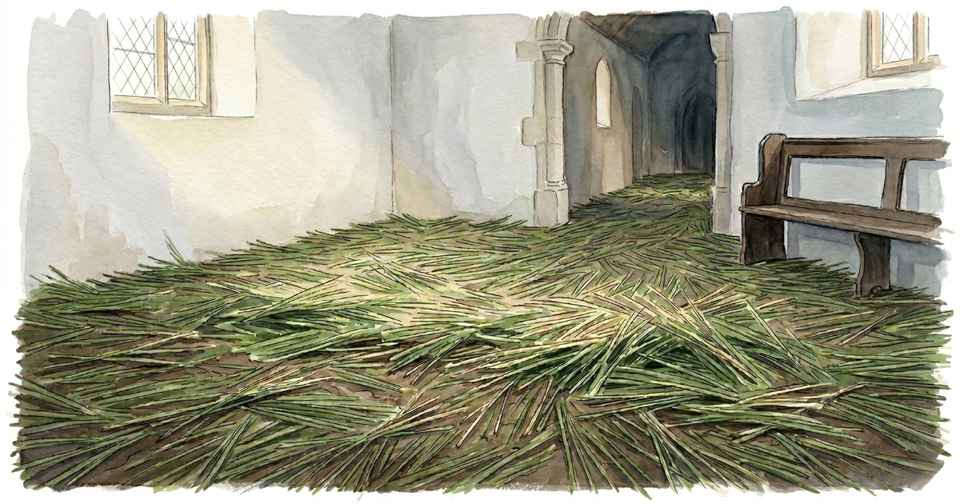
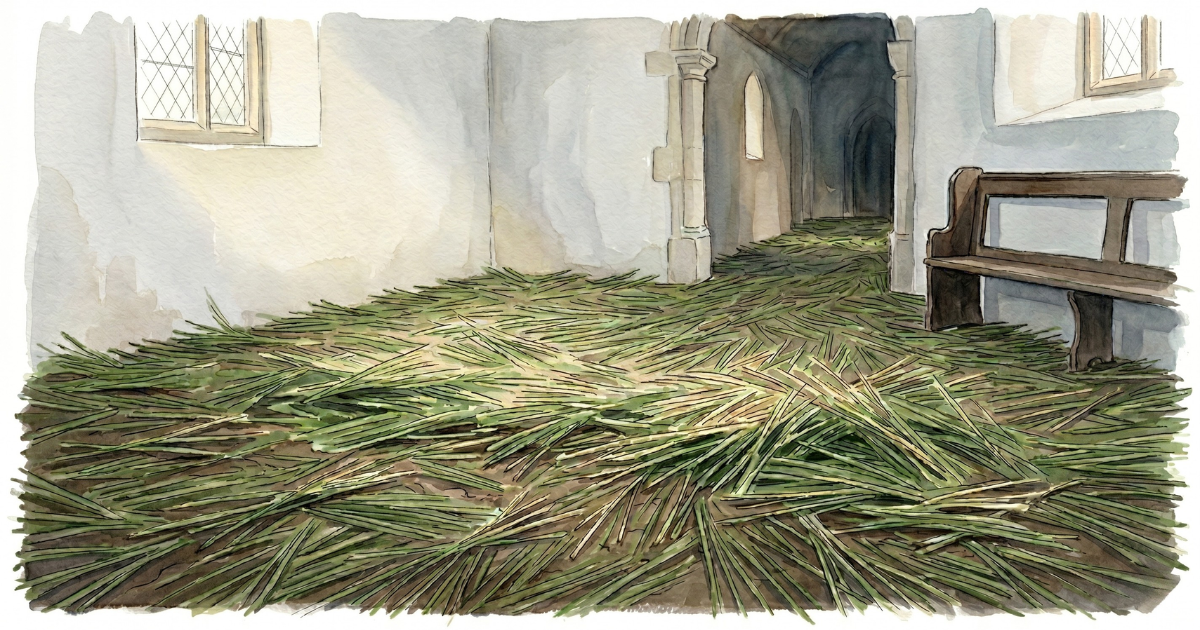
For most of their history, English parish churches had floors of beaten earth or rough stone, strewn thick with rushes. Cut green from the nearest pond margin and laid over the cold ground, the rushes were carpet, insulation, and a dry-ish surface to kneel on through a long service. In many churches they also lay over the dead, since the better-off were buried inside the building, under the same floor the living stood on. Once a year the old rushes came up and a fresh load came in, and in a great many parishes that replacement was not a chore but the festival of the year.
Why a church needed rushes
A medieval church floor was not the swept stone of today. It was earth, or stone laid straight onto earth, cold underfoot and damp for much of the year. Rushes gathered from the pond and the river margin were the obvious covering: cheap, renewable, and warm enough to kneel on. They muffled the footfall, they took up the wet, and they could be strewn with herbs to sweeten the air of a building that held its own dead beneath the floor. Rushes laid one summer were filthy by the next, trodden flat and damp and full of whatever had walked in on boots and paws.
The festival the deep clean became
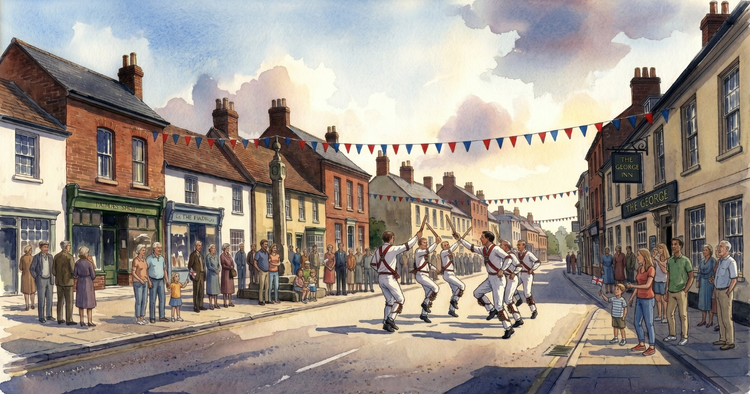
The new rushes were built onto a cart, packed and shaped and raised into a towering load, hung with ribbons and flowers and borrowed silver, and drawn to the church through the village behind a band and a side of Morris dancers, the whole parish walking after it. The day was pinned to the church's own saint or to the August wakes, and it pulled the rest of village life in with it: ale and gingerbread, wrestling and races, the rushes themselves plaited into crosses and crowns and garlands for the children to carry. It was the year's deep clean of the church, kept as the high point of the parish summer.
What ended it: flooring
What ended rushbearing was not reform or disapproval but a change underfoot. As parishes flagged their churches with stone and laid boards over the bare earth through the eighteenth and nineteenth centuries, the rushes had nothing left to do. A swept stone floor does not need a green covering renewed every summer. The practical reason fell away, and most of the rushbearings went with it, quietly, parish by parish, with no single date you could point to. By the time anyone thought to record the custom in detail, it was already a survival rather than a living practice across most of the country.
Where it survives
A few places held on, as pure ceremony, after the practical reason had gone. At Grasmere in the Lake District the rushes still go up to St Oswald's at the start of August, carried by children in plaited bearings. Sowerby Bridge in West Yorkshire still builds a full rush-cart and hauls it through the town. Warcop in Cumbria keeps its rushbearing on St Peter's Day in late June. The floor underneath each has been dry flagstone for two hundred years. The rushes are carried in anyway, which is the part worth standing in a churchyard to see: the work survives, complete, after the work itself stopped being needed.
The garland that climbed out of the church
Alfred Burton, whose 1891 account remains the fullest record of the custom, traced more than one survival back to the rush-strewn floor. The clearest is at Castleton in Derbyshire, where the floor of St Edmund's was unpaved and rush-covered until 1820; when it was flagged and the rushes stopped, the greenery that had hung from the bell-ropes migrated onto a man's shoulders and kept the old late-spring date. The result, the Castleton Garland Day procession, is rushbearing with the rushes turned into a four-stone beehive of flowers, still riding through the village every 29 May.
Sources: Alfred Burton, Rush-Bearing (1891); Grasmere Rushbearing (official notices); Roy Christian, Well-Dressing in Derbyshire (1976) for the Castleton parallel.