Self-Heal: The Wound Herb of the English Verge
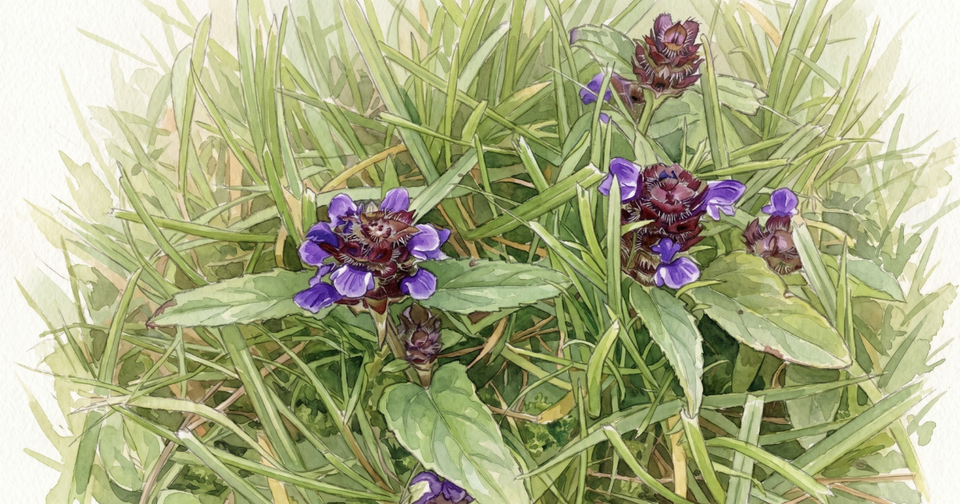
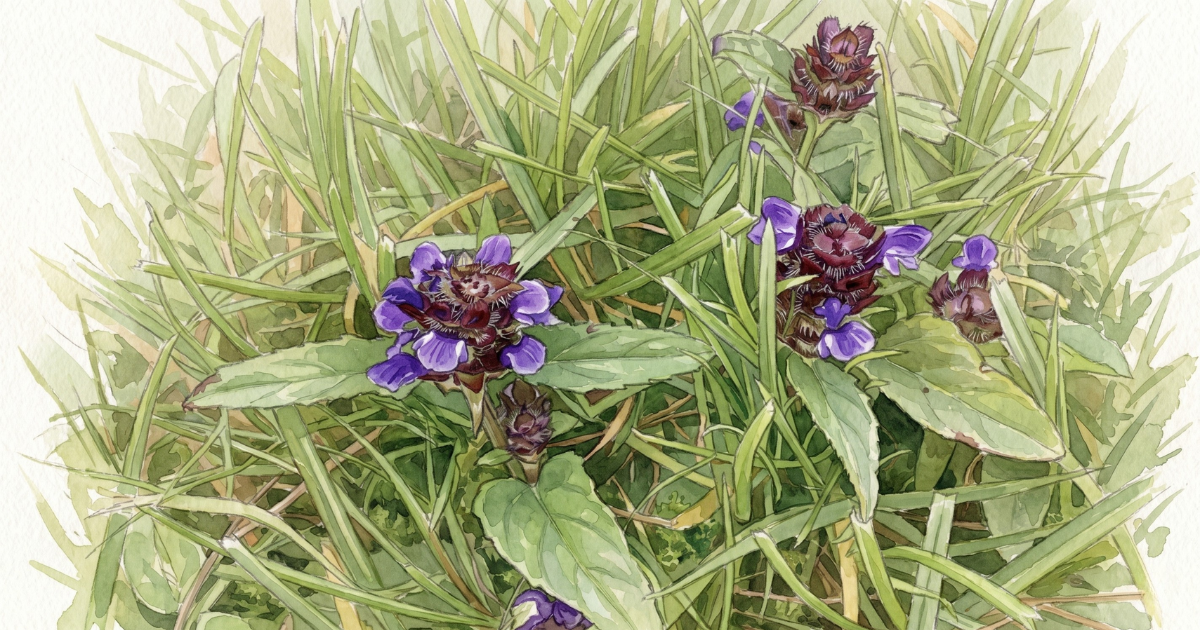
There is a low plant flowering in the rough grass right now, on every verge and lawn edge that has escaped the mower, that you have certainly stepped on and probably never named. Self-heal: a creeping thing in the mint family, a few inches high, carrying a stubby club of violet-purple flowers on a square stem. Crouch down to it and it is a handsome little plant. Stand back up and it disappears into the green. The name is the whole history, and it is one of the rare folk names that turns out to be holding up a respectable amount of truth.
Identifying it at ground level
Self-heal (Prunella vulgaris) grows close to the ground in a creeping mat, rarely more than ten or fifteen centimetres tall in cut grass, taller where it is left alone. The stem is square in cross-section, the giveaway of the mint family, and the leaves sit in opposite pairs. The flower is the thing to look for: a stubby cylindrical head, like a small purple thumb, made up of hooded two-lipped flowers in violet to deep purple, opening a few at a time from early summer onward. It flowers from June into autumn, holds on through repeated mowing, and turns up on lawns, verges, churchyards, and any patch of short grass that has not been dosed with weedkiller.
The names, and what they remember
Self-heal, heal-all, woundwort, carpenter's herb: the last because woodworkers reached for it when a chisel slipped. The cluster of names all point the same way, at a plant that was the standard country dressing for a cut. It was bruised and pressed straight onto the wound, the green pulp held against the broken skin. Carpenter's herb is the most specific of them, naming not a property but a user: the man whose trade put a sharp edge in his hand all day and who wanted something growing by the workshop door for when it went wrong. A folk name that records who used a plant, and for what, is worth more than one that only praises it.
Culpeper, 1653
Nicholas Culpeper put the plant plainly in his Complete Herbal of 1653, calling it a herb of Venus and writing that with it, when you are hurt, you may heal yourself. He recommended it for inward and outward wounds, for ulcers, and as a gargle for a sore throat and inflamed gums. Culpeper wrote in the full confidence of the doctrine he worked under, which assigned every plant to a planet and every planet to a part of the body. Modern hedge-medicine is more careful than that. But the plant does carry genuine astringent and antimicrobial compounds, which is the part of the old claim that has survived contact with a laboratory.
A self-heal infused oil
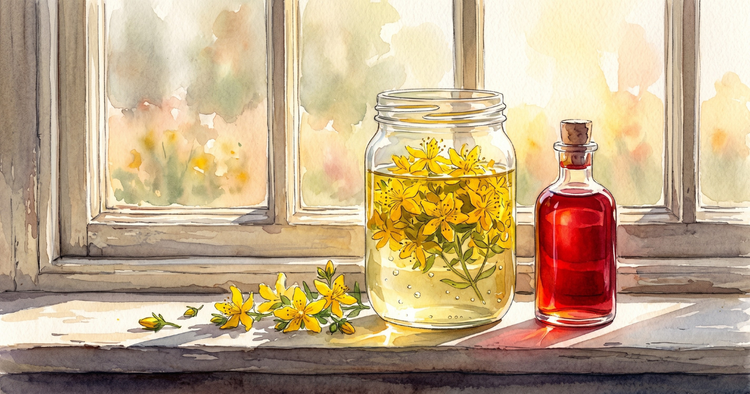
If you want to keep some of it by, the simplest preparation is an infused oil, used as it is on a graze or stirred into a salve. Gather a good handful of self-heal in flower, leaves, stems and purple heads together, on a dry afternoon. Chop it roughly and leave it to wilt for an hour or two to lose some of its water. Pack it loosely into a clean dry jar and cover completely with olive or sunflower oil, pressing the plant under so nothing sits proud of the surface. Lid on, stand it on a warm windowsill for three to four weeks, and shake it whenever you pass.
Using and keeping it
Strain the oil through muslin into a clean bottle. It keeps about a year in a cool cupboard and goes on minor cuts, grazes, and dry rough skin. It is not for taking internally. The infused-oil method is the same one the old still-rooms used for a dozen different hedge plants, and self-heal sits comfortably in that tradition alongside the other green wound-dressings of the English household. For more of those preparations and the room they were made in, see the English still-room, which gathers the herbal and domestic recipes of the period in one place.
Sources: Nicholas Culpeper, Complete Herbal (1653); Geoffrey Grigson, The Englishman's Flora (1958); Wildlife Trusts species note: Prunella vulgaris.